
Temperature strips get a bad reputation they don't entirely deserve. The criticism usually goes something like this: "They're not as accurate as a digital thermometer, so why bother?" It's a fair question on the surface, but it misunderstands what temperature strips are designed to do and what accuracy actually means in a practical trade or QA context. A strip that reliably tells you whether a surface has exceeded a critical threshold — and holds that record permanently — is doing exactly what it's supposed to do, even if it can't match the decimal-point precision of a calibrated digital probe. The real question isn't whether temp strips are accurate in an absolute sense. It's whether they're accurate enough for the specific job, and how to make sure you're getting the most reliable reading the strip is capable of giving you. That's what this guide covers.

Reviewed by the HVAC Shop Technical Team | Published: May 2026 | Last reviewed: May 2026
Understanding Tolerances and Standards
Every temperature strip has a stated accuracy tolerance — a figure that tells you the maximum deviation between what the strip displays and the actual surface temperature at the point of reading. Understanding this number is the starting point for any honest assessment of temperature strip accuracy.
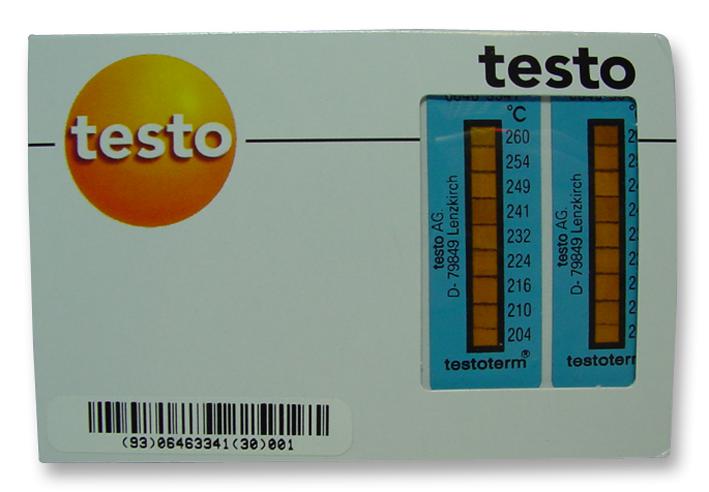
For industrial and HVAC surface monitoring strips, typical accuracy tolerances are in the range of ±1°C to ±2°C, though this varies significantly by product and manufacturer. Some precision-grade indicators are manufactured to tighter tolerances — ±0.5°C or better — while basic consumer-grade strips may have wider bands. The tolerance figure should be stated clearly on the product packaging or datasheet. If it isn't, that's a signal to ask the supplier directly before using the strips in any application where the reading will inform a compliance or safety decision. For applications requiring certified maximum temperature recording, using professional-grade Testoterm temperature strips gives you a product backed by documented manufacturing standards and traceable quality control.
Tolerance figures matter differently depending on the application. A ±1°C tolerance on a strip used to monitor whether a motor housing is staying below 80°C is entirely adequate — the relevant threshold is wide enough that a one-degree deviation doesn't change the decision. The same tolerance on a strip used to verify whether a pharmaceutical product has remained below 8°C during transport is a different matter — a reading of 8°C on a strip with ±1°C tolerance could mean the actual temperature was anywhere from 7°C to 9°C, which spans a meaningful compliance boundary. Matching the strip's tolerance to the precision the application actually requires is how you avoid using the wrong tool for the job.
Batch testing and quality control processes are the manufacturing-side factors that determine whether a strip's stated tolerance is consistently achievable across a full production run. Reputable manufacturers test strips across temperature ranges as part of their production quality process, and some publish batch-level test data on request. For NATA-accredited laboratories or facilities conducting temperature verification as part of an auditable QA process, asking for batch test documentation from your strip supplier is a reasonable and standard procurement step. The National Measurement Institute sets the framework for measurement standards in Australia, and for QA teams working to traceable measurement requirements, understanding how your strip supplier's calibration process aligns with those standards is part of due diligence.
The accuracy tolerance printed on a temperature strip is typically validated under controlled laboratory conditions — stable surface temperature, controlled ambient environment, correct dwell time. In real-world field conditions — vibration, varying ambient temperatures, humidity, contaminated surfaces — the effective accuracy may be slightly wider than the stated tolerance. This doesn't make the strip unreliable; it means understanding the lab-to-field gap is part of using the product correctly.
Environmental Factors Affecting Accuracy
Even a high-quality strip with a tight stated tolerance can produce an unreliable reading if the environmental conditions at the point of application are working against it. These are the factors most commonly responsible for accuracy problems in the field — not strip defects, but application conditions.
High Humidity
Humidity affects temperature strip accuracy in two ways. First, condensation on a surface creates a water film between the strip and the substrate, slowing thermal transfer and causing the strip to lag behind the actual surface temperature. In Brisbane cool rooms, Sydney coastal plant rooms, and tropical facilities in Darwin and Cairns, surface condensation on cold pipework and refrigeration equipment is a constant reality. A strip applied over a condensation layer isn't in direct contact with the metal surface — it's in contact with water, which has different thermal properties and will give a reading that lags the actual surface temperature, sometimes by several degrees.
Second, high ambient humidity can affect the adhesive bond over time. A strip that begins to lift at the edges due to adhesive failure in a humid environment is no longer making full surface contact, which compounds the thermal lag problem. The fix for both issues is surface preparation — wipe the target area dry before applying the strip, and in persistently humid environments, check periodically that the strip's edges remain bonded. In a QLD cold storage facility where condensation reforms quickly after wiping, time your application to coincide with a defrost cycle when surfaces are briefly drier.
Direct Sunlight Exposure
Ultraviolet exposure and solar heat load are significant accuracy risks for strips applied to outdoor or exposed surfaces. Direct sunlight can raise the surface temperature of the substrate the strip is bonded to well above the ambient air temperature — a steel pipe in direct sun in a Perth summer can be 20°C to 30°C hotter than the air temperature around it. If the strip is measuring the pipe surface and the pipe surface is being heated by solar radiation rather than by the process running through it, the strip's reading reflects that combined heat load — not just the process temperature you're trying to measure.
For outdoor applications, either shield the strip from direct sun using a cover or insulation wrap, or factor solar heat load into your interpretation of the reading. For irreversible strips used to detect whether process equipment has exceeded a threshold, an unshielded strip on an outdoor surface in a sunny climate may activate from solar exposure rather than from the actual process temperature — which creates a false positive that wastes investigation time and erodes confidence in the monitoring programme. This is a common failure mode on outdoor electrical switchboards and rooftop HVAC equipment across northern Australia.
Poor Surface Adhesion
A strip with air pockets trapped beneath it is measuring the air inside those pockets, not the surface. Air is a thermal insulator — a small gap between the strip and the substrate significantly slows the strip's temperature response and produces readings that lag behind the actual surface temperature. Poor adhesion typically results from one of three causes: contaminated surface (oil, dust, oxidation), curved surface the strip wasn't pressed to conform to, or a strip applied at a temperature outside the adhesive's working range.
On very cold surfaces — below 5°C, as you'd encounter on refrigeration pipework or inside a freezer store — some adhesive formulations lose tack and don't bond reliably. Check the adhesive temperature rating for the specific strip product before applying in sub-zero or very low temperature environments. For surfaces below the adhesive's minimum rating, a mechanical hold-down (a small piece of tape over the strip's edges) may be needed to maintain contact until the adhesive stabilises. This is particularly relevant for cold chain monitoring strips applied in Melbourne cool stores during winter and in any commercial or industrial freezer application nationally.
| Environmental Factor | Effect on Accuracy | Most Affected AU Contexts | Mitigation |
|---|---|---|---|
| High humidity / condensation | Thermal lag; adhesive failure | Brisbane, Darwin, Cairns, coastal NSW cool rooms | Dry surface before applying; check edge bond |
| Direct sunlight / solar heat load | False high reading; premature activation | Perth, Darwin, rooftop HVAC nationally | Shield strip from sun; use covered location |
| Very low surface temperature | Adhesive loses tack; poor contact | Freezer stores, cold chain, Melbourne winter | Check adhesive min temp rating; use tape hold-down |
| Surface contamination | Air pocket formation; insulation layer | Industrial plant, WA mining, food processing | IPA wipe before application; confirm bond |
| Vibration | Edge lifting; intermittent contact loss | Motor frames, compressors, pump housings | Confirm adhesive rated for vibration; check bond periodically |

Shelf Life and Storage Degradation
A strip that was accurate when it left the factory may not still be accurate by the time it's applied on site — if it hasn't been stored correctly, or if it has simply exceeded its usable shelf life. Shelf life degradation is one of the least-discussed accuracy risks in temperature strip use, and in Australian conditions it's more significant than in many other climates.
Most commercial temperature strips carry a stated shelf life of 18 to 24 months from the date of manufacture under recommended storage conditions — typically below 25°C, away from direct sunlight, in original sealed packaging. These conditions are achievable in most office, warehouse, or site office environments in temperate Australian cities. They are substantially harder to maintain in a Darwin equipment shed, a QLD warehouse without climate control, or a service van parked in the sun during a summer in Perth or Adelaide where interior vehicle temperatures can exceed 70°C within minutes.
Heat exposure is the most damaging storage condition for temperature strips. For irreversible chemical strips, elevated storage temperatures can pre-activate the indicator chemistry — the strip changes colour before it's ever been applied to a surface, making it useless. You won't necessarily know this has happened if the strip shows a partial colour change that could be mistaken for a valid reading from a previous application. For liquid crystal reversible strips, heat exposure during storage can permanently damage the crystal layer, causing patches of discolouration or inconsistent colour response that makes the reading unreliable. A strip that shows patchy or incomplete colour activation should be discarded regardless of whether its expiry date has passed.
UV exposure is the secondary storage degradation factor. Liquid crystal strips left in direct sunlight — even through a clear plastic bag or container lid — will degrade faster than those stored in opaque packaging. The original packaging is not just a convenience; it's part of the strip's preservation system. Strips removed from their packaging and left loose in a toolbox or parts tray are at risk of both UV and physical damage.
Signs a Strip Has Expired or Degraded
Knowing what a degraded strip looks like is as important as knowing how to store strips correctly. The visual signs vary by strip type. On a liquid crystal reversible strip, look for patchy colour response — areas of the display window that don't change colour when they should, or that show a colour different from the expected green-to-blue progression. Discolouration at the edges of the display window, cloudy or milky patches in the crystal layer, or a colour that appears faded or washed out are all indicators of degradation.
On an irreversible chemical strip, pre-activation is the main sign — any indicator dot or bar that has already changed from its baseline colour before the strip has been applied to a surface. Check each strip against the unused baseline colour shown on the packaging before application. A strip with one or more pre-activated indicators has been exposed to its threshold temperature during storage or transport and cannot be used as a reliable baseline record. Using a pre-activated irreversible strip without noticing the pre-activation means any genuine threshold breach during monitoring will not be distinguishable from the storage event — your compliance record is compromised from the moment you apply it.
When opening a new pack of irreversible temperature strips on site, take thirty seconds to check two or three strips from the pack against the baseline colour reference on the packaging before applying any. If any strips show pre-activation, remove the entire pack from service, note the batch number, and contact your supplier. A single degraded strip in a pack doesn't necessarily mean the whole batch is compromised — but it's worth verifying before you apply strips that will form part of a compliance record you may need to defend later.
Ensuring Reliable Measurements
Accuracy with temperature strips is less about the strip itself and more about the discipline of the process around it. A quality strip used carelessly in poor conditions will give worse results than a basic strip applied correctly to a properly prepared surface with the right dwell time and read under good lighting. The following is a practical checklist — not a theoretical framework, but the actual steps that separate a reliable field reading from a number you can't trust.
Check the strip before you apply it. Confirm the expiry date is valid, inspect for pre-activation or visible damage, and verify the temperature range is appropriate for the surface you're monitoring. A strip rated to 60°C applied to a surface that regularly reaches 80°C will give you a saturated, unreadable result — the chemistry will be permanently activated before it tells you anything useful about the actual temperature. Match the range to the application.
Prepare the surface before you apply. Wipe it clean and dry. If there's grease or oil, use an IPA swab and allow it to evaporate fully. On curved surfaces, take the time to press the strip from the centre outward so it conforms to the curve without air pockets. On very cold surfaces, check the adhesive minimum temperature rating first.
Respect the dwell time. This is the step most often skipped on a busy job and the one that most consistently undermines reading quality. Set a timer. Read the strip only after the manufacturer's recommended contact time has elapsed. For a QA record or compliance document, the dwell time should be noted alongside the reading — it's part of the method, not a formality.
Read in good light. Colour interpretation is affected by ambient lighting — warm yellow light shifts how green and tan appear; dim conditions make it hard to distinguish a clear activation from a partial one. A neutral white LED torch is a small investment that removes one of the most common sources of reading error in plant rooms, cold stores, and other low-light industrial environments.
Document what you see, not what you expect. If a strip is showing a transitional or ambiguous reading, record it as such. "Reading between 42°C and 44°C" is an honest and useful data point. "44°C" recorded because that's what you expected to see is a data integrity problem that can have downstream consequences in a QA audit or warranty dispute.
For teams building a temperature monitoring programme across multiple assets or sites, sourcing strips from a consistent, reputable supplier — one who can provide batch documentation, stated tolerances, and product datasheets — removes the variability that comes from mixing strip brands and quality levels across a site. If you're putting together a specification for QA-grade temperature monitoring or need help matching strip tolerances to your application requirements, talk to our team — we can help you confirm the right product for the job and ensure your monitoring records will stand up to scrutiny.
When evaluating temperature strip accuracy for a QA programme, the key figures to request from your supplier are: stated accuracy tolerance (±°C), validated temperature range, recommended dwell time, adhesive minimum and maximum temperature rating, shelf life under stated storage conditions, and whether batch test documentation is available. If any of these figures are missing from the product datasheet or the supplier cannot provide them, treat that as a product qualification gap before committing to volume procurement.