
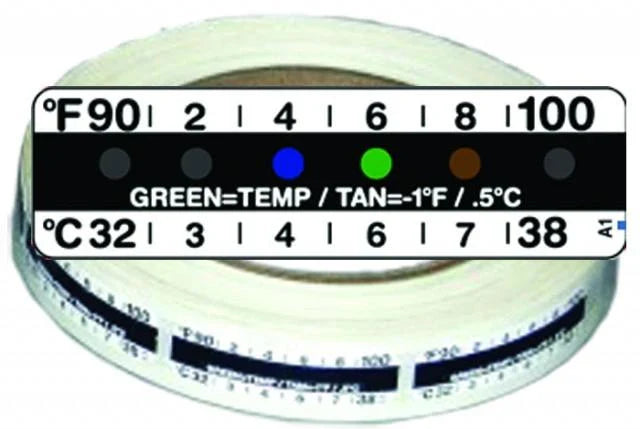
Getting a temperature reading from a toddler at two in the morning is nobody's idea of easy. A traditional oral or rectal thermometer requires stillness, cooperation, and time — three things small children and distressed patients rarely offer on demand. Forehead temperature strips change that equation entirely. Press one gently to a child's forehead, wait a moment, and you have a readable result without waking them fully, without causing distress, and without the hygiene concerns of a shared probe. For parents, carers, school nurses, and clinical staff across Australia, that simplicity is exactly what makes medical grade temperature strips a first-aid drawer essential rather than a novelty. But not all strips are the same — and understanding what separates a genuinely medical-grade product from a basic consumer strip matters when the reading is informing a clinical decision.

Reviewed by the HVAC Shop Technical Team | Published: May 2026 | Last reviewed: May 2026
How Clinical Strips Differ from Standard Strips
The term "medical grade" gets used loosely in consumer product marketing, which makes it worth unpacking what it actually means in the context of temperature strips sold and used in Australian healthcare settings.
The most significant difference is accuracy tolerance. A standard colour-change temperature strip — the kind used for industrial surface monitoring or aquarium temperature checks — is typically calibrated to within ±1°C or wider. For monitoring whether a pipe is running hot or a cool room is holding temperature, that tolerance is entirely adequate. For fever detection in a child, it is not. A reading that could be 37.5°C or 38.5°C depending on the strip's tolerance band spans the difference between a normal temperature and the threshold for clinical fever in a paediatric patient. Medical-grade strips are manufactured to tighter tolerances — typically ±0.2°C to ±0.5°C, though the specific tolerance varies by product and should be confirmed via the product datasheet or manufacturer specification. Always verify accuracy claims before using any strip in a clinical context.
The second key difference is adhesive and material composition. Medical-grade strips are formulated with hypoallergenic adhesives and skin-safe materials that are appropriate for direct, repeated contact with human skin — including the sensitive skin of infants and newborns. Standard industrial strips use adhesives engineered for metal, plastic, and glass surfaces, not skin. Applying an industrial strip to a child's forehead is not just inaccurate — the adhesive chemistry may not be safe for skin contact. In Australia, medical devices including diagnostic temperature strips used in clinical settings are subject to oversight by the Therapeutic Goods Administration (TGA). Products intended for medical use should be checked against TGA registration requirements before procurement, particularly for hospital and clinic use where regulatory compliance is part of the supply chain obligation.
The third differentiator is the calibration reference point. Standard strips measure surface temperature — the temperature of whatever they're in contact with. Medical forehead strips are calibrated to correlate forehead skin surface temperature with core body temperature, applying a compensation factor based on the typically cooler temperature of the skin surface relative to internal body temperature. This compensation is built into the strip's colour-change chemistry and the scale printed on the strip. A strip not calibrated for skin application will display a reading several degrees lower than the patient's actual body temperature, which could lead a carer or clinician to incorrectly conclude a fever is absent. This is one of the most consequential misapplication errors in the medical strip category, and it happens most often when someone uses a non-medical strip because it was the only one available.
Forehead skin temperature is typically 1°C to 2°C lower than core body temperature, depending on ambient conditions, recent activity, and individual variation. Medical-grade forehead strips account for this difference through their calibration — which is why the scale on a medical forehead strip shows values in the normal body temperature range (around 36°C to 38°C) rather than the lower surface temperatures those values actually represent at the forehead.

Best Practices for Paediatric and Hospital Use
Even a well-made medical temperature strip will give an unreliable reading if it's applied incorrectly or read in the wrong conditions. Consistent technique matters — particularly in a clinical setting where readings inform treatment decisions or are documented in patient records.
Forehead Application Technique
The strip should be applied to the centre of the forehead — between the eyebrows and the hairline — and pressed flat across its full length. Avoid the temples, which are influenced more by ambient temperature and airflow than by core body temperature. In a busy paediatric ward or a school sick bay, ambient conditions vary significantly: a child who has just come in from a cold Melbourne morning or a hot Darwin playground will have a forehead surface temperature that reflects their recent environment, not just their core temperature. Allow two to three minutes for the child to settle in a stable indoor environment before applying the strip. This is especially important in winter when a child has been bundled up in warm clothing and their skin is warmer than normal, or conversely when they've been in air conditioning and their skin is cooler.
Hold the strip flat against the forehead with light, even pressure for the full recommended contact time — typically 15 to 30 seconds, though check the specific product instructions. Pressing too hard can temporarily blanch the skin and alter the local surface temperature. Pressing too lightly creates air gaps that reduce thermal transfer and slow the colour-change response. Once the contact time is complete, read the strip immediately in good lighting. Don't remove it and then try to read it after a delay — the strip begins returning to ambient temperature the moment contact is broken.
Reading Ambient vs Body Temperature
This is the most common source of misinterpretation in home and clinical use. If a child has been lying with one side of their face against a pillow, that cheek and the adjacent forehead area will be warmer than the other side. If a child has been crying, their forehead may be flushed and temporarily warmer than their core temperature would suggest. If the strip is applied immediately after wiping the forehead with a cool cloth, the reading will be artificially low. None of these situations mean the strip is faulty — they mean the reading reflects exactly what it should: the skin surface temperature at that moment, in those conditions.
Best practice is to take two readings two minutes apart and note whether they're consistent. A single reading taken in suboptimal conditions is a starting point, not a conclusion. For clinical documentation purposes, record the conditions alongside the reading — "reading taken after child settled for three minutes, ambient temperature approximately 22°C" provides more useful context than a number alone.
Single-Use vs Reusable Hygiene Protocols
In a home first-aid kit, a reusable forehead strip used only on one child and cleaned between uses is perfectly appropriate. In a clinical or institutional setting — a school sick bay, a childcare centre, a GP clinic, a hospital — single-use strips are the standard. Reusing a strip across multiple patients introduces cross-contamination risk that no amount of surface cleaning fully eliminates, particularly in environments where infectious disease transmission is a genuine concern. During respiratory illness seasons in Australia — particularly in Sydney and Melbourne where winter brings consistent waves of influenza and respiratory viruses — single-use protocols in schools and clinics are especially important.
For institutions procuring strips in volume, check that the product's intended use matches single-use or reusable designation before purchasing. A strip marketed as reusable that is being used as a single-use item in a clinical setting should still be confirmed as skin-safe and within its accuracy tolerance for the intended use case.
In a childcare or school setting, store temperature strips in a clearly labelled container at room temperature — not in a first-aid bag left in a car or a storage room that gets hot in summer. In Queensland and the Northern Territory especially, storage areas without climate control can exceed 40°C on hot days, which can pre-activate or degrade strips before they're used. A cool, dry drawer in the office or clinic room is the right spot. Check the expiry date on the packaging when restocking — expired strips may no longer meet their stated accuracy tolerance.
Fever Strips vs. Digital Thermometers
This is the question most parents and carers ask when they first encounter forehead temperature strips: are they actually reliable, or are they just a convenient shortcut that trades accuracy for ease? The honest answer is that they're both — and understanding which situations call for a strip versus a digital thermometer is more useful than declaring one superior across the board.
| Factor | Medical Temp Strip | Digital Thermometer |
|---|---|---|
| Speed | 15–30 seconds | 10 seconds to 2 minutes depending on type |
| Accuracy tolerance | ±0.2°C–±0.5°C (medical grade — confirm datasheet) | ±0.1°C–±0.2°C (digital probe, varies by model) |
| Distress to child | Minimal — non-invasive, no discomfort | Low to moderate — ear probe can cause resistance |
| Hygiene | Single-use options available — no cross-contamination | Probe cover required for clinical use |
| Usable on sleeping child | Yes — non-disruptive | Difficult — movement or waking likely |
| Cost per use | Low (single-use) to negligible (reusable) | Higher upfront, low per-use (probe covers add cost) |
| Clinical confirmation | Screening tool — confirm borderline readings with digital | Preferred for definitive clinical documentation |
| Battery / charging required | No | Yes |

The practical takeaway from this comparison is that temperature strips and digital thermometers are complementary tools, not competing ones. A strip is the right first-line check when you want a quick, non-disruptive read — checking whether a child is running a temperature before deciding whether to wake them fully for a more detailed assessment, or screening multiple children quickly in a school or childcare setting. A digital thermometer is the right tool when you need a precise, documentable reading to inform a clinical decision or to monitor whether a known fever is rising or falling in response to treatment.
The mistake is using a strip as the only tool when clinical precision is required, or dismissing strips entirely because they're less precise than a digital probe. In the right context — as a rapid first screen — a medical-grade forehead strip used correctly is a genuinely useful clinical tool.
Most medical-grade forehead temperature strips display a reading range from approximately 35.5°C to 40.5°C — the clinically relevant range for human body temperature from below normal through to high fever. Strips calibrated outside this range, or strips without a clearly stated accuracy tolerance on the packaging, should not be used for clinical fever assessment. Always check the packaging for stated accuracy, intended use (forehead/skin vs surface), and whether the product carries TGA registration or equivalent regulatory approval for medical use in Australia.
Stocking Up on Medical Temp Strips
Whether you're managing supplies for a busy GP clinic, a paediatric ward, a school health room, or a family medicine cabinet, the procurement considerations for medical temperature strips are slightly different from general consumable stocking.
For clinics and hospitals, volume purchasing makes sense — strips have a defined shelf life (typically 18 to 24 months from manufacture, though confirm per product), and running out mid-shift is not an option. When buying in bulk for a clinical setting, confirm that the product is appropriate for the intended use — single-use designation, hypoallergenic materials, and stated accuracy tolerance within the clinical threshold. If your facility requires TGA-registered products for procurement compliance, verify this before placing a bulk order rather than after. A procurement officer who orders a large quantity of non-registered strips for clinical use creates a compliance problem that's more expensive to fix than the cost of checking upfront.
For bulk clinical procurement, it's also worth confirming the storage requirements and whether the supplier can provide batch traceability. In a hospital setting, the ability to trace a product back to its manufacture batch matters if a quality issue is identified. A reputable supplier should be able to provide this information on request.
For home first-aid kits, the calculus is simpler. One or two reusable forehead strips stored in a cool, dry location give you a reliable rapid-check option for the whole family. If you have infants or young children, prioritise strips that are specifically labelled for paediatric use and that state their accuracy tolerance clearly on the packaging. A strip that says "suitable for babies" without stating a temperature range or accuracy specification is not giving you enough information to make a confident purchase decision.
Combining a medical temperature strip with a quality digital thermometer — using the strip for quick overnight checks and the digital for definitive readings — is the approach most recommended by paediatric health practitioners. It covers both the convenience case and the clinical precision case without compromising either. If you're unsure which product best suits your clinic's or family's needs, talk to our team — we can help you identify the right specification and quantity for your application without the guesswork.