
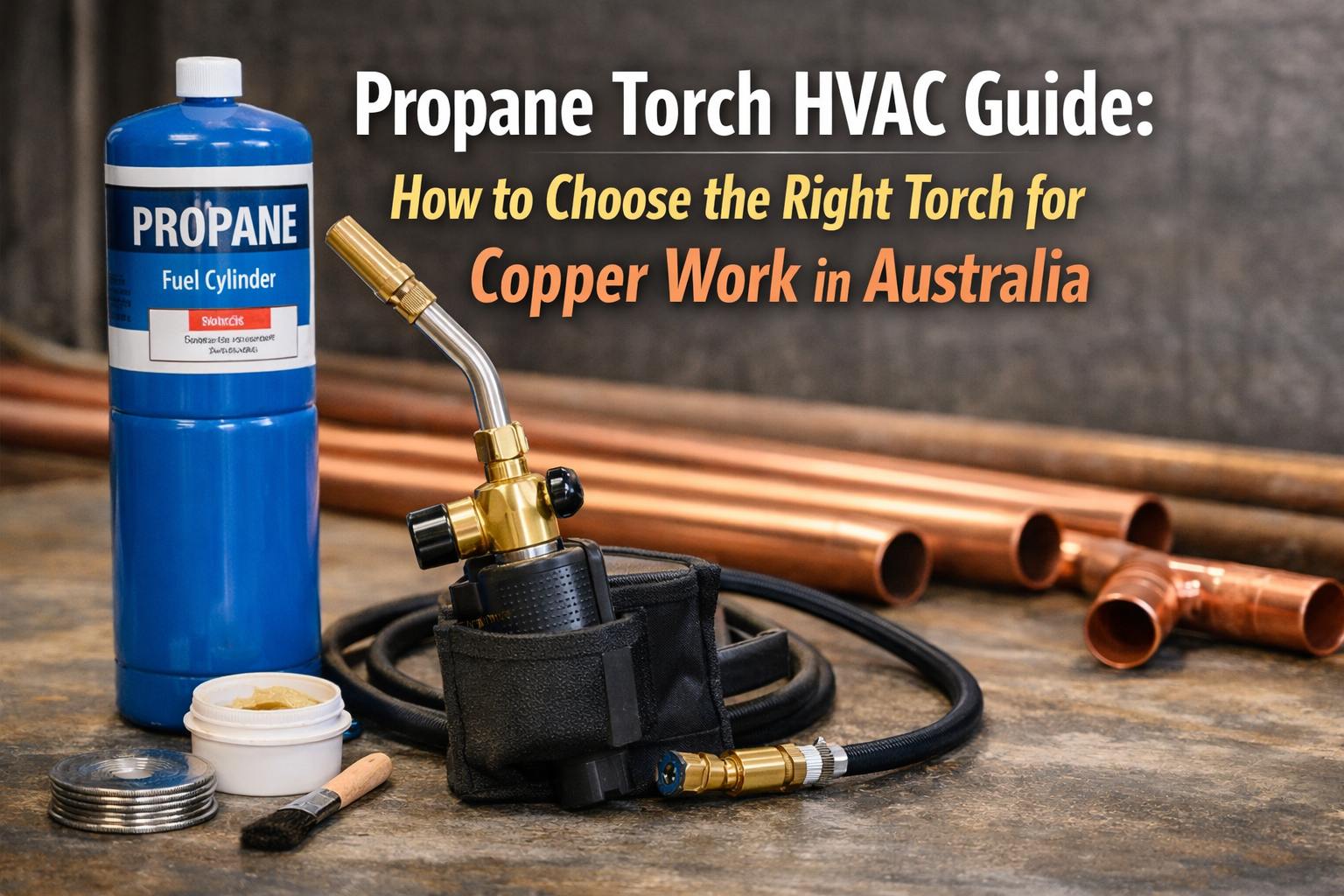
Propane Power for HVAC Work
If you work in HVAC, you already know propane. It is the workhorse fuel that shows up on jobsites across Australia. It is easy to source, easy to keep in the van, and simple to run when you have the right torch head.
But here is the trap: a lot of people underestimate what a propane torch can actually do in HVAC work. They hear “propane is cheap” and assume it must be weak. Or they bolt on the wrong head, get slow heat on copper, then blame the fuel instead of the setup.
This guide is built to fix that. It is a complete propane torch HVAC guide for Australian tradies, apprentices, and facilities teams who want reliable heat for copper work without overspending or overcomplicating their kit.
We will cover why propane makes sense, what “propane torch temperature” really means on copper, when propane is the right choice, and when it is smarter to upgrade. We will also compare propane vs MAPP vs butane in plain language, then help you choose the right torch style for the way you actually work.
If you want the bigger picture first, start with our heating torch fundamentals. It shows how propane fits into the broader heating torch world, so you’re choosing based on the job, not a random recommendation.
And if you are already in “show me the gear” mode, you can browse propane torch options and use this guide to narrow it down to the best fit for your copper sizes, your job type, and your day-to-day workflow.
Why Propane for HVAC Torches?
Propane has stayed popular for a reason. It hits a practical sweet spot for cost, availability, and real-world performance on many HVAC jobs. It is not the “fastest” fuel for every situation, but it is often the most sensible fuel for the work most techs actually do.
Lower cost than MAPP gas
Propane is usually cheaper than MAP-Pro style “MAPP” fuels. That matters when you are doing regular brazing work and you do not want fuel spend creeping up month after month.
But the real value is not just bottle price. It is cost plus outcome. If propane gives you clean joints without slowing you down, it becomes the right decision because you get dependable results without paying for extra heat you don’t use.
Wider availability Australia-wide
Propane is easy to source across Australia. Whether you are in a capital city, a regional town, or heading to a remote site, propane is one of the easiest fuel types to replace quickly.
That is a big deal in real trade life. A fuel that is “great” but hard to replace becomes a headache. A fuel that you can replace almost anywhere keeps the job moving and helps avoid mid-week panic buys.
Sufficient heat for most copper work
For a lot of day-to-day HVAC work, propane is enough. On common residential split installs and light commercial jobs, propane can handle many copper brazing tasks when you use the right torch head and you work clean.
This is where many people get caught out. They run a small general-purpose head, fight slow heat, and assume propane can’t do the job. Often, the setup is the issue. Propane can do solid work when the torch head suits the copper size and the way you apply heat makes sense.
If you are often working in windy areas, remember that wind steals heat. It does not mean propane is “bad”. It means you may need better shielding, better flame shape, or a different setup for those specific jobs.
Compatible with existing torch heads
Another advantage is compatibility. Many tradies already have torch heads designed for propane cylinders, or they have a torch that can run propane with the correct connection and seals.
That makes propane a practical choice when you want to improve your workflow without buying a whole new system. In many cases, the best upgrade is not changing fuel. It is choosing a better torch head and improving heat placement on the joint.
Proven reliability
Propane has been used for heating and brazing work for a long time. The routines are familiar. Storage and handling habits are well understood. That proven reliability is part of why propane remains a “default” fuel on many Aussie jobs.
If you want the foundation view again, our guide on understanding heating torches helps you pick based on job needs, not guesswork, especially when you are building a consistent kit across a team.
Propane Torch Temperature and Performance
When people search “propane torch temperature”, they usually want one number. But on the job, that number is only the starting point. What matters is heat transfer into copper, how evenly you can heat a fitting, and how steady your flame stays in real site conditions.
Flame temperature: 1980°C in air
A commonly quoted figure for propane in air is around 1980°C. That sounds huge, and it is, but your joint does not instantly become 1980°C. The flame is hot, but copper and fittings need time to absorb that heat.
Tech Specs
Torch temperatures are commonly quoted “maximums” under ideal conditions. Real performance varies by torch head design, gas flow, airflow, and how much metal you’re heating. Judge propane performance by time-to-temperature and joint control, not by one headline number.
Heat transfer to copper
Copper is a brilliant conductor. That is good and bad. It helps spread heat through the joint, but it also pulls heat away from your target area. That is why torch head design and flame shape matter so much.
A wide, soft flame can warm a big area but struggle to push a fitting into the working zone quickly. A more focused and stable flame puts heat where it counts, which makes propane feel stronger without changing fuel at all.
Local conditions change the feel too. On a roof in Sydney coastal air, breezes can strip heat away. In Melbourne cold snaps, copper starts colder and soaks more heat before it reaches working temperature. In Brisbane humidity, the bigger issue is keeping connections clean and seals in good nick, because corrosion and grime can turn small issues into leaks and unreliable flame behaviour.
Time-to-temperature on different sizes
It is tempting to ask, “How long does propane take to braze 1/4 inch copper?” The honest answer is: it depends. Tube size, fitting mass, torch head, and airflow all change the outcome.
What you can rely on is the pattern. Small copper and small fittings heat up quickly. As you move to larger copper and heavier fittings, propane can still work, but you need better heat placement and more patience for heat soak.
This is why “propane torch for copper” is not a one-size answer. Propane can be great on common line set work, but if you are regularly battling bigger heat sinks, you may want a second setup for those heavier days.
When propane works best
Propane is a strong choice when your work is mostly residential split systems, service calls, and light commercial joints where portability and simple setup matter.
It is also a good fit when you want predictable operating costs. If you are trying to keep consumables sensible while still getting professional results, propane is often the “workhorse” fuel that stays practical across a full month of jobs.
When to upgrade to MAPP
The upgrade question usually comes down to speed and heat density. If you are regularly waiting for copper to come up to temperature, or you are working on thicker copper and bigger fittings, you may benefit from a hotter air-fuel option.
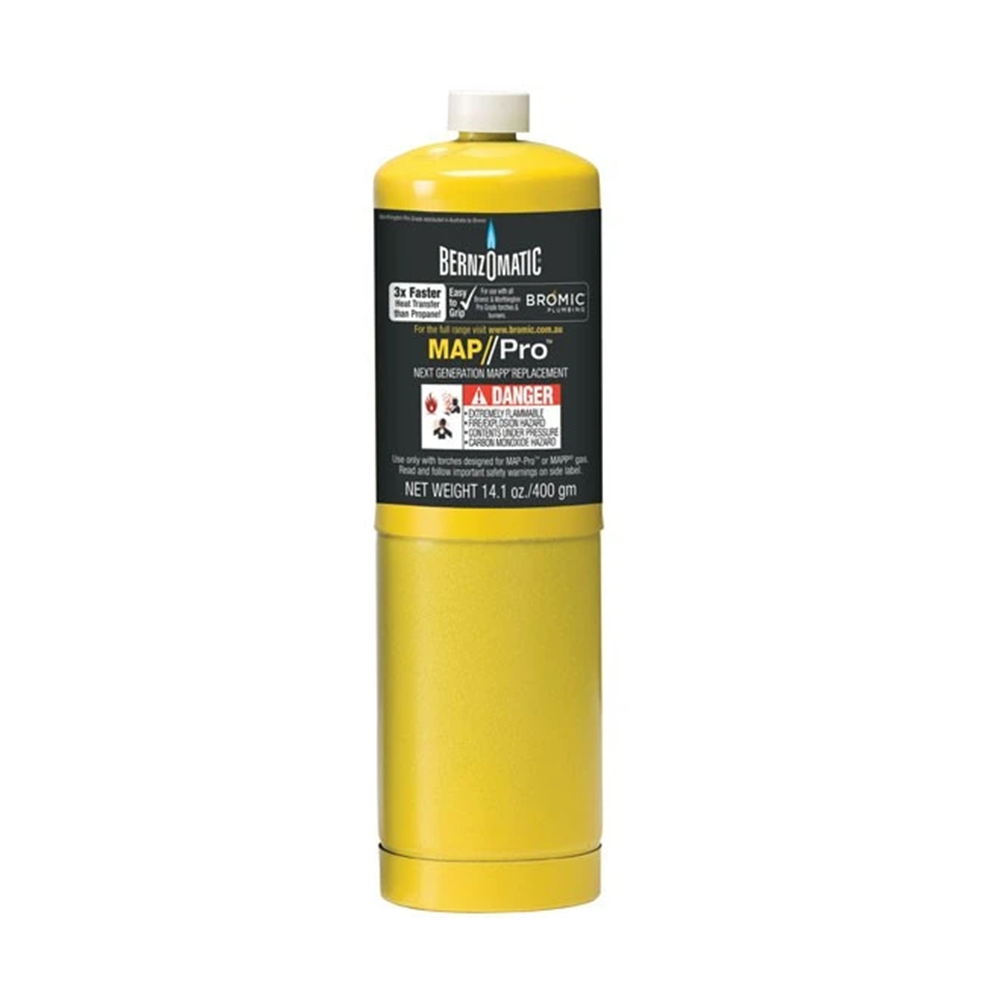
That is where MAP-Pro style fuels often come into the conversation. They can feel faster on heavier joints, especially when paired with a high-intensity torch head that transfers heat efficiently.
👉 If you need faster heat-up on heavier copper, using MAP-Pro (MAPP) gas cylinders for faster HVAC brazing can significantly reduce heat-up time and improve joint efficiency on demanding jobs.
If you want the straight trade-off view, our guide on when to upgrade to MAPP gas helps you decide based on your job mix, not hype.
Propane vs MAPP vs Butane Comparison
This is the comparison most people are really looking for when they search “propane vs MAPP torch” or “propane torch vs butane”. The goal is not to crown a winner. The goal is to match the fuel to the job.
Below is a buyer-focused comparison. Temperatures are shown as commonly cited air-fuel figures where relevant, and should be treated as rough guides. The performance you feel on the job depends heavily on torch head design, wind, and technique.
| Fuel | Commonly cited flame temp (air-fuel) | Cost (relative AU) | Heat speed on heavier copper | Best HVAC use |
|---|---|---|---|---|
| Propane | ~1980°C | $ | Moderate (depends on torch head and airflow) | General purpose work, common copper sizes, service and installs |
| MAP-Pro (often called “MAPP”) | Commonly cited around ~2020°C (varies by setup) | $$ | Often faster on heavy joints and bigger fittings | When heat-up time is the bottleneck on thicker copper |
| Butane | Often cited in a similar range, but used for smaller flames | $ | Slower on bigger heat sinks | Precision light work, small heating tasks, fine control jobs |
If you want the deeper job-based breakdown, read our MAPP vs propane fuel comparison. It focuses on what changes at the joint: heat transfer, time-to-temperature, and control on thin vs thick copper.
Australian pricing considerations are usually about two things: how easy the fuel is to replace, and how much time the setup saves or costs you. Propane wins on availability and usually on ongoing cost. MAP-Pro style fuel can win on speed on heavier work, which may be worth it if that is your regular job mix. Butane often wins on fine, light heating where too much flame is a risk.
One practical truth: fuel choice does not fix poor technique. If joints are dirty, heat is uneven, or you are feeding rod too early, a hotter fuel will not magically solve it. It can even make mistakes happen faster.
If you keep MAP-Pro style fuel on hand for the heavier days, it helps to keep supply consistent. Some techs keep a backup pack of MAP-Pro fuel cylinders so they are not changing brands or bottle types every time stock runs low.
Best Propane Torches for Australian Techs
“Best propane torch Australia” searches usually mean one thing: “What should I choose that will actually work for HVAC?” The answer depends on your jobs, not a brand label.
Instead of guessing, choose based on ignition style, build strength, flame control, and cylinder setup. Those are the things that decide whether your propane torch feels like a reliable trade tool or a frustrating toy.

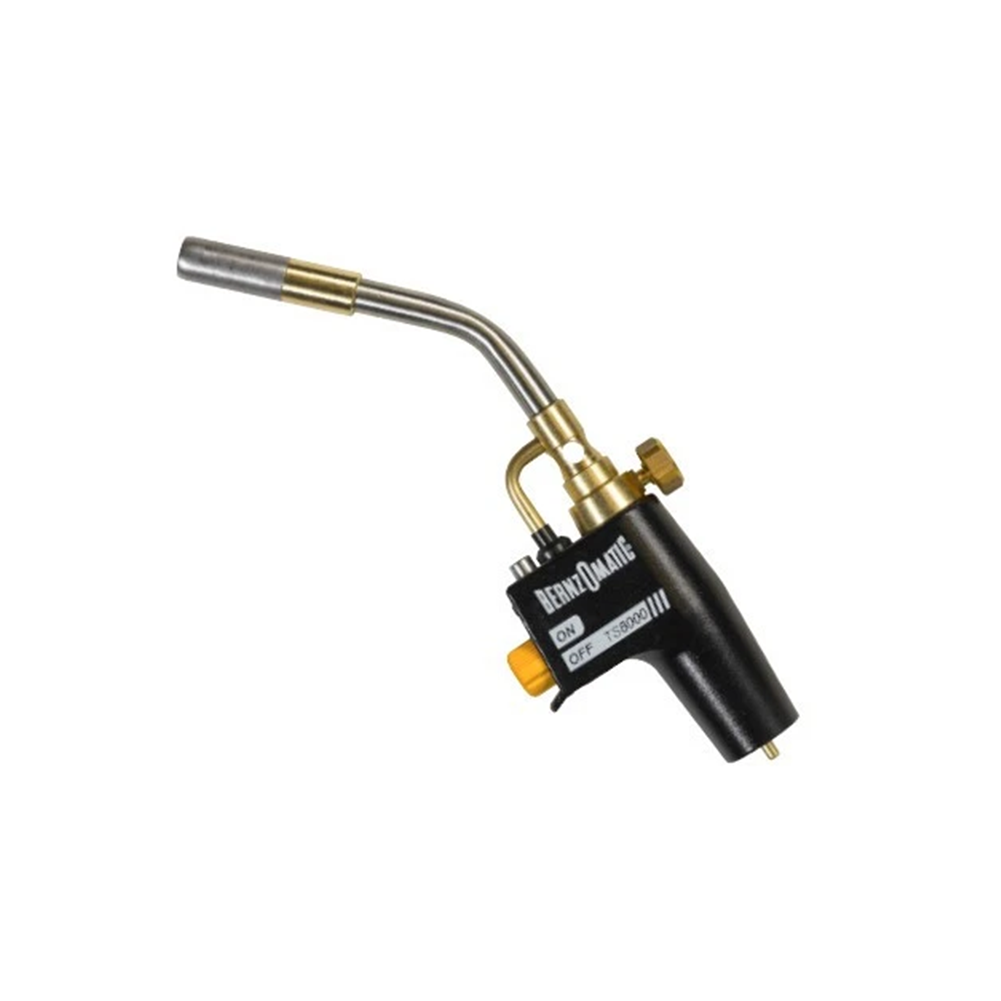
Trigger-start propane torches
Trigger-start torches are popular because they speed up workflow. If you are doing multiple joints, moving between indoor and outdoor units, or doing stop-start heating tasks, trigger-start keeps the job moving.
For apprentices, trigger-start can also reduce bad habits. When ignition is easy and repeatable, people are less likely to crack the valve too far just to keep the flame alive. That means fewer scorched fittings and better control.
In cold weather, trigger-start can be a quality-of-life upgrade too. When Melbourne mornings are icy and fingers are stiff, quick ignition reduces the temptation to “mess around” with the valve and end up with a flame that is bigger than it needs to be.
Manual ignition options
Manual ignition torches can still be a solid choice. They are simple, and many tradies like the feel of a basic torch with a striker because it has fewer parts to worry about.
If you go manual, focus on control. A torch head with a smooth valve and stable flame gives you better outcomes than a cheap head that jumps between settings. In HVAC work, smooth control often matters more than raw flame size.
Heavy-duty vs standard models
“Heavy duty propane torch” is not just marketing words. For trade use, heavy duty usually means stronger threads, better seals, and a torch head that stays consistent after knocks in the van.
This matters in Australia because conditions can be rough. Sydney coastal air speeds up corrosion when tools live in open trays. WA dust can make threads gritty if you do not cap cylinders and store gear cleanly. Brisbane humidity can turn minor surface rust into real problems if you store gear damp.
A heavy-duty build helps keep the tool predictable. And predictable tools help produce predictable joints.
Disposable vs refillable cylinders
Many HVAC techs use disposable cylinders because they are easy. You swap and go. That simplicity is a real advantage on service calls.
Refillable options can suit some setups, but the key question is: does it make your day easier or harder? If it adds steps, adds storage issues, or adds more chances for damage and leaks, it may not be the best fit for field work.
For most vans, the best setup is the one you will actually carry into the job and use safely.
Professional recommendations
For a propane torch HVAC setup, choose a torch head that gives you control and a flame shape that suits copper joints. You want predictable adjustment. You want a flame that stays stable when you move around the fitting.
Also think about your typical tube sizes. If most of your work is on common residential sizes, a good propane head with decent heat density is often enough. If you often work on heavier copper or larger fittings, plan for that reality instead of hoping one torch will handle everything.
If you want to compare what fits your workflow, browse our propane torch range and narrow it down based on ignition style and the kind of copper work you do most weeks.
Pro Tip
Most “propane is weak” complaints are really “my torch head is wrong for the job”. If heat feels slow, check flame shape, check airflow, clean your threads, and make sure seals are in good nick before you blame the fuel. A better head and a cleaner setup can change everything.
Complete kits (when you want a second setup)
Some techs prefer matched kits because everything is designed to work as a system. That can help if you are upgrading your hot work gear and you want fewer compatibility surprises.
On heavier work, some tradies run propane day-to-day and keep a second kit for the bigger jobs. If you are comparing complete systems, options like professional torch kits sit in that “higher output” category where speed can improve on heavier joints, but training and safety discipline also matter more.
If you are weighing that kind of upgrade, it helps to understand how MAP-Pro style torch setups behave compared with propane. Our guide on MAPP gas torch features is a useful companion read, because it focuses on real job outcomes like flame control, heat transfer, and compatibility habits.
Propane Torch Applications
This is where the “propane brazing torch” question becomes real. In HVAC, the torch is not just a tool you own. It is a tool you use in specific situations. The best choice is the one that suits your most common applications.

Residential split system brazing
On residential splits, propane can be a great fit. The work is portable, access can be tight, and you want a setup that gets in and out without dragging a mountain of gear.
For many installs, propane provides enough heat for clean joints when you use good technique. The goal is even heating. You want the fitting and tube to come up to temperature together so the filler flows properly and the joint seals cleanly.
Where people get into trouble is rushing. They heat one side too hard, feed rod too early, and end up with filler that blobs instead of flowing. That is not a fuel problem. That is heat placement and timing.
Light commercial work
Propane is also common in light commercial service and installs where joints are still in a manageable size range and portability matters. The moment you start dealing with heavier pipework and bigger fittings regularly, you may feel propane slow down.
A practical approach is to use propane as your daily setup, then have a clear plan for heavier jobs. That might mean a hotter air-fuel setup or a separate kit for those sites, rather than forcing one torch to do everything and losing time every day.
Copper tubing up to 5/8
Your outline calls out copper tubing up to 5/8 as a typical propane-friendly range for many HVAC tasks. In real use, propane can be strong here when your torch head is suited to the job and you heat the joint properly.
The key is to heat the fitting and tube, not the rod. When the base metal is in the right zone, the filler flows where it should. If you heat the rod directly, you can get a messy, weak joint that looks “done” but does not hold long-term.
If you want a practical guide to the joint process, our article on professional brazing techniques is useful even if you are using propane, because the fundamentals of heat placement and joint prep are the same.
Soft soldering applications
Some techs use propane for soft soldering tasks where lower, controllable heat helps. This is where flame control matters more than raw heat.
If you do occasional soldering, choose a torch that can hold a stable low flame. A torch that only behaves well on high flame is harder to use on delicate tasks and increases the chance of scorched insulation and damaged nearby materials.
Heating and thawing
Propane torches are also used for general heating tasks: freeing stuck fittings, warming parts for easier movement, and sometimes thawing. But this is where people can do damage if they rush.
If you heat too hard in one spot, you can damage insulation, seals, wiring, and plastic components. You can also crack parts by creating fast temperature changes. If you use a torch for thawing, keep it gentle, keep it moving, and think about what is near the area you are heating.
DIY vs professional use
Propane is widely available, which means DIY users often pick it up. But HVAC brazing is not casual work. It is hot work, it is skill-based, and it has consequences when done poorly.
For professionals, the goal is repeatable joints and safe habits. That means correct cleaning, correct heat placement, and correct cylinder handling. For DIY users, the biggest risk is rarely the fuel. It is lack of technique and poor safety discipline.
Troubleshooting common propane torch problems
If your propane torch is not performing well, start with the basics. Is the cylinder connection clean? Are the threads damaged? Does the seal look worn? Is the flame sputtering because the valve is sticky or the connection is not sealing properly?
Also check flame shape. A weak, wide flame often means you are not getting heat density where you need it. That makes propane feel slow even when it is capable. A stable, focused flame usually gives better results on copper joints.
Finally, check the environment. Wind strips heat away. Cold copper soaks more heat. Tight spaces force awkward angles that make heating uneven. Fixing position, shielding wind, and improving setup often delivers a bigger result than changing fuel.
Cost Analysis: Propane Economics
“Propane torch cost Australia” searches usually mean more than the torch price. People want to understand ongoing cost: cylinders, burn rate, and whether propane actually saves money once you include time on the job.
The safest way to handle costs is not to throw out numbers that change by location. It is to use a simple method you can apply to your own workflow.
Propane cylinder costs Australia-wide
Propane costs vary across Australia based on supplier, region, and how you buy. Metro areas are usually easy to restock quickly. Regional work is often still fine, but you may prefer to keep a spare so you do not lose a day driving around for fuel.
The key economic advantage of propane is usually not the exact price. It is the stability. The supply is consistent, which reduces downtime and keeps your monthly spend predictable.
Cost per braze joint (a practical way to estimate)
Rather than guessing, estimate your own cost per braze joint. Track how long a cylinder lasts in your normal workflow and roughly how many joints you complete in that time. You do not need perfect numbers. You just need a real feel for your own work.
Then compare that with labour time. If propane gets the job done cleanly without slowing you down, it is usually good value. If propane is consistently slow on your common jobs, the “cheaper fuel” may cost more once you factor in time and call-back risk.
Monthly fuel budget
A simple monthly fuel budget keeps things calm. If you know your normal propane spend, you can plan stock levels and avoid panic purchases.
Panic purchases are where kit gets messy. People grab random bottle types, mismatched heads, or “whatever is on the shelf”, then wonder why connections leak or flame behaviour changes week to week.
ROI on a quality torch
Return on investment on a quality torch is not about fancy features. It is about reliability and speed. A better torch head can transfer heat more efficiently. A smoother valve gives better control. Better threads and seals reduce leaks and wasted time.
If a quality torch saves even a small amount of time per job and reduces rework, it can pay for itself quickly in real trade terms.
When cheaper fuel makes sense
Propane makes sense when it suits your work and keeps costs predictable. It is often the right choice for residential installs, routine service, and light commercial work where the main goal is consistent results without overspending.
If your jobs sit in that zone, sticking with propane is not “settling”. It is matching the fuel to the work.
Did You Know?
On many HVAC jobs, the biggest fuel “cost” is not the cylinder. It is lost minutes. If a setup adds five minutes to every joint, that labour time can cost more than any difference between fuels.
Because propane use sits under broader site expectations around flammables, storage, and hot work discipline, it is smart to stay aligned with workplace safety requirements. It keeps your process clean and reduces risk on site.
Choose Propane for Reliable Work
Propane remains a top choice for a reason. It is cost-effective, easy to source Australia-wide, and capable of professional HVAC work when you use the right torch head and good technique.
To choose well, start with your job mix. If most of your work is residential split systems, service, and light commercial joints, propane can be the daily workhorse that keeps running costs sensible and setup simple.
Then be honest about your exceptions. If you regularly hit heavier copper, bigger fittings, or windy exposed conditions where heat speed is critical, it may be worth keeping a second setup or upgrading for those jobs. That is not abandoning propane. It is matching tools to the work.

If you want to compare what fits your workflow, you can browse shop propane torches and talk to our team to confirm compatibility with your torch style, cylinder type, and typical copper sizes. If you are quoting larger work or planning ongoing installs, contact us for a quote and we will help you pick a setup that stays reliable on real Aussie jobs.
When to upgrade to MAPP
The upgrade question usually comes down to speed and heat density. If you are regularly waiting for copper to come up to temperature, or you are working on thicker copper and bigger fittings, you may benefit from a hotter air-fuel option.
That is where MAP-Pro style fuels often come into the conversation. They can feel faster on heavier joints, especially when paired with a high-intensity torch head that transfers heat efficiently.
If you want the straight trade-off view, our guide on when to upgrade to MAPP gas helps you decide based on your job mix, not hype.