
How to Choose the Right Torch Head for HVAC Brazing in Australia
The Right Torch Matters
If you’ve ever stood there heating a copper joint and thought, “Why is this taking so long?”, you’ve already learned the big lesson: the torch matters as much as the fuel.
Lots of Aussie tradies start by swapping bottles. They try “MAPP gas” (often sold today as MAP-Pro style torch fuel) because it’s known for strong heat. But if the torch head is wrong, you can still waste time. You can still cook the area around the joint. And you can still end up with a braze that looks okay on the day, then leaks later.
That’s why “mapp gas torch” is such a common search. People aren’t chasing trivia. They want a setup that lights fast, holds a steady flame, and gives repeatable results on the copper sizes they touch every week.
This guide is built for HVAC and refrigeration work in Australia. It’s not a sales pitch. It’s a straight, job-real torch selection guide. We’ll cover compatibility, torch types, torch heads, the features that actually matter in a van, and how to pick a kit that won’t bite you later.
We’ll also keep things safe and honest. We won’t invent BTU numbers or pretend one torch is perfect for every job. If something varies by model, we’ll say so and show you how to confirm it.
MAPP Gas Torch Compatibility
Compatibility is where most people get caught. Not because they’re careless, but because torch and cylinder standards aren’t always clear when you’re buying on the run.
When someone says “torch mapp gas”, they usually mean a handheld torch head that screws onto a small disposable cylinder. That setup can work well for HVAC brazing, as long as the threads match, the seal is sound, and the torch is designed for the fuel you’re using.
CGA600 connection standard
Most disposable MAP-Pro style cylinders and many handheld torch heads use a common small-cylinder thread. You’ll often hear it called CGA600. The name matters less than the feel of a correct fit.
Your jobsite check is simple. The torch should screw on smoothly. It should sit square. It should not feel crunchy, crooked, or “tight in a weird way”. If it does, stop. Don’t force it. Cross-threading is one of the fastest ways to damage a valve, create a leak, and turn a good torch into a risky tool.
If you’re standardising a crew, make “smooth screw-on, sits square” the rule. It saves a lot of headaches later.
MAP-Pro torch requirements
MAP-Pro style fuel is made for high-heat torch work. But that doesn’t mean you need the biggest flame you can find. In HVAC, stable heat is usually the winner.
You want a torch head that holds a steady flame, lets you control the size, and keeps the heat where you point it. The goal is even heating of the base metal so the filler flows cleanly. A jumpy flame makes you chase heat, and chasing heat is when joints get messy.
If you’re buying a torch for MAP-Pro use, confirm two things before you commit. First, confirm the thread standard matches the cylinders you’ll buy in Australia. Second, confirm the torch is rated by the manufacturer for that fuel type.
Propane torch compatibility
Some handheld torch heads can run on propane cylinders with the same small-cylinder thread. That’s why people assume everything is interchangeable.
In practice, you still need to check the torch is approved for the fuel and cylinder you’re attaching. Some torches behave well on both. Some are fussy. And some simply aren’t designed for the fuel mix you’re trying to run.
This is also where people get confused when a “fuel upgrade” doesn’t feel like an upgrade. If you change bottles but keep a weak head, you may not feel much difference. The torch head shapes the heat. The fuel supports it.
Adapter considerations
Adapters are where people get tempted to “make it work”. On HVAC jobs, that can be a risky habit.
If you use an adapter, it needs to be the correct adapter for that exact purpose, and it needs to seal properly. If it creates wobble, poor sealing, or odd flame behaviour, it’s not worth it.
Most of the time, if you need adapters often, it’s a sign your kit is mixed. The better move is to standardise. One cylinder type. One connection system. Torch heads that match that system.
Australian safety standards
In Australia, treat torch gear like fuel equipment, not a casual accessory. Follow the manufacturer instructions, store cylinders properly, and keep basic leak awareness as a normal habit every time you connect a bottle.
On real jobs, that habit matters even more. Hot vans, dusty plant rooms, and rough transport can all turn a small problem into a bigger one if you ignore it.
Did You Know?
Most “wrong bottle” dramas aren’t about the fuel at all. They’re about the connection. If the torch won’t screw on smoothly and sit square, don’t force it. Confirm the thread standard before you buy more cylinders.
Torch Types for MAPP Gas
When someone searches “mapp gas torch head”, they’re usually asking, “Which torch style suits my work?”
Below are the common torch types you’ll see for MAP-Pro style fuel, and what they do well on HVAC jobs.
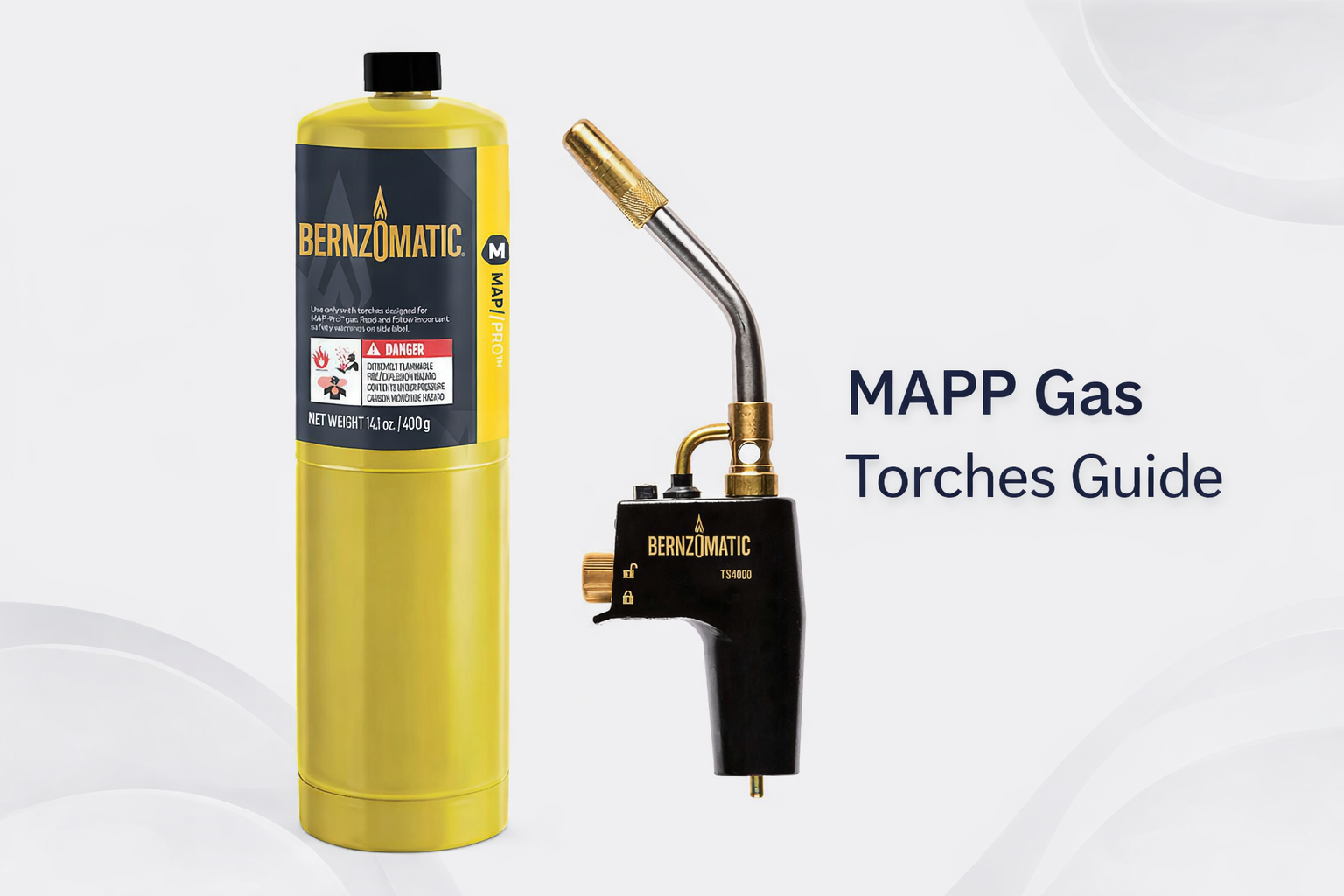
Trigger-start torches (TS4000 / TS8000 style)
Trigger-start torches are popular because they light fast and consistently. That matters on service work where you might light and adjust the torch many times in a day.
They can also reduce wasted gas. If you’ve ever cracked a valve, hunted for a striker, and watched fuel drift away while you’re distracted, you’ll understand why a trigger-start MAPP torch feels like a practical upgrade.
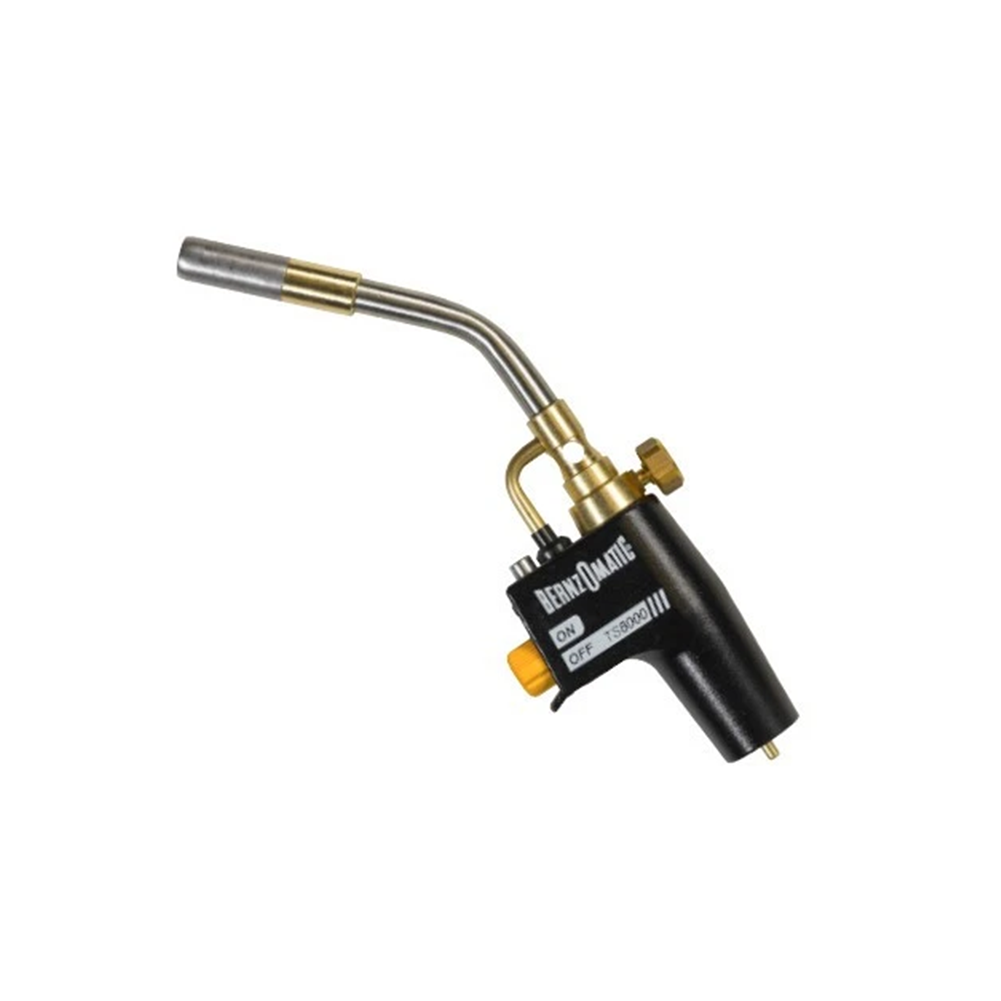
People often mention model families like TS4000 and TS8000 as shorthand for “trigger-start” and “high intensity”. The key point isn’t the model number. It’s the benefit: fast ignition plus steady flame control.
Manual ignition torches
Manual ignition torches are the simple, classic option. They rely on a striker or ignition source and good hand habits.
They can be reliable and cost-effective, but they add an extra step. If your work is mostly planned installs with fewer stop-start moments, manual ignition can be fine. If you do lots of quick brazes, trigger-start often feels easier.
High-intensity swirl flame torches
Swirl flame heads are built to transfer heat fast. They create a flame pattern designed to wrap and push heat into the metal more efficiently than a basic straight flame.
On thicker suction lines and bigger fittings, swirl flame can be the difference between steady progress and that annoying “nearly there” feeling.
The trade-off is control. Faster heat-up is great, but it also means you can overshoot on small joints if you camp on one spot. Swirl heads reward good habits.
Pencil flame precision torches
Pencil flame heads are about precision. They focus heat into a smaller area, which helps when you’re working near sensitive materials or tight clearances.
On HVAC work, pencil flame can be handy on smaller lines, careful touch-ups, and spots where you want to avoid heating everything around the joint.
The trade-off is speed on big heat sinks. If you use a pencil flame on 7/8" suction work, you may be back to longer heat-up times.
Oxy-MAPP systems
Oxy-MAPP setups add oxygen to the mix and can deliver higher heat intensity than air-fuel torch heads.
This can suit heavier work and specialist cases, but it also demands more training, more care, and a clear reason for the extra heat. More heat is not automatically better. It just changes the speed and the risk window.
If you want to see what that higher-output category looks like, the Bernzomatic Oxy MAP-Pro system is a good example of an oxy-fuel style kit built around MAP-Pro fuel.
Bernzomatic range in Australia
Bernzomatic comes up a lot in searches like “bernzomatic mapp gas torch” because it’s a well-known name in torch gear. But don’t buy the logo. Buy the flame pattern and control that fits your work.
If you want to compare torch styles in one place, the complete welding torch range is helpful because it shows different torch categories side by side, in the context of brazing work.
Torch Head Comparison
This is the section that helps you pick the right “mapp gas head” for the way you actually work.
You’ll sometimes see listings talk about BTU output. In real HVAC work, output varies by model, flame setting, fuel type, and conditions like wind and ambient temperature. The safest approach is to treat output as a rough guide and confirm details from manufacturer documentation when it matters.
So instead of pretending one number tells the full story, the table below compares head types by flame pattern, control, and where they shine on real jobs.
| Torch head type | Flame pattern | Heat feel (relative) | Best HVAC use | Watch-outs |
|---|---|---|---|---|
| Basic straight flame | Direct cone | Medium (model dependent) | General heating, smaller copper, light brazing | Can feel slow on big fittings, wind, and heavier joints |
| Swirl flame | Wrap-style heat | High (model dependent) | Faster heat-up on 5/8" to 7/8", bigger valves, repeat joints | Easy to overshoot small joints if you camp in one spot |
| Pencil flame | Narrow point | Low to medium (model dependent) | Precision work, tight spaces, controlled heating near sensitive materials | Can feel slow on large copper and heavy heat sinks |
| Turbo / high-intensity | Aggressive, high-energy flame | Very high (model dependent) | Time-critical work, heavier joints (with strong technique) | Higher risk of overheating and collateral damage in tight areas |
| Oxy-MAPP | Oxy-fuel style flame | Very high (system dependent) | Specialist heavy-duty heating where air-fuel isn’t enough | Needs training and careful handling for safe control |
Here’s the simple way to choose. If you mostly do smaller lines and occasional brazing, a stable basic head can be enough. If you regularly hit thicker copper and bigger fittings, swirl flame heads often feel like the best balance of speed and control. If you’re working near tight clearances, pencil flame can help keep heat where it belongs.
If you’re thinking “best mapp gas torch” means “most heat”, pause. For HVAC work, the best torch is usually the one that gives you control and repeatable results across the jobs you actually do.
Pro Tip
If a joint feels slow, don’t blame the fuel first. Check wind, check flame shape, and check how you’re heating the fitting and tube together. A clean flame and good technique often beat “more heat”.
Essential Features for HVAC Work
Once you understand torch head types, features are what separate a torch that feels great for a week from a torch that still works properly six months later in a van.
These features matter most for HVAC brazing and service work, especially in Australian conditions like Brisbane humidity, Sydney coastal air, and Melbourne cold snaps.
Trigger-start for safety and fuel savings
Trigger-start is not just convenience. It’s consistent ignition and less wasted gas. If you do lots of stop-start work, it can reduce the time your valve is open without a stable flame.
It also helps training. Apprentices tend to do better when ignition is simple and repeatable. Fewer fiddly steps usually means fewer rushed mistakes.
Adjustable flame control
Adjustable flame control is what keeps a hotter fuel from becoming a problem. MAP-Pro style fuel can heat fast, but good brazing needs even heating.
A valve that lets you fine-tune flame size helps you heat the tube and fitting together, instead of blasting one spot and hoping it spreads.
Durable construction that survives van life
HVAC tools live in vans, on roofs, and in dusty plant rooms. A torch that feels nice in a shop can feel average after months of vibration and knocks.
Pay attention to the threads and connection area. If the connection starts to feel loose or sloppy, you can get unstable flame behaviour or leak risk. That’s not something to ignore.
Heat shield protection
Heat shields matter when you’re working close to your hands and close to other materials. On a hot roof, anything that reduces unnecessary heat exposure helps you stay calmer.
Calm hands usually mean better joints. When you’re sweating hard in Brisbane humidity, small comfort features can genuinely improve consistency.
Lightweight for rooftop work
On ladders and rooftops, weight matters. You don’t want a heavy torch that makes your wrist tired halfway through the job.
Lightweight does not mean flimsy. You want a torch that feels balanced and easy to hold steady while you heat evenly.
Lock-on for continuous use
Lock-on can be handy for longer heat-up tasks, as long as you still keep control and awareness of what’s around the joint.
It’s not “set and forget”. It’s a comfort feature. Used well, it reduces hand strain. Used badly, it can encourage lazy flame control.
Using a MAPP gas torch: step-by-step habit (no fuss, just repeatable)
If you search “using mapp gas torch”, you probably want a simple, repeatable workflow that works on real jobs. Here’s the way most good techs keep it calm and controlled.
Step 1 is the connection. Screw the torch onto the cylinder smoothly and straight. If it doesn’t feel right, stop and check threads and seal surfaces. Don’t force it.
Step 2 is ignition and stability. Crack the valve slightly, ignite safely, then adjust until you have a steady flame that doesn’t flutter or roar strangely. If it flares or pops, turn it down and check for drafts or a poor connection.
Step 3 is the site scan. Look behind the copper. Timber, insulation, paint, cables, dust, and building wrap can all create problems fast. Use shielding where needed and keep your head on what’s around the joint, not just the joint itself.
Step 4 is base metal heating. Don’t aim the flame at the filler. Heat the fitting and tube together. Move the flame to warm the joint evenly. When the metal is ready, the filler flows toward the heat.
Step 5 is a calm finish. Let the joint cool naturally. Don’t shock cool it. Then inspect. A good joint usually looks even and controlled, not like the filler was chased around in a panic.
If you want a safety-focused deep dive that matches this exact topic, read MAPP gas safety features and keep it as a refresher for new staff and apprentices.
For an external safety reference that’s still job-practical, SafeWork guidance on flammable gas equipment safety is a solid reminder that storage, handling, and ignition awareness matter on real sites.
Torch Kits vs Individual Components
This is where “mapp torch kit” and “mapp gas torch kit Australia” searches usually land. People want to know if they should buy a complete kit or build a custom setup.
Both can work. The better choice depends on how often you braze, how many techs are in the crew, and how much you care about standardising gear across the van.
Complete kits with cylinder included
A complete kit is the easiest way to avoid compatibility mistakes. The torch and cylinder are matched, and you’re less likely to end up with parts that don’t fit.
Kits also make training easier. When the setup is consistent, you teach one good habit instead of dealing with three different torch behaviours across the team.
If you want a straightforward example of a matched kit built for higher output, the high-intensity trigger-start torch kit is the kind of “one box” setup many techs choose when they want simple compatibility and strong performance.
Building a custom setup
A custom setup makes sense when you already know what head type you want. For example, you might want a swirl flame for bigger copper and a precision head for tighter spaces.
The risk with custom setups is “random buying”. One cylinder from one place, one head from another, and suddenly you’re back to adapters and mismatched behaviour. Custom is great when it’s planned. It’s painful when it’s improvised.
Spare torch head benefits
Spare heads aren’t a luxury if you rely on torch work. They’re an insurance policy.
If a head gets blocked, damaged, or worn, you don’t want to lose a day. A spare means the job continues and you sort the damaged one later.
Carrying case options and van organisation systems
Van organisation sounds boring until you’re on a roof and you realise the striker is missing, the torch head is bouncing around, and the cylinder valve has collected dust.
A simple case or dedicated spot in the van keeps the connection clean and reduces damage. That makes the torch safer and more reliable over time, especially if you work in WA dust or coastal salt air where grit and corrosion are always trying to sneak in.
Once your torch compatibility is confirmed, fuel supply becomes simple. If you need cylinders as a separate component, individual MAP-Pro cylinders are the clean option for consistent supply without mixing random bottle types.
Tech Specs
For crew setups, consistency beats “best on paper”. Pick one connection system, one main torch style, and a repeatable storage spot in the van. It reduces wrong-bottle issues and makes brazing results more repeatable.
Bernzomatic MAPP Torches in Australia
If you search “bernzomatic mapp gas torch”, you’re usually looking for a known feel and a setup you can buy again later without surprises.
Bernzomatic is commonly discussed because it covers popular torch styles like trigger-start, high-intensity heads, and oxy-fuel kits. But keep it simple. Don’t buy by model number first. Buy by job type.
TS4000 trigger-start (most popular style)
Trigger-start torches are popular for service work because ignition is quick and consistent. If you do lots of stop-start heating, this style reduces fuss and keeps your attention on the joint.
If you’re often working in tight ceiling spaces, stable ignition also matters because you’re usually lighting up close to other materials. You want calm control from the start.
TS8000 high-intensity style (when heat-up time is the bottleneck)
High-intensity heads can earn their place when heat-up time is your main problem. Thicker copper, bigger fittings, and repeat joints are where they feel useful.
A matched kit is often the safest way to get into this category without compatibility guessing. That’s why many techs lean on Bernzomatic trigger-start kits when they want a known setup for HVAC work.
Oxy-MAPP Pro kit (specialist heavy work)
Oxy-fuel is a different category. It can suit heavier work, but it also demands a more deliberate approach to safety and technique.
If you’re stepping into that higher-output territory, the Bernzomatic Oxy kit for heavy work is a clear example of the category. The smart move is to compare it to your real needs, not your curiosity. If air-fuel already handles your work, you may not need to level up.
Warranty and support
Warranty terms and support vary by product and supplier, so don’t assume. The safe habit is to check the product documentation for the exact item you’re buying.
The job-real goal is simple: buy gear you can replace or service without drama. If your torch is a key tool, you don’t want a one-off setup that disappears in six months.
Genuine vs generic parts
Generic parts can look similar, but they don’t always seal the same and they don’t always behave the same.
If a part touches the connection, valve, or flame shape, treat it as critical. A small mismatch can create unstable flame behaviour or leaks. In HVAC work, that’s not worth the gamble.
Choose Your Perfect MAPP Torch
So, how do you choose the right torch without overthinking it?
Start with your copper sizes. If most of your work is smaller copper and occasional brazing, prioritise control and ease of use. If you regularly hit 5/8" and up, you can justify a head style that heats faster and stays stable in wind.
Next, think about your job conditions. If you’re on windy rooftops in Sydney coastal air, stability matters. If you’re in tight ceiling spaces, precision and shielding matter. If you’re doing long days in Brisbane humidity, a torch that reduces hovering time can reduce fatigue, and fatigue is when mistakes creep in.
Then lock in compatibility. Confirm the connection system. Confirm the torch is designed for the fuel. Avoid adapters unless you have a clear, approved reason to use one.
If you want the cleanest starter approach, a matched kit is often the safest move because it removes guessing and helps you build consistent habits faster.
If you want to compare your options side by side, the portable gas torches category is the best place to line up torch types and pick the head style that fits your real work.
When you’re ready to standardise, the simplest next step is to choose from the complete MAPP torch selection and build a kit that stays consistent across jobs.
If you’re not sure which torch head suits your copper sizes and workflow, talk to our team to confirm compatibility. If you’re setting up a crew or standardising a van, contact us for a quote and we’ll help you choose a torch-and-fuel setup that works the same way on every job.
And if you want the hub page that ties the full content set together, including what “MAPP gas” means in the modern market, read understanding MAPP gas fuel and keep it as your reference link for apprentices and new staff.
MAPP Gas Torch FAQs
What does CGA600 mean for a MAPP/MAP-Pro torch?
CGA600 is a commonly referenced small-cylinder connection standard used by many handheld torch heads and disposable MAP-Pro style cylinders. On the job, the practical test is that the torch screws on smoothly and sits square. If it feels crunchy, crooked, or oddly tight, stop and confirm compatibility rather than forcing it.
Can I use the same torch head for propane and MAP-Pro?
Sometimes, but you must confirm the torch is approved by the manufacturer for the fuel you’re using and the cylinder you’re attaching. Some heads behave fine on both fuels, while others are more sensitive. If you “upgrade fuel” but keep a weak torch head, you might not feel the benefit.
Which torch head is best for thicker copper suction lines?
For thicker copper and bigger heat-sink fittings, many techs lean toward swirl-flame or higher-intensity heads because they transfer heat faster. The best option is the one that stays stable in your common job conditions and lets you heat the base metal evenly without rushing the joint.
Are adapters safe for MAPP/MAP-Pro torches?
Adapters can create risks if they add wobble, sealing problems, or odd flame behaviour. If an adapter is used, it must be correct for that exact application and seal properly. If you find you need adapters often, it’s usually smarter (and safer) to standardise your torch and cylinder system.
Should I buy a kit or build a custom setup?
A matched kit is the simplest way to avoid compatibility mistakes because the torch and cylinder are designed to work together. A custom setup can be excellent when planned (for example, different heads for different job types), but “random buying” across brands often leads back to adapters and inconsistent results.
If you’re still weighing up options, pick the torch head style first (control vs speed), then confirm compatibility with your cylinders. Once that’s locked in, choosing a mapp gas torch becomes a lot simpler—and your brazing results usually get more consistent fast.