
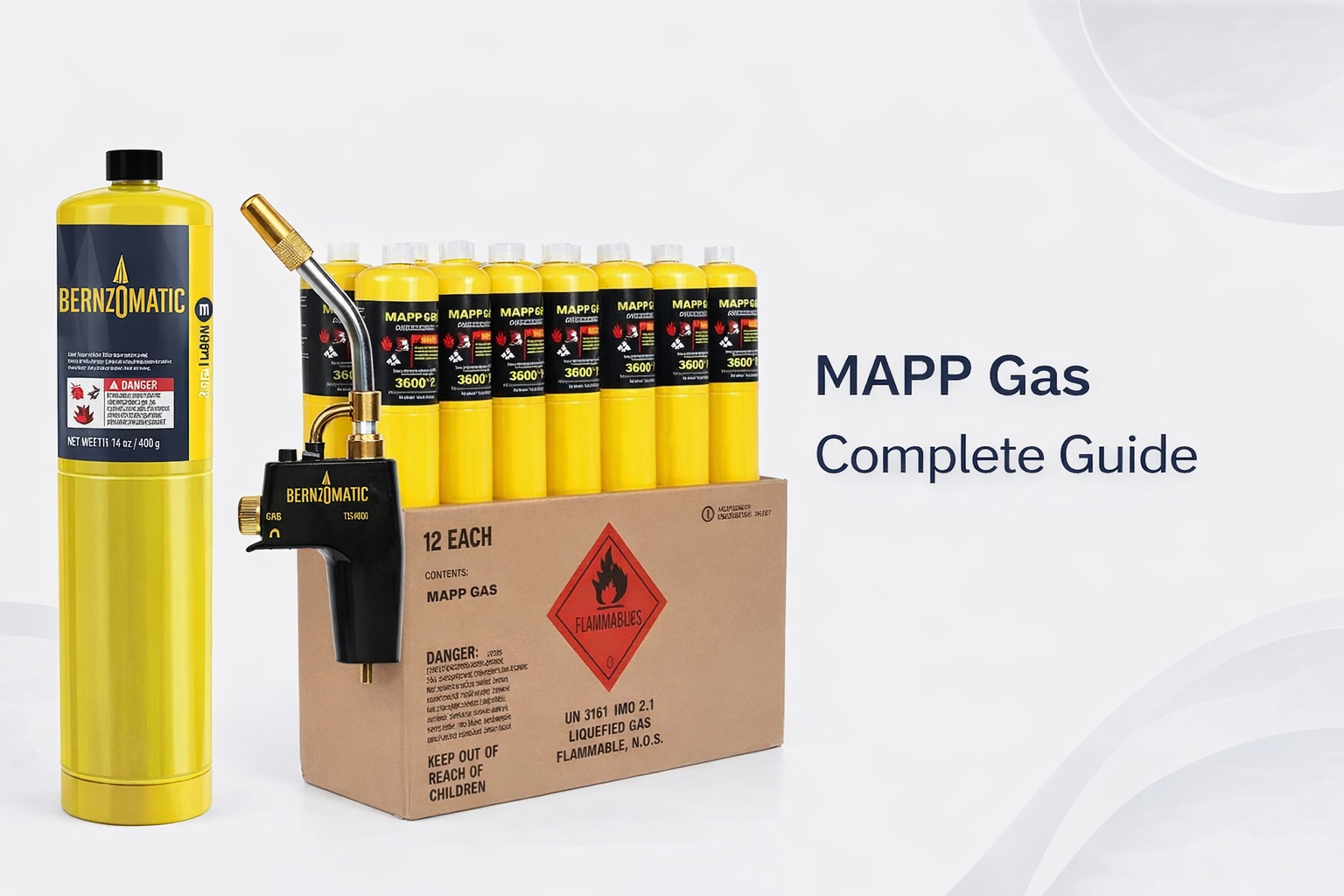
MAPP Gas for HVAC Brazing in Australia: What It Is, MAP-Pro vs Propane, and How to Choose
The Professional's Fuel
If you’ve ever tried to braze copper on a cold morning and felt like you were waiting forever for the joint to come up to temp, you already know why tradies talk about MAPP gas.
In HVAC work, speed matters. Not because you want to rush. Because a clean braze needs steady heat, the right timing, and less mucking around while the copper soaks up energy.
That’s the simple appeal of mapp gas: it gets copper hotter faster, which can make brazing feel more controlled on real jobs.
But here’s the catch. Not all “gas cylinders” are equal for HVAC brazing. Some fuels struggle when copper is thicker. Some torches don’t match the thread. Some setups waste heat and time. And some people buy “MAPP” thinking it’s one thing, when the cylinder is actually a modern MAP-Pro style mix.
This guide clears it up in plain English for Australian techs. What MAPP gas is today, what’s inside it, when it’s worth using over propane, and how to choose cylinders and torches that actually fit your workflow.
We’ll keep it job-focused and honest. We won’t invent specs or throw around price claims. Instead, you’ll get practical decision checks you can repeat: read the cylinder label, confirm the thread, match the torch, and pick the fuel that makes the joint easier to do properly.
If you’re setting up or refreshing your kit, it helps to start in the right category so you’re not chasing random parts. You can browse HVAC welding and brazing equipment to see the kind of torches, fuel, and kits Australian HVAC techs typically use.
And because fuel choice is part of your broader “job-ready” setup, this overview of essential HVAC tools for Australian tradies is a useful companion read. It explains how the right gear reduces rework and makes results easier to prove.
Choosing Your Brazing Fuel
Choosing a brazing fuel sounds like a small decision, but it affects everything that happens at the joint.
If the fuel and torch combo can’t put heat into the copper fast enough, you start doing workarounds. You hold the flame longer. You chase the temp. You re-position again and again. That’s when you’re more likely to overheat one side, cook flux, oxidise the pipe, or end up with filler that doesn’t flow cleanly.
On the other hand, a hotter fuel doesn’t automatically mean a better braze. Too much heat, too close, and too aggressive can blow past the sweet spot and leave you with a messy joint, burnt insulation nearby, or damage to anything sitting close to the line set.
So the “right fuel” is the one that helps you control the joint, not fight it. For many HVAC techs, that means having a fuel option that gets thicker copper up to temp without dragging out the heat-up time.
That’s where MAPP gas (often sold today as MAP-Pro style fuel) sits in the conversation. It’s popular because it can feel like the copper responds quicker, which makes timing easier, especially when the joint is acting like a heat sink.
Fuel choice also changes what you need to pay attention to. On propane, you often need patience and better wind management. On MAP-Pro style fuels, you often need better flame control and good habits to avoid overheating the same spot.
If you keep this one idea in mind, you’ll make better decisions: your fuel choice should match the copper size you touch most weeks, not the rare “once a year” job. That’s how you avoid buying something that looks good on paper but doesn’t suit your normal workload.
Temperature: The Critical Difference
People love to talk about flame temperature because it sounds like the answer. Higher number equals better, right?
In real HVAC work, temperature matters, but it’s not the only thing. Heat transfer to the copper is what you actually feel, and that depends on the torch tip, flame shape, distance, wind, and how much metal is pulling heat away.
Still, it helps to understand why MAPP/MAP-Pro is often seen as “hotter” than propane in the field.
MAPP/MAP-Pro flame temperature is commonly quoted around 2020°C in air. Propane is commonly quoted around 1980°C in air. Those figures are widely referenced, but real-world results vary by torch design, fuel mix, and conditions, so treat them as a guide rather than a promise.
So why does a difference that looks small on paper matter on the roof or in a ceiling space?
Because the joint doesn’t care about the headline number. The joint cares about how quickly you can bring the copper and fitting to the right working temperature so the filler flows properly. If you’re stuck hovering and waiting, you’re losing control.
That extra “push” in the flame, combined with the way many MAP-Pro style torches deliver heat, often shows up as faster time-to-temperature on thicker copper, on windy days, or when the line is tied into a big fitting that soaks heat away.
A simple way to picture it is this. Copper is like a sponge for heat. The bigger the copper and the more it’s connected to, the faster it steals your energy. If your setup can’t keep up, your braze turns into a slow fight, and slow fights are where bad habits creep in.
This is also why technique matters so much. If you hold the flame too close, you can overheat the outside while the inside is still not ready. If you hold it too far away, you waste heat into the air. If you angle it wrong, you heat the fitting but not the tube, or the tube but not the fitting.
The goal is stable, even heating that brings both parts up together. A fuel that helps you reach that point faster is useful, but only if you still control the flame and respect the joint.
What is MAPP Gas?
“MAPP gas” is one of those terms that people still use, even though what’s sold today is often a modern version rather than the original formula.
So when someone asks, “what is MAPP gas?”, the best answer is: it depends what era you’re talking about, and what the cylinder label says.
Original MAPP (methylacetylene-propadiene)
The original fuel commonly referred to as MAPP was based on a mix associated with methylacetylene and propadiene. That’s why older tech notes and older training materials describe it differently to what you may see on shelves today.
In the real world, you’ll still hear older tradies say “MAPP” as shorthand for “hotter than propane” and “good for brazing copper”. That habit stuck.
But original formulations and product availability changed over time. That’s why you should treat “MAPP” as a label you must verify, not a guarantee of a specific chemistry.
Modern MAP-Pro formulation
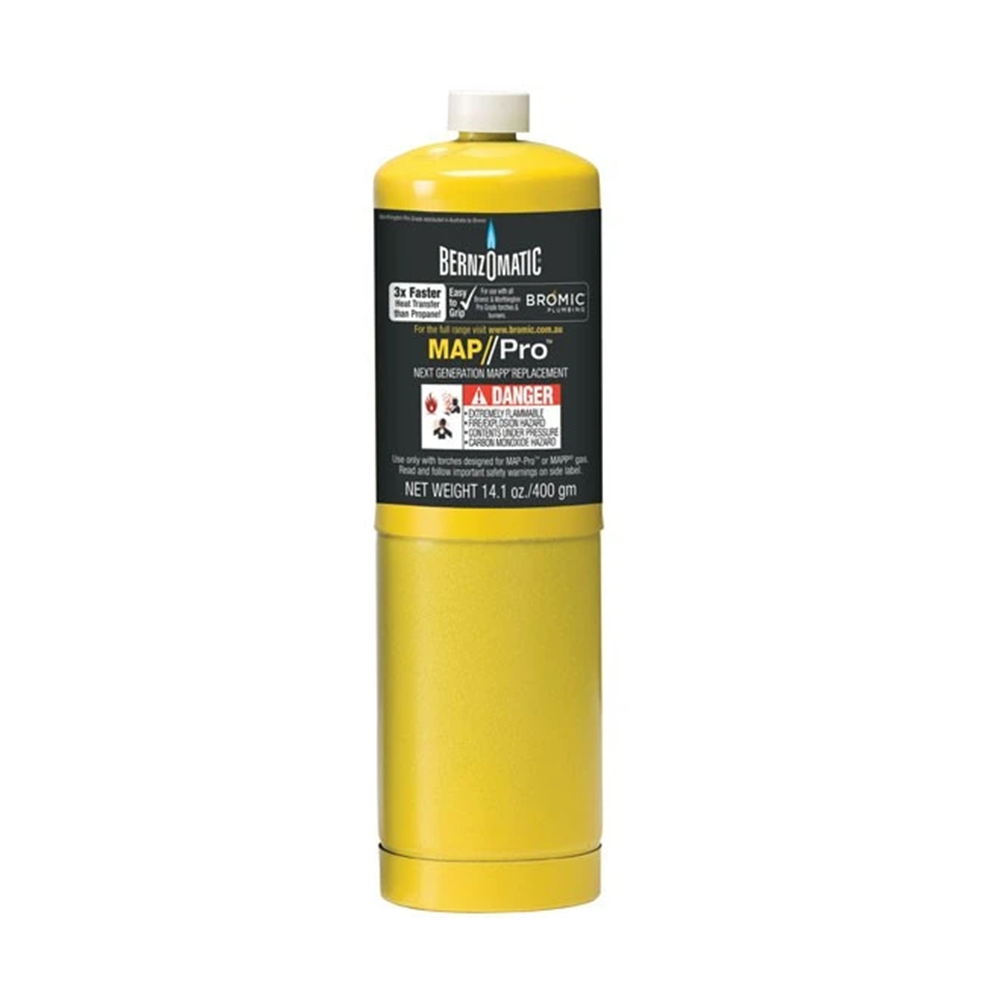
In today’s market, a lot of cylinders sold as “MAPP” are commonly MAP-Pro style fuels. You’ll also see the term “MAP-Pro gas” used directly.
The practical point is not memorising chemistry. The practical point is knowing you’re buying a high-heat torch fuel designed for fast heating and brazing tasks, and then confirming what the manufacturer states on the label and Safety Data Sheet.
If you want a clear “buy the exact thing” starting point, the simplest path is to view MAP-Pro gas cylinders and read the product description and documentation provided there. That’s the safest way to confirm what the supplier is selling right now in Australia.
Chemical composition explained (without the headache)
Here’s a simple way to think about it. These fuels are hydrocarbon-based torch gases designed to burn hot and transfer heat quickly to metal.
They are not refrigerants. They are not “special HVAC gases”. They’re fuels for a flame, and the job is to put enough heat into copper and brass to let your filler flow properly.
If you want to know “what is in MAPP gas” on a specific cylinder, the only reliable answer is on the cylinder label and the Safety Data Sheet for that exact product. If it matters for site rules or documentation, always confirm the exact product name and SDS rather than relying on what someone called it on site.
How to confirm what you’re actually buying (label, SDS, and thread)
This is the part that saves money and avoids the “wrong bottle” headache.
First, read the cylinder label like it’s a parts label. Don’t just look for the word “MAPP”. Look for the actual product name. Look for “MAP-Pro” or similar naming. Look for the safety and handling info. If it looks vague or the label is unclear, treat it as a sign to slow down and verify.
Second, check the Safety Data Sheet when you need certainty. If you’re on a site that cares about what you bring in, or you’re writing documentation for a contractor pack, the SDS is the cleanest “source of truth”. It will tell you what the manufacturer says the product is, and it keeps you out of arguments based on nicknames.
Third, do a quick thread and torch check before you buy in bulk. A lot of “mapp pro gas” frustrations are not about the fuel at all. They’re about the cylinder connection. If the torch and cylinder aren’t designed to match, you’ll waste time, risk leaks, and end up buying adapters you didn’t need.
The best habit is simple. Know what your torch is designed to take, then buy cylinders that match that system. If you’re mixing brands, don’t assume. Confirm.
What “MAP-Pro” naming usually means in-store
In-store, the naming can be confusing because people still say “MAPP” as a general term.
In many modern product lines, MAP-Pro is the name used for a hotter, high-performance torch fuel aimed at brazing and faster heating tasks. It’s commonly chosen because it can feel quicker than standard propane on copper joints.
The important point is not the marketing name. It’s consistency. If you find a cylinder that suits your torch, and you can get it reliably in your area, that matters more than whatever nickname the counter staff use.
Why HVAC pros choose it
HVAC techs choose MAPP or MAP-Pro style fuel for one simple reason: time-to-temperature.
When you’re brazing copper lines, especially when you’re working with thicker pipe, heat loss is the enemy. Copper pulls heat away fast. If your flame can’t keep up, you end up cooking the area for longer, which can make the job feel harder than it needs to be.
With a hotter, more aggressive fuel, you often get a joint that comes up to temp faster, which can make the braze feel cleaner and more controlled.
Australian product availability
In Australia, you’ll see MAPP/MAP-Pro style cylinders sold through a mix of trade suppliers and retail stores. Availability can change by city and season.
The key is not where it’s sold. The key is that you can get consistent supply, the cylinder fits your torch, and you can keep the same workflow across jobs.
If you’re running service calls across a big area, consistency matters even more. The best setup is the one you can restock without drama, so you’re not changing fuels and tips every second week.
Did You Know?
A lot of “MAPP” cylinders in the modern market are MAP-Pro style fuel. Don’t guess from the nickname. Confirm the exact product label and SDS if it matters for your site or your paperwork.
MAPP Gas vs Propane: Quick Comparison
This is the question most techs ask first: should I use MAPP/MAP-Pro or propane?
The honest answer is: both can work, but they win in different situations. The right choice depends on copper size, job speed, access, and how often you’re brazing.
To keep this practical, here’s a buyer-focused comparison. Flame temperatures are commonly quoted around 2020°C for MAPP/MAP-Pro in air and 1980°C for propane in air. Real-world results can vary by torch design, gas mix, and conditions, so treat the numbers as a guide and confirm your torch and fuel documentation if you need exact figures.
| Factor | MAPP / MAP-Pro style fuel | Propane | What it means on the job |
|---|---|---|---|
| Flame temperature (in air) | Often quoted around 2020°C | Often quoted around 1980°C | The headline difference is not massive, but the “feel” can be faster heat-up depending on torch design |
| Heat transfer and speed | Typically faster time-to-temp on copper joints | Can be slower on thicker copper or windy, cold conditions | Less waiting means easier control and less chance of overheating one spot while chasing temp |
| Typical HVAC use | Brazing copper lines, heating fittings, quicker work on service calls | General heating tasks, lighter brazing, budget-focused setups | If you braze often, speed and control matter more than small cost differences |
| Cost per cylinder | Often higher per disposable cylinder | Often cheaper and more widely available | Cheaper fuel can cost more if it slows you down or makes tough joints harder |
| When it wins | When you need faster heat-up, more control, and less waiting on copper | When you’re doing lighter work, occasional use, or cost is the main driver | Pick the fuel that matches your most common job, not the rare one |
If you want the longer version with more job examples and “when it goes wrong” scenarios, this detailed MAPP vs propane comparison expands on the real-world differences and the common mistakes techs make when switching fuels.
One simple rule helps: if propane keeps leaving you waiting on thicker copper, windy rooftops, or cold morning starts, that’s where MAPP/MAP-Pro style fuel often earns its keep.
Scenario: Windy rooftop service call
Wind is a silent killer for brazing. It strips heat away and can make your flame unstable.
On a rooftop repair in Sydney coastal air, propane can feel like it’s always “nearly there” but never quite gets the joint to the point where the filler flows nicely. You end up hanging around longer, and that’s where you start overheating nearby insulation or cooking one side while trying to get the other side ready.
MAP-Pro style fuels can help because you often get a faster heat-up and less waiting time. But the real win is still your setup. Shield the joint from wind where you can. Keep your flame consistent. Heat the fitting and tube evenly. If your flame is bouncing around, you’ll struggle no matter what cylinder you’re holding.
Scenario: Thick suction line or big heat sink joint
When you step up into thicker copper or a joint that’s connected to a big chunk of metal, the heat sink effect is obvious.
This is where people say propane “struggles”. What they really mean is the joint keeps stealing heat faster than the setup can deliver it. So the time-to-temperature blows out.
MAP-Pro style fuel often feels better here because you can bring the joint up faster, which helps the braze happen cleanly before you start cooking the area. The trick is not to point the flame straight at the filler. The trick is to heat the base metal properly, then let the filler flow where the heat is.
Scenario: Cramped ceiling space with tight clearances
In tight ceiling spaces, you’re often working close to timber, insulation, cables, or plaster.
In that situation, you don’t want a long, uncontrolled heat-up that warms everything around the joint. You want controlled heat in a short window so you can get in, complete the braze, and get out without turning the area into a hazard.
A hotter fuel can help you shorten the “hover time”, but it also means you must be more deliberate with flame distance and direction. This is where a stable flame and good habits matter more than ever. If you’re not set up to work safely in tight spots, changing fuel alone won’t fix it.
MAPP Gas Applications in HVAC
When people search “mapp gas for hvac”, they usually mean one thing: brazing copper lines.
That is the main use. But there are a few other legitimate HVAC applications where the same “faster heat” benefit can make jobs easier, especially when conditions are working against you.
Copper line brazing (main use)
MAPP/MAP-Pro style fuel is commonly used to braze refrigerant lines in split systems and ducted installs.
The goal is not brute force heat. The goal is controlled heating so your filler flows properly and you don’t cook the joint, oxidise the tube, or end up with a weak braze that leaks later.
If you want a step-by-step refresher that stays job-real, this guide on professional copper brazing techniques is built for HVAC work and focuses on clean joints and fewer call-backs.
A good habit for any fuel is to treat the braze like a process, not a moment. Prep and cleanliness first. Heat control second. Filler flow third. Cool down and inspection last. If you skip the first step, the last step usually bites you later.
Silver soldering fittings
Some HVAC-related fittings and repair tasks use silver soldering rather than standard brazing filler. The same principle applies: stable heat and control.
The fuel itself does not guarantee a good result. Your prep, cleanliness, and heat control do. But a fuel that brings the joint up to temp faster can reduce the “hovering” time where people tend to overheat one area.
On small fittings, the risk is the opposite of thick copper. You can overshoot quickly. That’s where your flame distance, movement, and patience matter.
Hard brazing refrigerant lines
On some jobs, you’re dealing with thicker copper or heat-sinking components that pull energy away fast.
This is where propane can feel like it’s struggling. A hotter torch fuel can make it easier to keep heat where you need it, so the braze completes cleanly rather than dragging out.
That said, if your torch tip is wrong for the job, even a hotter fuel will disappoint. A poor tip match can give you a flame that’s too narrow, too wide, or unstable. Fix the torch setup first, then judge the fuel.
Heating for bending
Heating copper to assist with careful bending can be useful in tight spots, especially when you’re trying to avoid kinks and stress points.
The key is to heat evenly and avoid cooking one point. Uneven heating can leave soft spots, thin spots, and ugly bends that vibrate later.
If you’re heating to bend, think “gentle, even warmth”, not “red hot”. In HVAC copper work, you’re trying to shape the line without weakening it or damaging nearby insulation.
Thawing frozen lines
In some colder locations or odd site conditions, you may need controlled heat for thawing.
This is one area where safety and common sense matter. Don’t wave a flame around blindly. Protect surrounding materials. Know what’s behind the line. And follow the site’s safety rules and your own risk controls.
If thawing is the job, your safest tool is often planning and protection. The flame is only part of it, and it’s never the part you want to use casually.
Australian climate considerations
Australia throws a mix of conditions at you.
In Brisbane humidity, jobs can feel slow and sticky, and you may be working in roof spaces where heat is brutal. On Sydney coastal jobs, wind and salt air can add hassles. In Melbourne cold snaps, early morning starts can make heating copper feel slower than usual.
The point is not that MAPP is “magic”. The point is that faster, more confident heat-up can help you stay in control when conditions are working against you.
And control is what protects your work. A joint that’s done calmly and cleanly is a joint that’s less likely to become a call-back later.
Pro Tip
If your braze joint keeps “taking forever”, don’t just blame the fuel. Check your torch tip, flame shape, wind exposure, and how much copper is acting like a heat sink. Fix the setup first, then choose the fuel.
Where to Buy MAPP Gas in Australia
When someone searches “buy MAPP gas Australia”, they usually want two things: stock availability and the right cylinder for their torch.
In Australia, you’ll generally see MAPP/MAP-Pro style cylinders sold through HVAC trade suppliers and also through major hardware retailers. The experience is different.
HVAC specialist suppliers vs Bunnings Warehouse
Buying from an HVAC supplier is often about consistency. You can usually get the right torch gear, the right fuel, and advice that matches HVAC work.
Buying from a major retailer like Bunnings Warehouse is often about convenience. You might grab a cylinder quickly, but you still need to confirm thread type and compatibility with your torch setup.
That’s why “mapp gas bunnings” can be a tricky search phrase. People find a cylinder, then find out it doesn’t fit their torch, or it’s not the fuel they thought it was.
The smart approach is to treat retail as a backup option, not your whole supply plan. It can save you in a pinch, but it’s not always the best path for standardising your kit.
MAP-Pro availability nationwide
Availability can change by location and season, so the best approach is to use a supplier that can support repeat purchases.
Most searches for a mapp gas supplier Australia are really about trade supply: can you restock the same cylinders consistently, and do they match your torch threads every time?
If you’re working across multiple suburbs or regional areas, supply consistency matters more than the “perfect deal”. You want to know you can restock quickly and keep your torch setup the same across jobs.
This is also where trade supply habits help. If your crew uses the same cylinders and torch threads, training is simpler, results are more consistent, and you don’t have techs turning up with random gear that doesn’t match.
Cylinder sizes (400g standard)
Many disposable torch cylinders in this category are commonly seen around the “400g” class, but sizes can vary depending on brand and pack options.
Instead of shopping by weight alone, shop by how you work. If you’re doing a lot of brazing in a week, pack options can save hassle and reduce “ran out mid-job” moments.
If you’re doing occasional repairs only, a smaller supply may be fine, but you still want a cylinder that matches your torch so you’re not wasting time on compatibility issues.
Bulk buying for contractors
If you’re running a crew, bulk buying is usually about consistency and fewer emergency stops.
A bulk pack can also help standardise your team’s workflow. Everyone uses the same cylinders, the same torch thread, and the same setup, so training and job results stay consistent.
It also helps with job planning. If you know the crew has enough cylinders for the week, you’re less likely to lose time to mid-job runs and “who’s got a spare?” phone calls.
Trade workflow tips that stop mid-job runouts
Mid-job runouts are rarely a “fuel problem”. They’re usually a planning problem.
A simple trade workflow is to track your weekly jobs and how many brazed joints you typically complete. After a couple of weeks, you’ll have a rough feel for how many cylinders you burn through in a normal month.
Once you know that, you can restock on a schedule instead of restocking in a panic. That’s when your cost per job becomes more stable and your work becomes smoother.
For a lot of teams, the best setup is the one that removes decisions. Same cylinder type. Same thread. Same torch style. Same habits. That reduces mistakes, and it reduces the chance someone brings the wrong bottle to site.
Price comparison tips (without the guessing)
It’s tempting to chase the cheapest cylinder.
But on HVAC jobs, the real cost is time and rework. If a cheaper fuel slows you down, causes messy heating, or leads to a dodgy joint that leaks later, it’s not cheaper.
A smarter approach is to compare your cost per completed job. How many joints did you do? How much time did heating take? Did you get clean flow? Did you avoid rework?
If you want a setup that’s simple to source as a package, browse portable gas torches and MAPP fuel so you can match torch and cylinder without guesswork.
And if you’re unsure what suits your workload, talk to our team to confirm compatibility and get a quote based on the types of systems you work on and how often you braze.
MAPP Gas Cylinder Specifications
This section matters more than most people think.
A lot of frustration with MAPP/MAP-Pro fuel comes down to one thing: the cylinder doesn’t match the torch, or the user assumed “any cylinder fits any torch”.
Here are the core specs and checks that keep you out of trouble.
CGA600 thread connection
Many small disposable torch cylinders in this category use the CGA600 style thread. That’s a common standard people refer to when they talk about “torch bottle threads”.
The practical check is simple. Confirm what your torch is designed for. Confirm what the cylinder is designed for. Don’t force it. Don’t “make it fit”.
If you want a known compatible package, this complete MAPP torch kit is a clean example of how a torch and MAP-Pro cylinder are matched as a set.
Disposable vs refillable
Most tradies using handheld torch cylinders are using disposable cylinders for convenience.
Refillable options exist in broader gas markets, but what matters here is safety and compatibility. Use the fuel system the torch is designed for. Follow the manufacturer guidance. And don’t improvise with adapters unless they are approved and you understand exactly what you’re doing.
If you’re ever unsure, default to the simplest safe rule: use the cylinder type the torch was built for, and keep your setup consistent across jobs.
Cylinder weight and capacity
A “mapp gas bottle” is often chosen based on size and portability.
A small cylinder is easy to carry to a rooftop unit or into a tight ceiling space. A larger supply can reduce changeovers, but portability matters on many HVAC jobs.
For contractors, pack options can make life easier. If you’re trying to reduce downtime, a bulk option like a MAP-Pro cylinders 12-pack can be a practical way to avoid being caught short.
Shelf life and storage
Most cylinders have a long shelf life when stored correctly, but storage still matters.
Don’t leave cylinders cooking in a hot ute for months. Don’t store them near ignition sources. Don’t store them in ways that damage valves or threads.
For general guidance on safe storage and workplace risk controls, follow workplace safety requirements and your site rules.
Compatibility with torches
Compatibility is not just the thread. It’s also the torch design and the flame you need.
If you’re mostly doing copper line brazing, you want a torch that delivers a stable flame that’s easy to control, not just a “big flame”.
If you’re stepping up into oxy-assisted work for tougher heat demands, that’s a different class of kit. In that case, torch and fuel choices should match your training, your job type, and your safety processes.
Common torch mismatch problems (and quick fixes)
If the cylinder won’t thread on smoothly, stop. Don’t force it. Cross-threading can damage the valve and create a leak risk, and it can wreck the torch connection so it never feels “right” again.
If the cylinder threads on but the flame is weak, uneven, or keeps fluttering, the issue might be the torch tip, the valve setting, or the way air is mixing. It can also be a sign the cylinder is near empty or the tool has a fault. Before you blame the fuel, check the simple things: is the tip clean, is the flame stable at different valve positions, and does the problem follow the torch or follow the bottle?
If you smell gas or hear a hiss at the connection, treat it as a hard stop. Don’t keep working and hope it “goes away”. Turn it off, disconnect safely, inspect the seal and threads, and only continue when you’re confident the setup is sound.
If you’re mixing brands and it becomes a constant hassle, that’s usually your answer. Standardise. Use one cylinder system and one torch style as your main kit so your gear behaves the same on every job.
Tech Specs
Before you buy, confirm three things: the cylinder thread, the torch compatibility, and the flame style you need for your common copper sizes. A mismatch here is the fastest way to waste money.
Cost Analysis: MAPP Gas Investment
MAPP/MAP-Pro fuel usually costs more per disposable cylinder than propane. That’s the reality.
But the smarter question is not “what’s the cheapest cylinder?” The smarter question is “what does it cost me per job when I include time and rework?”
Price per cylinder Australia (how to think about it safely)
Prices move around by brand, location, retailer, and whether you’re buying single cylinders or packs.
So instead of quoting a number that will go stale, use a simple framework. Compare your likely monthly usage and your time-to-complete on brazing tasks.
If MAP-Pro style fuel saves you time on every heat-up, the cost difference can be smaller than it looks.
It also helps to be honest about your work mix. If you braze once a fortnight, the “investment” question is different to a tech who brazes every day.
Cost per braze joint
Cost per joint is where the maths gets real.
If you use one cylinder across multiple jobs, work out roughly how many joints you complete before you replace it. Then divide your cylinder cost by your typical joint count.
Now compare that to what one call-back costs you. A return trip, lost time, and a cranky customer usually costs more than the difference between fuels.
Even if the leak isn’t “your fault”, you still lose time proving it. That’s why good brazing habits are worth more than small fuel savings.
Monthly usage for HVAC techs
Monthly use depends on what you do. Install-heavy techs use more. Service techs doing occasional repairs use less.
If you’re doing commercial work with regular brazing, planning your supply makes more sense than grabbing cylinders one at a time.
If you’re only doing occasional brazing, the goal is not bulk. The goal is still consistency. Same torch setup, same cylinder type, and good storage so the gear is ready when you need it.
ROI on faster heating
Return on investment is mostly about speed and control.
If you can complete joints faster and more cleanly, you reduce the temptation to “push” a joint when it’s not ready, which is when mistakes happen. Better control can also mean less overheating, less oxidation, and fewer ugly joints that become future leaks.
In Brisbane summer roof spaces, speed can also mean less time cooking in the heat. In windy coastal conditions, better heat-up can mean fewer frustrating restarts. In Melbourne winter starts, faster warm-up can mean you spend less time waiting for copper to cooperate.
There’s also a mental ROI. When your setup behaves the same every time, you stop second-guessing. You focus on prep and technique instead of blaming tools.
Trade account pricing
If you buy regularly, trade accounts and planned restocking can reduce hassle and smooth out your monthly spend.
If you’re moving into heavier-duty heating work where you want more output and different capability, a setup like the Bernzomatic Oxy MAP-Pro kit is an example of a higher-output option that suits specific use cases, as long as you confirm it matches your job needs and safety processes.
If you want help planning your supply and choosing the right setup, talk to our team to confirm compatibility and get a quote based on your usage and the type of brazing work you do.
Choose MAPP for Professional Work
If you want a clean summary, here it is.
MAPP/MAP-Pro style fuel is popular because it heats copper faster and can make brazing feel more controlled. That often means fewer delays, cleaner flow, and less frustration when the job conditions are working against you.
Propane still has a place. But when propane starts to feel slow on thicker copper, windy rooftops, or tight timeframes, that’s where MAP-Pro style fuel often becomes the better professional choice.
The key is doing it properly. Confirm what the cylinder actually is. Confirm the thread. Match the torch. Then use good technique, not brute force.
If you’re unsure what’s best for your workload, contact us for a quote or talk to our team to confirm compatibility. The goal is simple: faster, cleaner heating, fewer call-backs, and a brazing setup you can trust on every job.
When you’re ready, you can shop MAPP gas and torches Australia-wide and build a kit that suits how Australian HVAC techs actually work.