
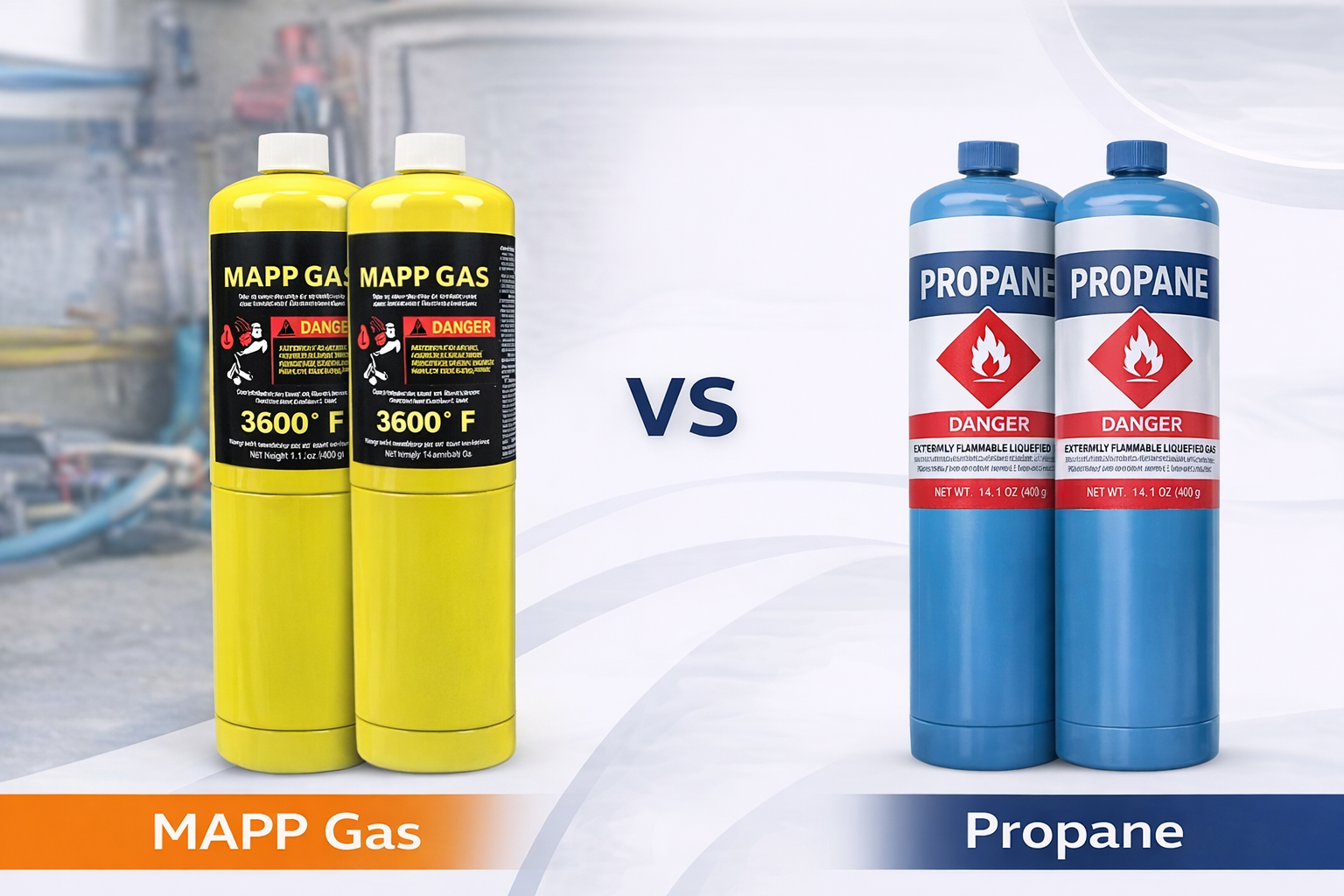
Choosing Your Brazing Fuel: MAPP Gas vs Propane
If you’re brazing copper lines, your fuel choice shows up fast. Not in the brochure—on the job. It shows up when the joint won’t come up to temp, when the wind keeps stealing your heat, or when a thicker suction line feels like it’s soaking your flame like a sponge.
This is exactly why "mapp gas vs propane" is such a massive debate among Aussie fridgies and HVAC tradies. You aren't chasing trivia; you want a setup that makes brazing easier to control, faster to knock out, and less likely to turn into a nightmare call-back.
Propane is cheap and everywhere. MAPP (often sold today as MAP-Pro style fuel) costs a bit more per bottle, but most tradies swear it "hits harder" on copper and feels quicker on the tools. Here is the no-BS, real-world comparison of when to use which.
Temperature: The Critical Difference
Let’s clear up the temperature numbers that everyone throws around.
In air, MAPP/MAP-Pro style fuel burns at about 2020°C, while propane sits around 1980°C. On paper, a 40°C difference looks like splitting hairs. So why does it feel so different on site?
Because flame temperature isn't the same as joint temperature. You don’t braze with a spec sheet. You braze by getting the copper tube and fitting into the working temperature zone so the silver filler flows cleanly.
- The Heat Sink Effect: Copper is a brutal heat sink. On a 1/4" liquid line, propane is easy. On a 7/8" suction line or a chunky brass valve body, propane can leave you waiting and hovering.
- Time-to-Temperature: MAPP/MAP-Pro gets the joint into the working zone faster. Less time hovering means better control, a cleaner flow, less oxidation inside the pipe, and a lower chance of melting nearby insulation.
- The Danger of Speed: Hotter fuel punishes sloppy technique. If you camp on one spot with MAPP, you’ll overheat the outside of the pipe before the inside is ready, leading to ugly, weak joints.
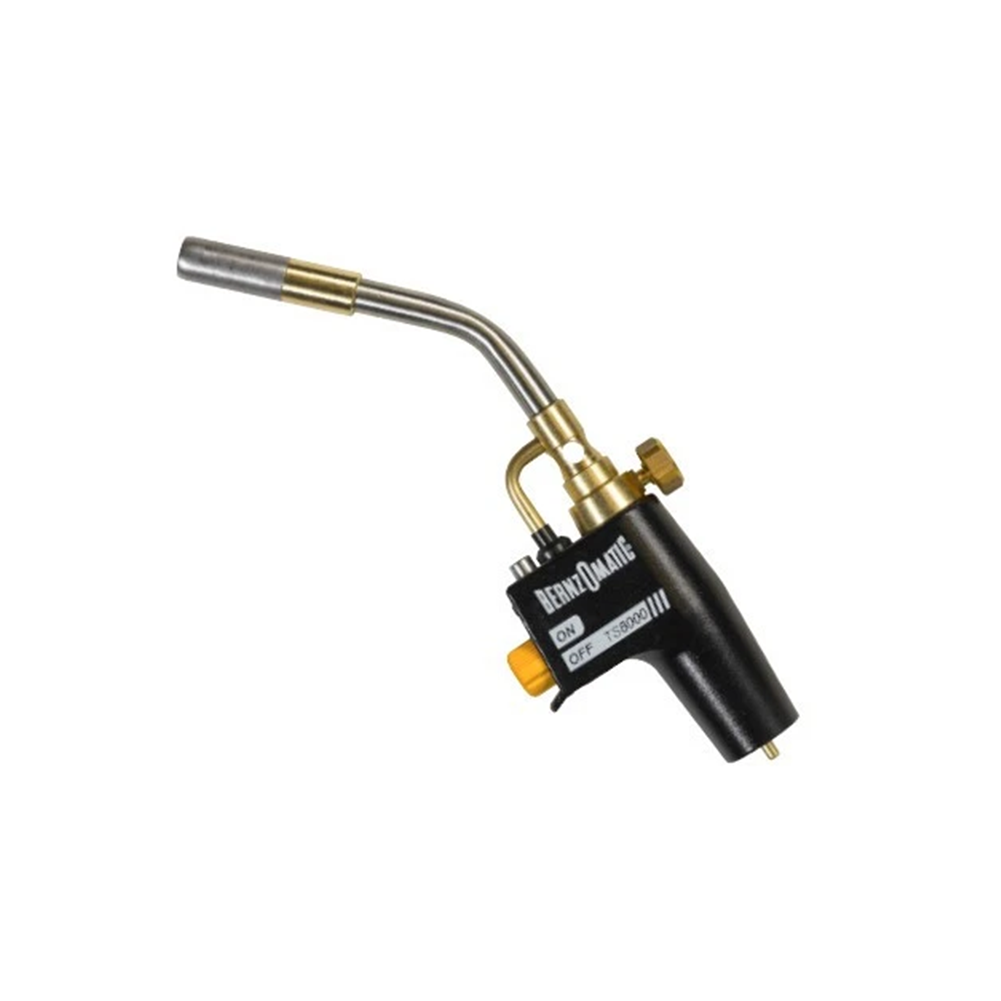
Did You Know? A lot of “MAPP gas” sold today is actually MAP-Pro style torch fuel, not the original older formulation mentioned in vintage training manuals. What matters most is how it performs on your copper sizes with your specific torch head.
Brazing Performance Comparison
Fuel is only half the battle—prep, fit-up, nitrogen purging, and heat control make the joint. But your fuel choice dictates how hard you have to work for it.
| Scenario | MAP-Pro / MAPP | Propane |
|---|---|---|
| Heat-Up Time | Faster to bring thicker copper into the working zone. | Slower on heavy joints, cold starts, and windy roofs. |
| Thin Copper (1/4") | Works great, but easy to overshoot if heavy-handed. | Very forgiving and excellent for small joints. |
| Thick Copper (7/8"+) | Confident and fast on big heat-sink joints. | Can feel like you're waiting forever; risks massive heat spread. |
| Flow Control | Shorter heat window equals cleaner flow and less oxidation. | Longer heating can oxidise the copper and dirty the joint. |
Cost Analysis: Time vs. Gas Money
Yes, propane is cheaper at the counter. But the real question is: Which one costs less per completed job when you factor in your labour?
If a $15 propane cylinder saves you 10 bucks but costs you an extra two minutes per joint on a massive VRV install, you are burning your "savings" in pure labour time. Ten slow joints equals 20 minutes lost. Do that all week, and propane just cost your business serious money.
The Break-Even Rule: In commercial HVAC, time is almost always your biggest expense. Buy the fuel that gives you speed, control, and limits fatigue late in the day.
Australian Climate Considerations
We don't braze in climate-controlled labs. We braze in real Aussie conditions:
- Windy Coastal Roofs: Sydney or Perth winds will strip the heat right off your pipe. MAPP fights the wind better by transferring heat faster.
- Cold Melbourne Mornings: Copper feels incredibly stubborn at 6:00 AM in the cold. MAPP cuts through the thermal lag.
- Brisbane Humidity: Humidity makes you sweat, get tired, and rush. A faster heat-up time reduces fatigue, meaning fewer sloppy joints at 4:00 PM.
Make Your Fuel Choice
Here is the bottom line:
- Stick to Propane if: You are doing light residential repairs, mostly working on 1/4" to 3/8" lines, or only braze occasionally. It's cheap, forgiving, and gets the job done.
- Upgrade to MAP-Pro if: You regularly hit 5/8" and 7/8" copper, work on windy roofs, tackle thick brass valves, or do multiple time-critical joints a day. It buys you speed and control.
Frequently Asked Questions (FAQ)
Is MAPP gas hotter than propane for brazing?
MAPP/MAP-Pro is commonly quoted at about 2020°C in air compared to propane at about 1980°C. However, on the job, the biggest difference you'll notice isn't the raw temperature, but the superior heat transfer and faster time-to-temperature at the joint.
Why does MAP-Pro feel faster on thicker copper?
Thicker copper and large brass fittings act like massive heat sinks. A MAP-Pro setup brings the joint into the optimal working zone much faster, which reduces your "hovering" time and makes controlling the flow of the filler metal much easier.
When should HVAC techs use MAPP/MAP-Pro instead of propane?
MAP-Pro is most useful when heat-up time is your main bottleneck. This includes working with larger copper sizes (usually 5/8 inch and up), executing multiple joints per day, dealing with windy rooftops, cold morning starts, or tightly scheduled time-critical work.
When is propane enough for HVAC brazing?
Propane is perfectly adequate for smaller copper sizes (like 1/4" or 3/8") and occasional brazing tasks where heat-up is easy. As long as you can work patiently with good flame control, wind shielding, and proper base-metal heating, propane will get the job done.
Is ‘MAPP gas’ sold today the same as older MAPP?
Usually, no. Many products sold as “MAPP” today are actually MAP-Pro style torch fuels rather than the original formulation you might read about in older training manuals. Always confirm the exact label and Safety Data Sheet (SDS) for your specific product.