
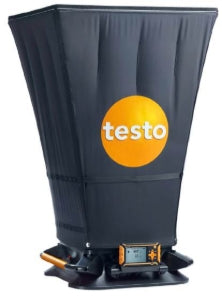
Volume Flow Measurement HVAC: Testo 420 Balometer Guide
Volume flow measurement sits at the centre of every HVAC commissioning job. Before a building can be handed over, before a facilities manager can sign off on a maintenance cycle, and before a TAB contractor can produce a report that holds up under scrutiny, someone has to put a calibrated instrument against every outlet and inlet and record what the system is actually delivering.
The Testo 420 is the instrument a growing number of Australian HVAC-R technicians and TAB contractors reach for on commercial jobs. It combines a digital differential pressure measuring instrument with a purpose-built capture hood, an integrated flow straightener for swirl outlet correction, and app-based data logging that takes the paperwork burden off the technician on-site. This guide covers how it works in practice, where it fits in a TAB workflow, and what makes it a practical choice for Australian commercial commissioning.
Written by Rica Francia Macaspac, HVAC Shop content writer, in consultation with Aussie HVAC tradies and industry experts. Published: June 2026 · Last reviewed: June 2026.

Why Volume Flow Matters in HVAC
Every HVAC system is designed around target airflow rates. Supply air volumes are calculated to maintain temperature, humidity, and air quality within a space. Return air volumes are balanced to maintain neutral or slightly negative pressure relative to corridors and adjacent zones. When the delivered volume doesn't match the design intent, the whole system underperforms, regardless of how well the refrigeration circuit or the hydronic plant is functioning.
In Australian commercial construction, commissioning requirements are embedded in the National Construction Code and referenced against AS 1668 for mechanical ventilation and AS/NZS 3666 for air handling systems in health-care premises. The Australian Standards framework sets the benchmark for what a compliant installation looks like, and volume flow verification is a core component of that benchmark. Without measured data, there's no compliant commissioning record.
Energy efficiency is the other driver. An HVAC system delivering 20 percent more air than designed is wasting fan energy and refrigeration capacity. One delivering 20 percent less may be failing to meet the ventilation rates required under the Building Code of Australia. Either way, the discrepancy creates a liability for the mechanical contractor and a performance problem for the building owner. Accurate volume flow measurement at commissioning catches both scenarios before handover.
For TAB contractors specifically, the measurement data also serves as professional protection. If a tenant complains about thermal comfort or air quality six months after handover, a complete commissioning record showing measured airflow at every outlet and inlet is the difference between a billable re-investigation and an expensive warranty dispute. That record doesn't just satisfy the building surveyor at handover. It protects the contractor for the life of the installation. View the full Testo HVAC instrument range to see how the 420 fits within a broader commissioning toolkit.
Testo 420 Balometer vs Mechanical Flow Hoods
The term balometer gets used loosely in the trade to cover any device that captures airflow from an outlet or inlet and derives a volume flow reading. Traditional mechanical balometers use a velometer or rotating vane anemometer inside a fabric hood, and the technician reads the result off an analogue dial or a basic digital display. They work, and plenty of experienced TAB contractors still use them. But the digital generation of instruments, with the Testo 420 as a current example, offers workflow advantages that are hard to ignore on larger commercial jobs.

The most significant difference is real-time data display with on-board averaging. Rather than reading a needle on a dial while also holding a hood against the ceiling, the technician sees a live digital readout on the instrument display and can initiate a timed measurement average with a single button press. The instrument does the averaging internally and stores the result. On a 200-outlet office fitout, this alone reduces the chance of transcription error significantly.
The Testo 420 air flow hood kit pairs the differential pressure measuring instrument with a capture hood in a complete package. Unlike a mechanical unit where the measurement element is fixed inside the hood, the Testo 420 separates the instrument from the hood, allowing the hood to be swapped for different outlet sizes without replacing the measurement unit. This is a practical consideration on mixed-outlet jobs where you're measuring both compact residential-style diffusers and large commercial return grilles on the same site.
App-based reporting is another genuine step forward. Testo's Smart Probes app, compatible with the 420 system, allows measurement data to be logged directly to a smartphone and exported as a formatted report on-site. For a TAB contractor, this means the commissioning documentation is effectively complete before you leave the building, rather than requiring hours of data entry back at the office from handwritten site notes.
Tradie Pro Tip: On large commercial jobs, app-based logging isn't just a convenience. It's an error-reduction tool. Manual transcription from a clipboard to a spreadsheet introduces mistakes that show up later as inconsistencies in the commissioning report. Digital logging from the instrument removes that step entirely.
Accuracy is the other comparison point worth addressing honestly. Both mechanical and digital balometers are subject to the same fundamental constraint: the measurement is only as good as the hood-to-outlet seal. A digital instrument with a poorly fitted hood will produce an inaccurate reading just as a mechanical unit will. The Testo 420 addresses this through its range of interchangeable hoods and integrated flow straightener, but correct hood selection and placement technique still matter. The instrument improves the measurement workflow. It doesn't substitute for good site practice.
Multi-Point Measurement Technique
Volume flow measurement through a capture hood is not a single-point spot reading. The airstream exiting a diffuser or grille is not uniform across the face of the outlet. Supply air velocity is typically higher near the centre of the diffuser and lower toward the edges. Return air grilles show a different but equally non-uniform distribution. A single velocity reading at one point in the airstream, multiplied by the outlet area, will not give you an accurate volume flow result.
The Testo 420 addresses this through multi-point measurement across the hood's internal sensing grid. Per Testo's technical documentation, the instrument takes readings across sixteen measurement points distributed across the hood face, then derives an averaged velocity from which volume flow is calculated. This approach accounts for the non-uniform velocity distribution that is inherent in real diffuser discharge patterns, rather than assuming a uniform profile that doesn't exist in practice.

The sixteen-point measurement grid is a function of the sensing element inside the hood, not a procedure the technician carries out manually. The instrument handles the multi-point averaging internally during the measurement period. What the technician needs to do is hold the hood steady against the outlet for the full measurement duration and ensure the hood is fully seated with no edge gaps. Movement during the measurement period introduces velocity variation that corrupts the averaged result.
Flow straightener technology addresses the other major source of measurement error at swirl outlets. Swirl diffusers, which are common in modern commercial HVAC designs because they improve air mixing and reduce stratification, discharge air in a rotating pattern. If that rotating airstream enters the hood without correction, the sensor registers a lower velocity than the actual discharge velocity because the swirl component partially cancels across the measurement plane. The integrated flow straightener, a mesh baffle built into the hood assembly, breaks up the rotation before the airstream reaches the sensor and produces a representative reading.
For technicians working on modern commercial fitouts in Queensland or Western Australia where swirl diffusers are specified on most new office builds, this correction matters on a large proportion of outlets measured. Using a hood without flow straightener capability on a swirl outlet produces readings that understate actual flow, which then affects every balancing decision made downstream. The Testo 420 differential pressure measuring instrument and its hood accessories are designed to handle this as standard, not as an optional extra.
Tech Specs: The Testo 420 uses a differential pressure measurement principle rather than a direct velocity sensor. The hood converts the airstream into a measurable pressure differential across the sensing element, from which the instrument derives velocity and then volume flow. Confirm the full technical specification against the current Testo 420 datasheet before commissioning, as Testo may update specifications between production runs.
TAB Contractor Workflows
Testing, Adjusting, and Balancing is the systematic process of verifying and correcting airflow across an HVAC system to achieve the design intent. For a TAB contractor, every job follows a broadly similar sequence: gather design data, measure existing conditions, compare measured to design, adjust to bring the system into balance, re-measure to verify the adjustment, and document the results. The Testo 420 fits into this workflow at the measurement steps, but the way it handles data makes it useful across the full sequence.
Design Verification
Before any adjustments are made, the TAB contractor measures what the system is actually delivering at each outlet and inlet. This first-pass measurement creates a baseline that shows how far the as-installed system is from the design schedule. Discrepancies at this stage are expected. Ductwork as installed rarely matches the design model precisely, and fan duty points shift with real-world static pressure conditions. The baseline measurement tells you where to start adjusting.
The Testo 420 305x1220mm flow hood is the standard starting point for most commercial office fitouts where linear slot diffusers are the predominant outlet type. Having the right hood on the van from the first visit avoids the time cost of returning with a different size after finding the diffuser dimensions don't match what the drawings showed.
| TAB Stage | What You're Doing | Testo 420 Role | Key Output |
|---|---|---|---|
| Design Verification | First-pass measurement of all outlets and inlets | Measure and log baseline volume flow at each point | Baseline dataset vs design schedule |
| Adjustment | Set dampers and VAV boxes to bring flows to design | Real-time display during damper adjustment | Adjusted flow at each outlet |
| Verification | Re-measure after adjustment to confirm balance | Logged final readings for commissioning record | Verified flow data for report |
| Issue Troubleshooting | Investigate specific zones with comfort complaints | Targeted measurement to isolate underperforming outlets | Identified fault zone and corrective action |
| Performance Documentation | Produce commissioning record for handover | Export logged data as formatted report via app | Compliant commissioning documentation |
Live Adjustment and Re-verification
The adjustment phase is where real-time display makes the most difference. When a technician is setting a manual damper, they need to see how the flow at the outlet changes as the damper moves, without removing the hood and walking back to a central display each time. The Testo 420's live readout, visible on the instrument panel while the hood is positioned against the outlet, allows single-person damper adjustment and flow verification on the same visit.
On VAV systems, the adjustment conversation is with the BMS rather than a physical damper, but the measurement workflow is the same. Measure, log the result, request a BMS setpoint change, measure again to verify the change landed where it should. The Testo 420 stores readings in sequence, so the before-and-after comparison is already in the instrument memory when you step back from the outlet.
Issue Troubleshooting
Post-handover complaints about thermal comfort or air quality are a regular part of life for any mechanical contractor or facilities maintenance team. The instinct is often to assume the refrigeration side of the system is at fault, but the issue is frequently in the air distribution. A single blocked VAV box, a partially closed fire damper that didn't re-open after a test, or a zone that was balanced for cooling season and never re-set for heating can create comfort complaints across an entire floor.
Using the Testo 420 to take a targeted measurement set across the complaint zone is a fast way to determine whether the air distribution matches the design intent. If the flows are correct, the problem is upstream in the refrigeration or hydronic plant. If they're out of balance, you've found the fault without pulling any plant apart. This diagnostic capability is one of the underappreciated use cases for a quality balometer beyond initial commissioning.
Commercial Building Applications
The Testo 420 is applicable across the full range of Australian commercial building types, but each application type has its own measurement priorities and practical challenges.
Office Buildings
Commercial office fitouts in Australian capital cities are the most common context for TAB commissioning work. Ceiling heights vary from around 2.7 metres in older stock to 3.5 metres or more in premium grade buildings. Linear slot diffusers are the dominant outlet type in both cases, and a standard rectangular hood handles the majority of supply outlets. Return air grilles are typically larger square or rectangular units, often requiring a different hood size from the supply measurement.
On multi-tenant floors with mixed-use zoning, the TAB contractor may be working across multiple VAV zones in a single visit. The app-based logging in the Testo 420 system allows measurements to be organised by zone as they're taken, rather than requiring post-visit sorting of a paper-based data set. This is particularly useful on large Sydney CBD fitouts where tenant demarcation means commissioning documentation needs to be zone-specific for the base building owner.
Healthcare Facilities
Healthcare is the application where volume flow measurement carries the most regulatory weight. Operating theatres, intensive care units, and isolation rooms operate under positive or negative pressure differentials that are maintained by precisely controlled supply and return airflow rates. AS/NZS 3666 applies to air handling systems in health-care premises, and commissioning of these systems requires documented verification of airflow at each supply and return point.
The challenge in healthcare is access and scheduling. Measurement in occupied clinical areas often requires out-of-hours access, and every measurement point needs to be completed accurately on the first attempt because the opportunity to return may be weeks away. Having an instrument that stores readings internally and produces a formatted report immediately reduces the risk of data gaps that require a repeat visit.
The Testo 420 telescopic stand, extending to 4 metres with wheels for repositioning, is particularly useful in healthcare plant rooms and large-volume spaces where ceiling heights exceed comfortable hand-held reach. One-person operation with the stand reduces the site staff required for measurement, which matters in restricted-access clinical areas.
Education Centres
Schools and universities present a high outlet count across many rooms of similar configuration. A typical secondary school may have 30 to 50 classrooms each with four to eight supply and return points. The measurement task is repetitive but the outlet dimensions are consistent, which makes it well-suited to a systematic hood-and-log workflow. The time saving from app-based data logging versus manual transcription is most apparent on this type of job.
Data Centres
Data centre HVAC is specialised, but volume flow measurement is still a commissioning requirement. Precision air conditioning units, in-row cooling systems, and perforated floor tile airflow all need to be verified and documented. Perforated floor tile measurement is a specific application the Testo 420 can address using the appropriate hood configuration, and the differential pressure measurement principle is well-suited to the high-velocity airstreams common in data centre underfloor plenums.
Reporting and Documentation
The commissioning report is the deliverable that matters to the client, the building owner, and the building surveyor. For the TAB contractor, producing a complete, accurate, and professionally formatted report efficiently is as important as the measurement work itself. A technically excellent commissioning that takes three days of office time to document is not a commercially sustainable practice.

The Testo Smart Probes app integrates with the Testo 420 system to allow on-site protocol generation. As measurements are taken, they are logged against the outlet reference from the measurement schedule, and the app assembles these into a formatted report structure that can be emailed directly from the jobsite. For straightforward jobs, the report can be in the client's inbox before the technician has packed up the van.
Data archiving is the other documentation benefit. App-stored measurement records create a timestamped, location-tagged data set that serves as an audit trail if commissioning results are queried later. In the context of an Australian commercial building dispute, where questions about original commissioning may arise years after handover, having digitally archived measurement records is significantly stronger evidence than reconstructed site notes.
Compliance proof is increasingly required as part of building certification under the National Australian Built Environment Rating System (NABERS) and Green Star frameworks. Volume flow verification at commissioning is one of the documented requirements for buildings pursuing energy efficiency ratings. The ability to export measured flow data in a format suitable for inclusion in a NABERS or Green Star submission adds practical value beyond the mechanical commissioning process itself.
For mechanical contractors and TAB specialists working across multiple commercial projects, the full air balancing hood range at HVAC Shop covers the complete Testo 420 accessory set. Talk to our team to confirm which hood sizes suit your typical project mix, or to discuss trade pricing on multi-unit orders for larger commissioning businesses.
Did You Know? NABERS energy ratings for commercial office buildings require verified fresh air delivery rates as part of the Indoor Environment assessment. Volume flow measurement data collected with a calibrated balometer at commissioning can directly support this submission, provided the instrument and measurement procedure meet the applicable standard. Confirm against current NABERS technical requirements for your specific building type.
Frequently Asked Questions