
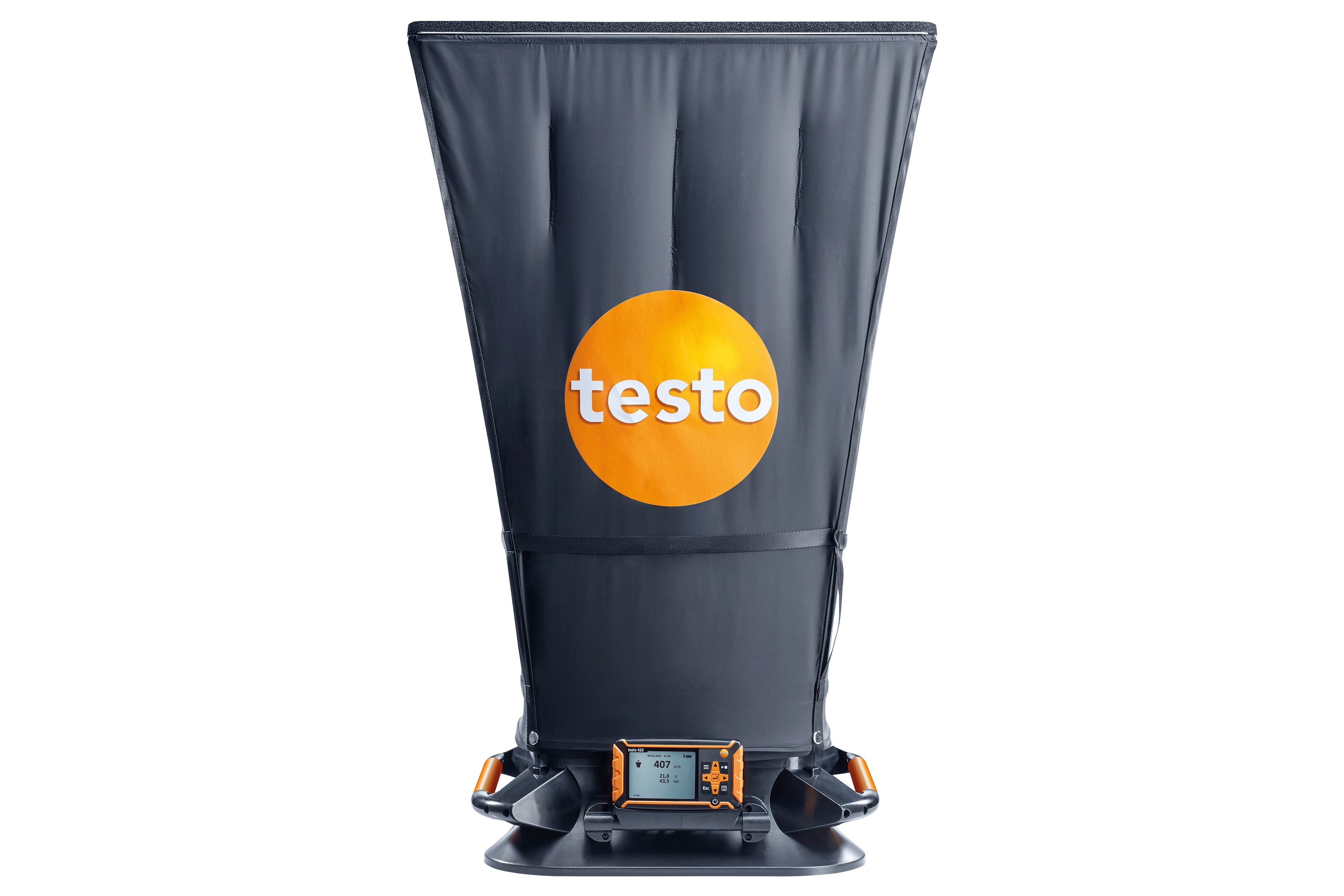
Testo 420 Flow Hood: Air Inlet/Outlet Measurement Guide
Getting airflow readings right matters on every commissioning job. Whether you're balancing a multi-storey office in Brisbane, fine-tuning a retail fitout in Perth, or commissioning a new rooftop pack on a Sydney CBD building, an accurate volume flow measurement starts with one thing: the right hood on the right outlet.
The Testo 420 is a purpose-built volume flow measuring instrument for HVAC-R applications. But the instrument itself is only part of the system. The measurement hood is the textile capture hood that fits over the grille or diffuser, and it directly determines whether your reading is accurate or garbage. A hood that's too small for a large supply plenum, or too big for a compact residential outlet, introduces leakage or turbulence error that no amount of correction factor will fully recover.
This guide walks through the full Testo 420 hood range, explains which size suits which application, covers hood maintenance and changeover, and gives you a practical comparison table to match the hood to the job before you're standing on a scissor lift mid-commissioning.
Written by Rica Francia Macaspac, HVAC Shop content writer, in consultation with Aussie HVAC tradies and industry experts. Published: June 2026 · Last reviewed: June 2026.

Why Replacement Hoods Matter More Than You Might Think
The textile hood is the interface between the instrument and the airstream. If that interface doesn't match the outlet, the measurement is compromised before the Testo 420 even takes a reading. It's the same principle as using the right probe for the right application: the tool is only as accurate as the attachment you fit to it.
HVAC grilles and diffusers come in a huge range of shapes and sizes across Australian commercial and residential builds. Standard square diffusers, long linear slot diffusers, large return air grilles, ceiling plenums and swirl outlets each have different dimensions and airflow characteristics. A single hood size won't serve all of them.
Measurement accuracy loss from a mismatched hood is real and significant. If the hood is too small for the outlet, uncaptured airflow escapes around the edges and your reading understates the actual flow. If the hood is oversized, turbulence inside the hood disrupts the sensor and readings become unreliable. Neither failure mode gives you a number you can sign off on.
The Testo 420 305x1220mm flow hood is one of the most common starting points for commercial linear diffuser work, but it's one of four hood sizes across the range. Selecting the right one from the outset saves you repeat site visits, arguments with the building manager, and commissioning reports that don't stack up.
Swirl outlets add another layer of complexity. Swirl diffusers are increasingly common in modern commercial builds because they discharge air in a rotating pattern to improve mixing. They require specific swirl correction capability from the hood and instrument combination. Using a standard hood on a swirl outlet without applying correction will give you a reading that's measurably off. The Testo 420 system addresses this, but only when the correct hood is fitted and the right measurement mode is selected.
Tradie Pro Tip: Before ordering a replacement hood, photograph the outlet with a tape measure in frame. This takes 30 seconds on-site and saves you ordering the wrong size, especially on large jobs with mixed diffuser types across different zones.
Small Hood: 360x360mm Applications
The Testo 420 360x360mm flow hood is the compact option in the range, designed for smaller square diffusers and tighter installation spaces. It suits residential split system outlets, compact cassette units, and smaller commercial diffusers where a larger hood simply won't fit cleanly against the ceiling.

Per the Testo datasheet, this hood is suited to outlets with a minimum face dimension of 335x335mm. Below that, you're looking at poor hood-to-grille contact and edge leakage that will skew your reading. If the outlet is right on the boundary, measure twice and assess whether the seal is solid before logging the result.
Weighing approximately 2.9kg, this is the lightest hood in the 420 range. That matters on residential jobs where you're working a standard step ladder rather than a platform, or on apartment fitouts in narrow ceiling voids where you're reaching rather than standing square. Less mass on the end of an extended reach makes a practical difference over a long day.
The 360x360mm hood includes an integrated flow straightener, which is the internal mesh baffle that corrects for swirl turbulence from swirl-type diffusers. This is a key spec to understand. Without it, swirl outlets produce artificially low readings because the rotating airstream partially cancels itself out across the sensor. The integrated straightener breaks up the rotation before the airstream reaches the measurement plane.
For apprentices getting started with volume flow measurement: swirl diffusers are identifiable by their angled vanes, where the blades are set at an angle to deliberately rotate the supply air. If you can see that rotating pattern in the discharge, assume you need swirl correction and confirm with your supervising tech before logging the reading.
Medium Hoods: 305x1220mm and 610x1220mm
Linear slot diffusers are the dominant supply air outlet type in Australian commercial construction. You'll find them running the perimeter of office floors in Melbourne CBDs, along the internal corridors of hospital wings, and installed in long runs across QLD shopping centre food courts. They're narrow, long, and they need a rectangular hood rather than a square one.
The Testo 420 305x1220mm hood is the narrower of the two medium options. At 305mm tall, it suits slot diffusers with a short face height, which is a common configuration in ceiling-mounted linear grilles where the outlet depth is limited by the ceiling void above. The 1220mm width covers a full 1.2 metre run in a single measurement, aligning with the standard 1200mm linear diffuser module used across most Australian commercial fitouts.

The Testo 420 610x1220mm hood doubles the face height to 610mm. This suits taller linear diffusers, including wall-mounted linear grilles in plant rooms and return air grilles on perimeter walls in commercial buildings. It's also the right choice where a standard 305mm hood won't fully seal against a wider-faced outlet without edge gaps.
The decision between 305mm and 610mm comes down to the outlet face height. Measure it physically before you attend site if you're working from shop drawings, then verify against the installed diffuser on arrival. Drawing dimensions and installed dimensions don't always match, particularly on older buildings that have been refitted more than once.
Tech Specs: Both rectangular hoods incorporate the same integrated flow straightener as the square hoods. Swirl correction applies to linear slot diffusers with angled vanes, which are increasingly common in energy-efficient commercial HVAC designs. Confirm the diffuser type on the mechanical schedule before arriving on-site.
One practical note for jobs in coastal areas: the textile hood fabric on any Testo 420 hood can pick up airborne salt and dust in environments like Gold Coast beachfront high-rises or WA mining accommodation villages. Clean the hood after every job on coastal or dusty sites. More detail on that is covered in the maintenance section below.
Large Hood: 915x915mm
Some jobs don't fit standard diffuser dimensions. Large commercial supply plenums, oversized return air grilles in plant rooms, and ceiling-mounted return air boxes in large open-plan warehouses or hospital departments can push well beyond the 360mm square or 610x1220mm rectangular range. For these applications, the Testo 420 915x915mm large flow hood is the appropriate tool.

At 915mm square, this hood covers supply and return outlets that appear regularly in large commercial and industrial builds. Distribution centres with high-volume fresh air systems, hospital operating theatres with oversized ceiling supply diffusers, and data centre cooling infrastructure where large-face supply grilles are standard all fall into this category. These aren't edge cases. They're common in any mechanical contracting business doing commercial work above a certain scale.
Handling a hood this size changes your site setup. The 915x915mm hood is significantly heavier than the compact options, and raising it against a ceiling outlet at height requires a stable platform. The Testo 420 telescopic stand, which extends up to 4 metres and includes wheels, is the purpose-built solution for this. It allows one-person operation even at ceiling heights that would otherwise need a second person to stabilise the hood while you lock in the measurement.
The stand matters more than it might seem. Holding a large hood against a high ceiling outlet with one hand while operating the instrument with the other is awkward, fatiguing, and introduces movement error into the reading. A wheeled stand locks the hood position and lets you focus on the measurement.
| Hood Size | Typical Application | Stand Required? | Swirl Correction | Where Common in AU |
|---|---|---|---|---|
| 360x360mm | Compact square diffusers, residential outlets, cassette units | No, hand-held is practical | Yes, integrated flow straightener included | Apartments, retail tenancies, residential HVAC |
| 305x1220mm | Standard linear slot diffusers, ceiling-mounted linear grilles | Recommended at height | Yes, integrated flow straightener included | Commercial offices, healthcare, education |
| 610x1220mm | Taller linear grilles, wall-mounted returns, wide-face linear diffusers | Recommended at height | Yes, integrated flow straightener included | Commercial fitouts, plant rooms, corridor returns |
| 915x915mm | Oversized square diffusers, supply plenums, large return air grilles | Yes, stand strongly recommended | Yes, integrated flow straightener included | Hospitals, data centres, warehouses, large commercial |
All hoods in the Testo 420 range include the integrated flow straightener. This is consistent across the full size range, not just the compact option. Confirm specifications against the current Testo datasheet for your specific hood model before commissioning, as Testo may update specifications between production runs.
Hood Changeover and Maintenance
One of the practical advantages of the Testo 420 system is tool-free hood replacement. Switching between hood sizes on a mixed job, such as a hospital fitout with both compact bedroom diffusers and large corridor return grilles, doesn't require you to carry a tool kit just to reconfigure the instrument. The hood connects and releases without fasteners.
In practical terms, a hood changeover on a well-maintained set takes about a minute. That includes re-checking that the replacement hood is seated correctly before you re-engage the instrument. It's worth noting when you're quoting commission time on jobs with multiple diffuser types. The changeover itself isn't a significant time cost, but it's better to build it into your schedule than to discover the need for it mid-floor.
The Testo 420 telescopic stand also helps with changeover on large hoods at height. Rather than lowering the instrument and hood assembly to ground level for every change, the stand holds the instrument steady at ceiling height while you detach and reattach the hood. On a job with 40 or 50 outlets to measure, that efficiency adds up across the day.
Cleaning the Flow Straightener
The integrated flow straightener is the internal mesh baffle and the component most likely to degrade measurement accuracy if it's not maintained. Dust, lint, and fine particulate from the HVAC system accumulate on the mesh over time, increasing restriction and changing the flow profile inside the hood.
Clean the straightener after every job, or at minimum after every site where the system was running with visible contamination. On construction sites in Darwin or dusty regional NSW farm sheds where ductwork can carry significant particulate, clean it between measurement sessions on the same job.
Testo's guidance is to remove the flow straightener from the hood for cleaning. Use compressed air to blow through from the clean face, not the contaminated face. Blowing from the wrong direction pushes debris deeper into the mesh rather than clearing it. For the textile hood fabric, check for tears or deformation after every session. A small tear causes edge leakage that introduces systematic error into every reading taken with that hood.
Storage Between Jobs
Textile hoods should be stored flat or loosely rolled rather than compressed under weight. Permanent creasing in the hood fabric can create airflow channels along the fold lines that produce repeatable but inaccurate readings. In high-humidity climates like coastal QLD, store hoods in a dry environment between jobs to prevent mould growth on the fabric.
The rigid frame of the hood is typically aluminium. Check it for distortion after transport, particularly if the hood has been knocked or compressed in a vehicle. A distorted frame won't seal cleanly against the outlet face and introduces the same leakage error as an undersized hood.
Tradie Pro Tip: Run a quick visual inspection of the frame and fabric before every measurement session. Two minutes pre-job is faster than re-measuring 20 outlets because your commissioning report gets queried by the mechanical engineer.
Hood Comparison: Which Size for Your Job
Matching the hood to the job isn't complicated once you know what to look for. The core question is always the same: what are the face dimensions of the outlet you're measuring, and what is the discharge pattern, standard or swirl?
For square or near-square outlets up to roughly 335mm on the short edge, the 360x360mm hood is your starting point. Below that minimum face dimension, no hood in the range will seal reliably, and you'll need to consult the Testo datasheet for alternative measurement approaches.
For rectangular linear diffusers, which are the most common configuration in Australian commercial construction, the 305x1220mm and 610x1220mm hoods cover the majority of installed product. The height dimension of the outlet face is the differentiator. If the outlet face height is closer to 300mm, go with the 305mm hood. If the face is taller, up to around 600mm, step up to the 610mm option.
For large square outlets including supply plenums, oversized return grilles, and ceiling diffusers in high-volume spaces, the 915x915mm hood handles the applications that fall outside the other sizes. These are less common but are frequent enough in commercial mechanical work that carrying or having access to the large hood is practical for any contractor doing diverse commercial work.
If you're unsure which size to stock, or you're fitting out your first Testo 420 kit for a specific project, our team can help you work through the outlet schedule for your job. View the full air balancing hood range online, or get in touch to discuss your application. This is especially useful if you're dealing with non-standard outlet dimensions or mixed diffuser types across a large commercial site.
For B2B procurement across multiple sites or ongoing commissioning contracts, it's worth discussing trade pricing on hood sets with our team directly. Stocking one of each size is common practice for mechanical contractors with a diverse commercial client base. You don't want to turn up to a hospital commission with only the compact hood in the van.
For further product specifications across the Testo 420 system, refer to the Testo Australia official site to confirm current datasheet details and any updates to the hood range since this guide was published.
Frequently Asked Questions