
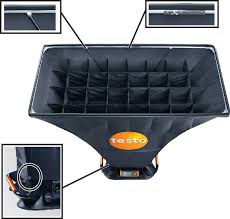
Testo 420 Flow Hood: Complete Guide for HVAC Air Balancing
Air balancing is one of the most technically demanding tasks in commercial HVAC commissioning. Getting the airflow right at every grille and diffuser across a building is not a matter of estimating or adjusting by feel. It requires a calibrated volume flow measurement instrument that can capture real airflow figures and log them for the commissioning report.
The Testo 420 is a professional flow hood designed for exactly this work. It measures volume flow at supply and return air outlets, handles differential pressure measurement for filter checks and duct static pressure, and connects wirelessly to the Testo Smart App for on-site data logging and report generation.
Browse the full Testo HVAC tools range at HVAC Shop to see the complete Testo 420 lineup including hoods, accessories and kits.
Written by Rica Francia Macaspac, HVAC Shop content writer, in consultation with Aussie HVAC tradies and industry experts. Published: June 2026 · Last reviewed: June 2026.

What Is the Testo 420 Flow Hood
A flow hood, sometimes called a balometer or capture hood, is a measurement instrument used to determine the volume of air moving through a supply or return air grille. It works by capturing all of the air coming out of or going into an outlet and measuring the differential pressure across an integrated flow grid. That pressure reading is then converted into a volume flow figure, typically expressed in cubic metres per hour (m³/h) or litres per second (L/s).
The Testo 420 handles volume flow measurement across a wide range, from 80 m³/h at the low end up to 3,500 m³/h at the top. This covers most supply and return air outlets encountered in residential, commercial and light industrial HVAC work across Australia.
The instrument includes flow straightener technology built into the hood. Flow straighteners correct for swirling or turbulent air at the outlet face before the measurement is taken. This is particularly important at swirl diffusers, which are commonly installed in commercial office buildings and produce highly turbulent discharge patterns that would give inaccurate readings on a basic hood without correction.
Automatic zeroing is another practical feature. Before each measurement sequence, the instrument zeroes the differential pressure sensor automatically, eliminating offset errors from changing ambient temperature or barometric conditions. On a long TAB day across multiple floors of a commercial building in Brisbane or Sydney, this keeps your readings consistent from the first outlet to the last.
The hood itself is a separate component from the measuring instrument. Testo supplies the 420 in several hood sizes to suit different grille dimensions, and the hood can be swapped out without tools. The instrument records the measurement and the correct flow correction factors are applied based on the hood size in use.

The Testo 420 complete flow hood kit with measuring instrumentTesto 420 Air Flow Hood Kit Includes Hood - 0563 4200 includes the instrument and a standard hood, giving you everything needed to start TAB work immediately. Individual hoods and accessories are available separately for expanding the kit.
Testo 420 Replacement Hood Sizes
Selecting the right hood size is the first practical decision when setting up a Testo 420 for a job. The hood must completely cover the outlet face to capture all of the supply or return air. A hood that is too small will miss airflow around the edges. A hood that is significantly larger than the outlet will still work, but the larger the hood relative to the outlet, the more leakage potential there is at the edges.
Testo supplies the 420 in five hood sizes. Each is designed for a specific range of outlet dimensions commonly encountered in HVAC installations. Choosing the right size for your typical work before arriving on site saves time and avoids the need to re-measure after discovering your hood does not fit the installed grilles.

| Hood Size | Typical Application | Key Notes |
|---|---|---|
| 360 x 360mm | Small supply and return grilles, residential and light commercial | Compact and lightweight; suits tight ceiling spaces |
| 305 x 1220mm | Linear slot diffusers and elongated return air grilles | Designed for long narrow outlets common in commercial fit-outs |
| 610 x 1220mm | Medium commercial supply and return outlets | Covers the most common commercial grille size range |
| 915 x 915mm | Large commercial and industrial outlets | Suited to oversized diffusers and large return air transfers |
| 1200 x 1200mm | Very large commercial and industrial outlets | Maximum coverage for high-flow industrial applications |
For most commercial office and retail work across Australia, the medium 610x1220mm hood for commercial buildings covers the widest range of installed grille types. It handles the majority of supply air diffusers and return air grilles found in standard commercial fit-out work.
For residential and small commercial work where grilles are smaller and ceiling access is tighter, the small 360x360mm flow hood for compact grilles is the practical choice. Its lighter weight and smaller footprint make it easier to handle on step ladders and in low-ceiling spaces.
For larger commercial buildings with oversized supply air outlets, industrial warehouses in QLD or Darwin, or any installation using large ceiling cassette diffusers, the large 915x915mm hood for oversized outletsTesto 420 Hood 915 x 915 mm is the correct tool. Using a hood that is too small on a large outlet will consistently underread the actual flow.
Each hood includes the flow straightener grid built in. The flow straightener is not an optional accessory. It is a structural part of the hood that reduces turbulence and corrects for swirl at the outlet face before the measurement grid samples the air. Without it, swirl diffusers will give readings that bear little resemblance to actual volume flow.
Tradie Pro Tip: If you're commissioning a building with a mix of grille sizes, it's worth carrying two hood sizes on site. Starting a job only to find your hood is too small for half the outlets wastes a day. Check the drawings or the installed grille dimensions before you arrive and pack accordingly.
Testo 420 Accessories and Stand
The Testo 420 is designed for practical TAB work in commercial buildings where ceiling heights vary, multiple floors need to be covered in a single day, and the instrument needs to be repositioned dozens of times. The right accessories make this feasible without a second person on site.
The most important accessory is the telescopic stand for hands-free operationTesto 420 Telescopic Stand up to 4m with Wheels. This stand extends up to 4 metres, which is sufficient to reach ceiling-mounted outlets in most commercial buildings including those with higher suspended ceiling heights. The stand includes wheels, allowing the whole assembly to be rolled between measurement points without breaking it down and reassembling it each time.

The stand holds the flow hood against the outlet face at the correct pressure without the technician needing to hold it in place. This frees both hands for operating the instrument, recording measurements and managing the Testo Smart App on a tablet or phone. On a large floor plate with 60 or 80 outlets, this makes a meaningful difference to how quickly the work can be completed.
Height adjustment on the stand allows the same setup to work from a standard 2.4 metre residential ceiling up to commercial and industrial ceiling heights without a ladder. For very high ceilings above 4 metres, a ladder or elevated work platform will still be needed, but the stand covers the vast majority of commercial installations encountered in Australian HVAC practice.
Soft carry cases are available for protecting the hood and instrument during transport. Given that the hood is a large fabric and frame assembly, a dedicated carry case makes sense for any contractor using the 420 across multiple sites. The instrument and hoods can take significant wear from being transported in the back of a ute without protection, particularly on dusty regional NSW or WA jobs.
Measuring Volume Flow with Testo 420
Volume flow measurement with the Testo 420 follows a straightforward sequence, but the detail of each step determines whether your readings are reliable enough to stand up in a commissioning report or TAB certification document.
The first step is hood selection. Match the hood size to the grille face dimensions as closely as practical. Place the hood flat against the ceiling or wall face so that the entire outlet area is captured within the hood perimeter. The hood should seal against the ceiling surface around the full perimeter of the outlet. Any leakage gap will allow supply air to escape unmeasured.
Allow the reading to stabilise before recording. The instrument needs a few seconds to average out turbulence and produce a stable volume flow figure. On swirl diffusers the stabilisation time is longer because the air is discharging in multiple directions simultaneously. The flow straightener reduces this, but some settling time is still needed. A reading that is still fluctuating significantly should not be recorded.
Multi-point measurement is supported by the Testo 420 for outlets that are too large for a single hood placement to capture the full face area. This involves taking multiple sequential measurements at different positions across the outlet face and combining them into a single volume flow figure. The instrument handles the calculation once the measurement points have been entered.
Swirl outlet correction deserves specific attention. Swirl diffusers are designed to discharge air in a rotating pattern to improve mixing in the occupied zone. This is excellent for comfort but problematic for flow measurement. Standard flow hoods without a flow straightener will underread swirl diffusers significantly because the rotating air does not pass cleanly through the measurement grid. The flow straightener in the Testo 420 hood breaks up the swirl before measurement and allows accurate readings even at swirl outlets.
The 80 to 3,500 m³/h measurement range covers nearly all outlets you will encounter in commercial HVAC work. At the low end, this covers small residential supply outlets. At the high end, it covers large industrial supply grilles and high-flow return air plenums in warehouse and manufacturing facilities across Darwin, Brisbane and regional Queensland.
Did You Know? Swirl diffusers can cause a basic flow hood to underread by 20 to 40 percent compared to actual volume flow. This is not instrument error. It is a physics problem caused by the rotating air pattern at the outlet face. The flow straightener in the Testo 420 hood corrects for this by converting swirling airflow into a laminar pattern before it reaches the measurement grid.
Differential Pressure Measurement
The Testo 420 differential pressure measuring instrumentTesto 420 Differential Pressure Measuring Instrument - 0560 0420 does more than volume flow measurement at grilles. The built-in differential pressure capability extends the instrument's usefulness across a wider range of HVAC diagnostic tasks.
Filter condition checking is one of the most common additional applications. A filter in a commercial air handling unit creates a pressure drop across itself as air passes through. A clean filter has a low pressure drop. As the filter loads with dust and debris, the pressure drop increases. Measuring the differential pressure across a filter gives a direct indication of filter condition without needing to remove and visually inspect it.
This is particularly useful in large commercial buildings in Sydney and Melbourne where air handling units may be in locations that are difficult to access for visual inspection. A pressure reading from the connection points takes seconds and tells you whether the filter needs replacement.
Duct static pressure measurement is another application. Measuring static pressure at multiple points along a duct run helps identify restrictions, leakage and distribution imbalances. This complements the flow hood measurements at outlets and gives a more complete picture of how the duct system is performing.
Pressure drop across components such as coils, dampers and attenuators can also be measured directly with connection hoses. Knowing the pressure drop across a coil tells you whether fouling or partial blockage is affecting airflow through the coil. An unexpected high pressure drop is a useful early warning of a maintenance issue before it affects system capacity.
Automatic zeroing before each measurement sequence removes the risk of accumulated offset error across a long measurement session. Temperature compensation is applied to the pressure readings, which matters in Australian conditions where AHU plant rooms can range from air-conditioned spaces at 22°C to hot plant rooms above 40°C in summer. The instrument accounts for these temperature effects so your readings remain accurate regardless of ambient conditions.
Bluetooth and App Integration
The Testo 420 connects to the Testo Smart App via Bluetooth. This changes how TAB and commissioning work is done on site in a practical way. Rather than writing measurements down on paper as you go and transcribing them into a report later, the app captures each reading directly as it is taken and associates it with the outlet location in your measurement protocol.
The Smart App displays the live measurement on your smartphone or tablet in real time. You can see the reading stabilise as the instrument settles, confirm the figure and move to the next outlet. This workflow reduces transcription errors significantly compared to a paper-based approach.

Measurement protocols can be set up in the app before arriving on site. The protocol includes the outlet reference numbers from the mechanical drawings, the design airflow for each outlet, and the tolerance range for acceptance. As you measure each outlet, the app compares the measured flow against the design figure and flags any outlets that are outside tolerance. This makes it straightforward to identify which outlets need adjustment before leaving the building.
On-site report generation is one of the most practically useful features for commercial contractors. At the end of a commissioning session, the app can generate a formatted measurement report including all outlet readings, the design targets, pass or fail status for each outlet, and the date and time of measurement. This report can be shared directly from the phone via email without needing to return to the office.
For comparison, a mechanical flow hood with no data logging requires manual recording of every reading, manual entry into a spreadsheet, and manual formatting of the final report. The time saving from the Testo 420 app integration is substantial on a large commissioning job with hundreds of outlets across multiple floors.
Browse the full air balancing hood range at HVAC Shop for the complete selection of flow measurement tools available for Australian HVAC contractors.
Tech Specs: All Testo 420 specifications including volume flow range, differential pressure measurement limits, accuracy tolerances and Bluetooth range should be confirmed against the current Testo datasheet for the instrument. Specifications are subject to revision by the manufacturer. Visit the Testo Australia official site for the most current technical documentation.
Frequently Asked Questions: Testo 420 Flow Hood