
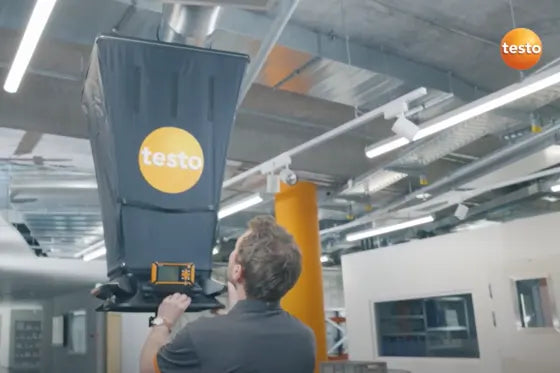
Testo 420 Balometer vs Traditional Flow Hoods: Comparison
Choosing the right flow measurement tool comes down to the work you do, the buildings you work in, and what you need to hand to the client when the job is done. For some HVAC-R technicians, a mechanical flow hood that's been reliably doing the job for fifteen years is still the right answer. For others, the shift to digital has changed what's possible on-site. This guide lays out where the Testo 420 sits in that picture and helps you work out which option makes sense for your situation.
The full air balancing hood and flow measurement tool range at HVAC Shop covers both digital and traditional options, and the decision between them isn't always obvious from a spec sheet. This comparison works through the practical differences so you can make the call based on your actual workflow rather than marketing material.
Written by Rica Francia Macaspac, HVAC Shop content writer, in consultation with Aussie HVAC tradies and industry experts. Published: June 2026 · Last reviewed: June 2026.

What Is a Balometer (Flow Hood)?
A balometer is any instrument that captures airflow from a supply outlet or return inlet and converts it into a volume flow reading, typically in litres per second or cubic metres per hour. The word balometer is a trade contraction of balanced air meter, and while the term is sometimes used interchangeably with flow hood, in strict usage a flow hood is the capture hood assembly while the balometer refers to the complete measurement system including the sensing element and display.
In practice, most HVAC-R technicians and TAB contractors use both terms to mean the same thing: a hood you place over a diffuser or grille to measure airflow. The result feeds into commissioning records, performance verification, energy compliance submissions, and fault diagnosis on underperforming zones.
The two main instrument types in current Australian use are mechanical balometers and digital balometers. Mechanical units use a rotating vane anemometer or velometer inside the hood to derive velocity, which the instrument converts to volume flow using the known hood area. Digital units, including the Testo 420, use a differential pressure principle across a multi-point sensing grid, with the instrument calculating volume flow from the measured pressure differential. The physics of what they measure is similar. The experience of using them on-site is quite different.
The Testo 420 sits at the digital end of the spectrum: a purpose-built differential pressure measuring instrument paired with interchangeable textile capture hoods in four sizes, an integrated flow straightener for swirl outlet correction, and Bluetooth connectivity to the Testo Smart Probes app for data logging and report generation. It's the combination of those features, rather than any single one, that distinguishes it from both mechanical units and simpler digital options.
Mechanical vs Digital Balometers
Mechanical balometers have been the standard tool for TAB work in Australia for decades. They're robust, require no batteries, need no software, and most experienced techs can read and record a result from one quickly. For straightforward residential and light commercial jobs with standard outlet configurations, they remain a serviceable option.
The limitations become apparent on more complex work. Analogue dials require the technician to read a moving needle while also holding the hood steady against the outlet, which introduces both parallax error and the practical difficulty of managing both tasks at height. On outlets where airflow is fluctuating, the needle movement can be significant, and estimating a representative average from a swinging dial is not precise measurement. On jobs where 150 outlets need to be recorded with a result that a mechanical engineer will scrutinise, this matters.
Battery requirements for digital balometers are sometimes cited as a disadvantage, but this is largely a non-issue in practice. The Testo 420 runs on standard batteries with sufficient life for a full day of commercial commissioning. Carrying a spare set is standard practice and adds negligible weight to the kit. The argument that mechanical units have no battery dependency is technically correct but practically irrelevant on any job where you're also running a laptop, a phone, and a Bluetooth probe set.
Accuracy differences between mechanical and digital units are real but context-dependent. A well-maintained mechanical unit operated by an experienced technician can produce accurate results on standard outlets under stable conditions. On swirl outlets, at temperature extremes, or on outlets with non-uniform velocity profiles, the accuracy advantage shifts clearly toward digital. The Testo 420's multi-point measurement approach and integrated flow straightener address both of those challenging conditions directly.

The Testo 420 complete air flow hood kit packages the instrument and hood together as a working system. This is worth noting when comparing purchase decisions, because a mechanical balometer that can handle swirl outlets, multiple diffuser sizes, and app-based reporting doesn't exist as a single purchase. Achieving equivalent capability with traditional tools requires a combination of separate instruments and accessories.
Tradie Pro Tip: If you're transitioning from mechanical to digital, run both instruments on the same outlets for the first few jobs and compare results. It builds confidence in the new instrument's readings and gives you a clear sense of where the accuracy differences show up in your specific application mix.
Testo 420 Competitive Advantages
The Testo 420's strongest differentiators relative to both mechanical balometers and simpler digital competitors are the Bluetooth app integration, the interchangeable hood system with integrated flow straightener, and the real-time data management capability. These aren't marketing points. Each one changes how the instrument is used on a real job.

Bluetooth App Integration
The Testo Smart Probes app connects to the Testo 420 via Bluetooth and logs measurements in real time as they're taken. The technician assigns each reading to the relevant outlet reference on the measurement schedule, and the app builds the commissioning record automatically as the job progresses. At the end of the session, the report is ready to export and email from the phone before leaving the building.
This matters most on high outlet-count jobs. On a 200-outlet commercial fitout in a Melbourne CBD office tower, the manual data entry step after a traditional balometer session can take two to three hours back at the office. With app-based logging, that step doesn't exist. The data was entered on-site as each measurement was taken, without the transcription errors that come from reading handwritten notes later.
The Testo 420 differential pressure measuring instrument is the core unit that drives this workflow. The Bluetooth connectivity is built into the instrument, not an add-on, so there are no separate transmitters to manage or pair.
Real-Time Display and On-Board Averaging
The instrument display shows live volume flow while the hood is positioned against the outlet. The technician initiates a timed measurement average with a single button press, and the instrument calculates and stores the result internally. There's no needle to read, no mental averaging of a fluctuating display, and no separate action required to record the result beyond what the app handles automatically.
For damper adjustment work, the live display is particularly useful. Setting a manual damper to achieve a target flow rate is a real-time feedback process. With a mechanical unit, you need to remove the hood, adjust the damper, reposition the hood, and read again. With the Testo 420 live display, you can monitor the flow change as the damper moves, which makes the adjustment process faster and more precise.
Swirl Outlet Correction
Swirl diffusers are increasingly specified in Australian commercial construction because they improve air mixing without requiring as much throw velocity, which reduces the risk of draught complaints in occupied spaces. The problem for flow measurement is that their rotating discharge pattern causes standard balometers to underread, because the swirl component partially cancels across the sensing element.
The Testo 420 hoods include an integrated flow straightener, a mesh baffle that corrects this rotation before the airstream reaches the sensing element. This is built into every hood in the range as standard, not available as a separate accessory. On a QLD commercial fitout where swirl diffusers are specified throughout, this correction applies to every outlet on the schedule, not just a few exceptions.
Multiple Hood Sizes
The Testo 420 uses one instrument with interchangeable hoods. The range covers 360x360mm for compact square diffusers, 305x1220mm and 610x1220mm for linear slot diffusers, and the Testo 420 915x915mm large hood for oversized return grilles and supply plenums. Each hood change takes about a minute without tools.
With a traditional mechanical balometer, the measuring element is fixed inside the hood. Covering the range of outlet types found in a typical Australian commercial building requires either multiple separate instruments or a series of adapter frames, each with its own calibration considerations. The Testo 420's interchangeable hood approach is more practical and keeps the calibration tied to one instrument.
Accuracy and Measurement Range
Accuracy in flow measurement tools needs to be understood in context. A published accuracy specification from a manufacturer's datasheet reflects performance under controlled laboratory conditions. On a real job, with a hood that's been through fifty sites, at ceiling heights where the hold isn't perfectly steady, measuring an outlet that's slightly undersized for the hood, the actual measurement uncertainty is greater than the datasheet figure. This applies equally to mechanical and digital instruments.
What digital instruments reduce is the operator-induced component of measurement error. Timed on-board averaging removes the need for the technician to judge a representative reading from a fluctuating display. Multi-point sensing across the hood face reduces the impact of non-uniform velocity profiles. These improvements are most significant in the challenging measurement scenarios that are common in real commercial work, not the straightforward conditions that favour mechanical instruments.
Per Testo's published datasheet, the Testo 420 measures volume flow across a substantial range suitable for the full spectrum of Australian commercial HVAC outlets from compact residential diffusers through to large commercial return air grilles. Confirm the specific measurement range, accuracy specification, and applicable measurement conditions against the current Testo 420 datasheet before commissioning on applications with tight tolerance requirements. Specifications can be updated between production runs.
| Feature | Mechanical Balometer | Testo 420 Digital | Practical Impact |
|---|---|---|---|
| Measurement principle | Rotating vane or velometer | Differential pressure, 16-point grid | Digital accounts for non-uniform velocity profiles |
| Swirl outlet performance | Underreads without correction accessory | Corrected via integrated flow straightener | Accurate results on modern commercial diffusers |
| Display and averaging | Analogue dial, manual reading | Live digital display, timed on-board average | Eliminates parallax error and manual averaging |
| Data logging | Manual record on paper | App-based via Bluetooth | Removes transcription step; report ready on-site |
| Hood interchangeability | Fixed element; adapters required | Tool-free swap, 4 sizes | One instrument covers full outlet size range |
| Power requirement | None | Battery (standard cells) | Negligible on-site impact with spare batteries |
| Calibration | Mechanical vane, periodic service | Instrument calibration, single unit | One calibration record for full hood range |

The full Testo HVAC instrument range at HVAC Shop covers the 420 alongside Testo's broader product line. If you're assessing the 420 against other instruments in the Testo range, our team can walk through the differences for your specific application.
Tech Specs: All accuracy and measurement range figures for the Testo 420 should be confirmed against the current Testo 420 datasheet before use in regulated applications. Testo publishes updated technical documentation on its website when specifications change between production runs. Never rely solely on third-party summaries for compliance-critical commissioning work.
Total Cost of Ownership
Purchase price is the most visible cost in any equipment decision, but for a tool that's going to be used on hundreds of jobs over several years, the total cost of ownership picture is more relevant than the upfront figure. This includes accessories, data management time, training, and maintenance across the instrument's working life.
A mechanical balometer has a lower purchase price as a starting point. But achieving the capability of a Testo 420 setup with traditional tools requires additional investment in multiple hood sizes or adapter frames, a separate data recording solution, and the labour time to process manual records into formatted reports after every job. When that post-job data entry time is valued at the technician's hourly rate, the cost difference narrows quickly.
Accessories for the Testo 420 system are modular and purpose-built. The Testo 420 915x915mm large hood is an accessory you add when the job demands it, rather than a separate instrument purchase. The same applies to the smaller hood sizes. You build the kit to match the work you actually do, rather than purchasing a complete range upfront.
Data management costs are where digital tools deliver their most consistent return. App-based logging eliminates the data entry step after every commissioning job. On a business doing ten commercial commissions per month, each requiring two hours of post-job data entry under a manual system, the annual time saving from switching to app-based logging is material. That saving compounds across every job for the life of the instrument.
Training for the Testo 420 is straightforward for anyone already familiar with HVAC commissioning work. The instrument operation is intuitive, and the app interface is consistent with other Testo Smart Probes products. Technicians who already use Testo instruments for other measurements face minimal learning curve. For businesses bringing on apprentices, the digital workflow with clear on-screen guidance is often easier to train than reading analogue displays accurately under variable conditions.
Maintenance for the Testo 420 centres on hood care and periodic instrument calibration. The textile hoods are replaceable accessories rather than serviced components, and hood replacement cost is far lower than the cost of sending a mechanical balometer for repair of its sensing element. Instrument calibration on the digital unit covers the full hood range with a single calibration record, which simplifies the compliance documentation for businesses that need to demonstrate calibration traceability on regulated jobs.
Which Tool for Your Situation
No single instrument is the right answer for every user. The decision depends on the type of work you do, the volume of jobs you're running, and whether the productivity and accuracy advantages of a digital system justify the higher upfront cost for your specific situation.

TAB Contractors
For TAB contractors doing significant volumes of commercial commissioning, the Testo 420 is the stronger choice in most cases. The combination of app-based data logging, swirl outlet correction, and interchangeable hood sizes addresses the three main friction points in a busy TAB workflow: documentation time, swirl diffuser accuracy, and outlet size variety. The return on the upfront investment is realised quickly on any business running more than a handful of commercial jobs per month.
For TAB contractors doing primarily residential or simple light commercial work with standard diffusers and low outlet counts, a quality mechanical balometer may still be a practical choice. The documentation demand is lower, swirl outlets are less common, and the outlet size range is narrower. In this context, the advantages of the Testo 420 are real but the magnitude of the productivity gain is smaller.
HVAC-R Technicians
For HVAC-R technicians whose primary work is maintenance and fault diagnosis rather than commissioning, the case for a Testo 420 depends on how often airflow measurement comes up in their work. If you're regularly diagnosing comfort complaints or checking system performance as part of a maintenance contract, having a calibrated digital balometer in the kit pays for itself in faster, more defensible fault diagnosis. The Testo 420 telescopic stand, which extends to 4 metres with wheels for repositioning, makes solo measurement practical in commercial plant rooms and high-ceiling spaces where a second person would otherwise be needed.
If airflow measurement is occasional rather than routine, a quality mechanical unit is a reasonable starting point. You can always step up to a digital instrument as the work demands it, and the skills transfer directly.
Facilities Maintenance Teams
For in-house facilities teams responsible for maintaining air quality and thermal comfort in a fixed building or campus, the Testo 420 offers a structured way to build an ongoing airflow performance record. Periodic measurement across all outlets and inlets, logged through the app, creates a trend dataset that can identify degrading performance before it becomes a comfort complaint. This is a different use case from point-in-time commissioning, and the app-based archiving is particularly well-suited to it.
For B2B procurement teams or facilities managers evaluating the Testo 420 for an organisation's tool inventory, our team can assist with specification confirmation, compatibility assessment for your specific building types, and trade pricing for multi-unit orders. Get in touch to discuss your application before committing to a purchase decision.
Tradie Pro Tip: Before buying any balometer, write down the three most common outlet types you measure and the average outlet count per job. If most of your work involves swirl diffusers, linear slots in commercial ceilings, or high outlet counts with documentation requirements, the Testo 420's advantages are directly relevant to your situation. If your typical job is a residential split system service call with two or three outlets to check, a simpler tool may serve you better.
ARCtick licensing is worth noting here for any HVAC-R technician considering the Testo 420. Airflow measurement work does not itself require an ARCtick licence, as no refrigerant handling is involved. However, commissioning work on HVAC-R systems regularly puts you near refrigerant circuits, and any work involving refrigerant access requires a current ARCtick licence under Australian law. If you're doing combined refrigerant and airflow work, ensure the refrigerant components are completed by a licensed technician. For ARCtick information, refer to arctick.org.
Frequently Asked Questions