
Choosing Your Upgrade
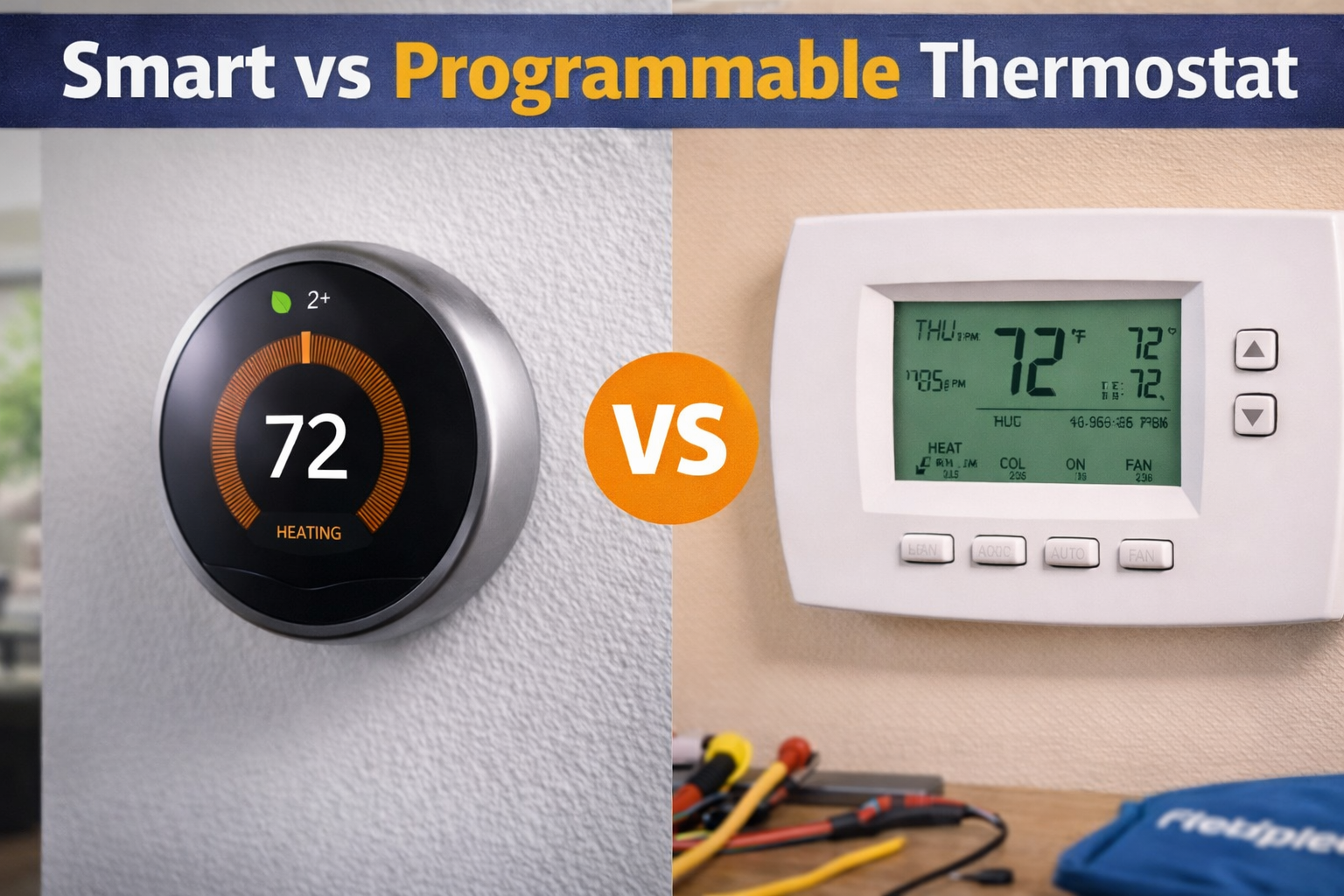
If you’re comparing smart vs programmable thermostat options, you’re already asking the right question. Both can save energy compared with old manual controls. The real question is which one saves more in your home, and whether the extra features are worth it for the way you actually live.
This is where a lot of Australian homeowners get stuck. One page says “smart is best”. Another says “programmable is enough”. Then you see different prices, different model names, and advice that sounds like it was written for another country, another climate, or another type of HVAC system.
This guide clears that up in plain English. We’ll compare smart thermostat vs programmable thermostat options side by side, explain how each type works, and help you choose based on routine, budget, compatibility, and real-world energy savings. We’ll also keep the advice grounded in Australian conditions, where Brisbane humidity, Melbourne cold snaps, and Sydney coastal air can all change how comfort feels in the home.

Before we go deep into the comparison, it helps to understand the basics of intelligent control. If you want the bigger-picture background first, our guide to intelligent thermostat fundamentals explains how connected controls, learning behaviour, and app-based management fit together.
You can also look at real-world programmable and smart thermostat options to see how the range is usually structured, from simpler schedule-based controls through to WiFi-enabled models.
We’ll talk about costs in this guide too, but in a practical way. Hardware prices vary by model and supplier, and install costs vary depending on wiring, zoning, and system type. So treat price ranges as a planning guide, not a guaranteed quote.
Did You Know?
A lot of “my HVAC costs are too high” problems are really thermostat control problems. Better timing and better settings can reduce waste even before you touch the equipment itself.
If you’re also wondering when to upgrade thermostat controls at all, the short answer is this: when comfort swings are annoying, energy waste is obvious, or your current control no longer matches your household routine. That’s where thermostat upgrade benefits usually show up fastest.
Programmable Thermostats Explained
A programmable thermostat is the “middle step” between a basic manual thermostat and a fully smart thermostat. It gives you scheduled control without needing internet, apps, or cloud services. For many homes, that is still a very solid upgrade.
The main feature is scheduling. A good programmable thermostat usually supports 7-day scheduling, which means you can set different temperatures and time periods for each day of the week. That matters because Monday can look very different from Saturday, especially in family homes.
Most programmable controls use fixed temperature programs. In simple terms, you choose the times and setpoints, and the thermostat follows that plan until you change it. If your household routine is steady, this can work really well. It’s predictable, simple, and often enough to cut obvious energy waste.

One big advantage is that no internet is required. If your WiFi is patchy, if you don’t want another app, or if the property is a rental where you want straightforward operation, a programmable thermostat can be the right fit. It still improves control compared with a manual unit, but without the added complexity of connected features.
Another reason programmable models stay popular is lower upfront cost. In many comparisons, programmable thermostats are commonly quoted around the $150–$300 range for hardware, depending on the model family and features. Some are simpler and cheaper, while others sit closer to smart prices if they include more advanced displays or system control options. Installation can be extra and depends on compatibility.
The trade-off is that manual programming is still needed. A programmable thermostat does not “know” your life changed this week. If the kids’ sport moved, if you started working from home, or if you went away for the weekend, the thermostat keeps following the old timetable unless someone changes it.
That’s why programmable thermostats are best for consistent routines. Think households that leave and return at roughly the same times most days. In that situation, a programmable thermostat can deliver a lot of the energy-saving benefit without the extra spend of a smart model.
In the Australian market, many people looking for a practical schedule-based upgrade start by comparing FocusPRO programmable thermostats and similar models that focus on reliability and easy daily use rather than app features.

There is also a compatibility angle. Some older HVAC systems or simple control setups may be better suited to basic or programmable thermostat replacements, especially where the homeowner wants a clean upgrade path without adding new network dependencies. That does not mean “old system equals no smart option”. It just means compatibility checks matter before you choose.
When people ask “Do programmable thermostats really save energy?”, the honest answer is yes, they can. A programmable thermostat energy savings result usually comes from reducing run time when you’re asleep or out of the house. The key is whether the schedule reflects real behaviour. If nobody updates the schedule, savings can fade.
Tech Specs
Before choosing a programmable thermostat, confirm your system type and control wiring. Check whether the system is heating-only or heating/cooling, whether it has stages, and whether the current thermostat is low-voltage control or a different switching setup.
That’s the main point: programmable thermostats are not “old tech” just because they are not connected. They’re a practical tool for households with stable patterns, simple needs, and a budget-conscious upgrade plan.
Smart Thermostats Explained
A smart thermostat builds on programmable control and adds connectivity, automation, and remote access. It can still run schedules, but it also gives you more ways to control comfort when life does not follow a tidy timetable.
The headline feature is WiFi app control from anywhere. A smart thermostat connects to your home network and links to an app, so you can adjust temperature, check system status, or change modes without standing at the wall controller. If you leave for work and forget the HVAC is running, you can fix it from your phone.

Smart thermostats also add remote access and monitoring. That matters for more than convenience. It helps you spot patterns, check whether the house is holding temperature, and make small changes before a comfort issue turns into a bigger complaint. For people who travel, this feature alone can make a smart thermostat worth it.
Some models include self-learning algorithms. In plain terms, the thermostat watches how your home responds and how you use the system, then adjusts timing or setpoint behaviour to match. This is where people often use the phrase “intelligent vs programmable thermostat”. A programmable unit follows your fixed plan. An intelligent or smart thermostat can adapt when your routine shifts.
Many smart models also use weather and occupancy adaptation. Weather adaptation can improve timing on cold mornings or hot afternoons. Occupancy features can reduce waste when the house is empty, especially when paired with app settings or geofencing. These features can help in Australia, but they only work well when the setup is done properly and the home’s HVAC system is compatible.
The trade-off is cost. Smart thermostat hardware is commonly described in the $250–$500+ range, depending on screen type, system support, app ecosystem, and control complexity. That does not automatically make smart “too expensive”. It just means the value question matters more. You want to know what the extra spend gives you in your specific home.
When people search “wifi thermostat vs programmable”, they’re often really comparing flexibility. A programmable thermostat is strong when the same schedule repeats. A WiFi thermostat is stronger when plans change and you need control from work, on the road, or from another room.
That’s also why smart thermostats are best for variable schedules. Shift workers, hybrid work households, frequent travellers, and families with changing routines often get more practical value from smart controls than households that run like clockwork every week.
In the local market, many buyers start by looking at higher-feature options such as Honeywell T6 Pro Smart WiFi 9000 style product families and comparing what features actually matter for their system, rather than just picking the most expensive screen.
It is also worth addressing a common search phrase directly: smart thermostat vs Nest. People use Nest as a benchmark because it is well known online, but in Australia the better question is often not “which famous brand wins?” It is “which thermostat works properly with my HVAC system, my wiring, and my support options here?” Compatibility and local support matter more than hype.
Smart thermostats can be excellent, but they are not magic. If ducting is leaking, filters are blocked, or airflow is poor, the thermostat cannot fix those mechanical problems. What it can do is make system behaviour easier to see and easier to manage.
Feature Comparison Table
Now let’s put the smart vs programmable thermostat comparison into one buyer-focused table. This gives you a quick way to see the core differences without bouncing between sales pages.
| Feature | Programmable Thermostat | Smart Thermostat | Why it matters in real homes |
|---|---|---|---|
| Remote control | No | Yes | Useful if your routine changes, you travel, or you forget to adjust settings before leaving. |
| Learning behaviour | No | Yes (varies by model) | Can improve timing and reduce manual schedule edits in busy households. |
| Energy reports | No | Yes (varies by model/app) | Helps spot long run times, changing habits, or possible comfort issues earlier. |
| Voice control | No | Yes (if supported) | Convenience feature for some homes, not essential for savings. |
| Weather adaptation | No | Yes (on some models) | Can improve comfort timing during Melbourne swings or hotter summer afternoons. |
| Scheduling | Yes (fixed programs) | Yes (fixed + adaptive options) | Both save energy when used properly; smart adds flexibility when plans change. |
| Internet required | No | Yes (for app/remote features) | Important in rentals, regional homes, or homes with unreliable WiFi. |
| Cost (hardware guide) | Lower | Higher | Choose based on savings potential, routine, and compatibility—not just upfront spend. |

If you want a deeper breakdown of app-driven functions and how they work in practice, our guide to detailed smart thermostat features is a good follow-on read once you’ve narrowed the choice to “programmable or smart”.
One important point from the table is that a programmable thermostat is not “bad” just because it says no in a few feature rows. If you do not need remote access or learning, those “no” features may have no value to you. This is why the best thermostat choice depends on how the household runs, not just on the feature count.
Energy Savings Comparison
This is the part most people care about: savings. When comparing smart thermostat savings with programmable thermostat energy savings, the common pattern is that both can reduce waste, but smart thermostats may save more in homes with changing routines.
A commonly cited rule of thumb is that programmable thermostats can save around 10–15% when schedules are set properly and actually match the household pattern. Smart thermostats are often described in the 15–25% range, especially where remote access, occupancy behaviour, and adaptive timing reduce “running by accident”. These are guide figures only, not guarantees.
Why the gap? A programmable thermostat can save money if the schedule is accurate. A smart thermostat can keep saving even when the schedule is not perfect, because you can change settings remotely and, on some models, the system can adapt better to your routine and weather changes.
Australian electricity costs matter here too. In broad terms, households often estimate power costs somewhere around $0.25–$0.40 per kWh depending on plan, location, and time-of-use structure. Your actual tariff may sit outside that range, so check your bill when doing your own numbers.
Let’s do a simple comparison using a round example. If heating and cooling use about 3,000 kWh across a year, then at $0.30 per kWh the annual electricity cost for that HVAC energy is 3,000 × 0.30 = $900. If a programmable thermostat saves 10–15%, that is $90 to $135 per year. If a smart thermostat saves 15–25%, that is $135 to $225 per year.
Now look at the difference between the two. In that same example, the extra savings from smart over programmable is roughly $45 to $90 per year. That gap is what helps answer the “smart thermostat worth it” question. If the hardware price difference is modest and the household routine changes often, smart can make financial sense sooner.
Here’s another example using a higher HVAC energy load and a higher tariff. If heating and cooling use about 4,000 kWh per year and the effective cost is $0.40 per kWh, the annual HVAC electricity cost is 4,000 × 0.40 = $1,600. A 10–15% programmable saving is about $160 to $240. A 15–25% smart saving is about $240 to $400. In homes with higher usage, the savings gap can be more obvious.
People often ask about ROI timeline. A commonly discussed rule is that smart thermostats can pay back their extra cost in around 2–3 years, but that depends on the price gap between a programmable and smart model, your energy use, and whether you actually use the smart features. If the smart model is only used like a basic programmable thermostat, the payback can take longer.
Climate zone differences also matter. In Melbourne, a smart thermostat may help because the weather can swing and people often need more flexible timing. In Brisbane, humidity and long cooling seasons can reward better control strategies, especially when people overcool the house trying to feel drier. In cooler inland areas, heating schedules may be steady enough that a programmable thermostat performs very well. In Sydney coastal homes, stable comfort control can matter as much as pure savings because “clammy” comfort complaints often drive thermostat changes.
The main takeaway is simple: both options can save money compared with manual control. Smart usually has a higher savings ceiling, while programmable often has a lower entry cost. The better financial choice depends on usage pattern, not just the sticker price.
Pro Tip
When calculating savings, use your own bill rate and your own HVAC usage pattern. A rough “national average” estimate is fine for planning, but your tariff and run hours decide the real outcome.
For installation and service work, treat thermostat upgrades like any other electrical/HVAC task and follow safe work practices. If you are unsure about wiring or system type, get a qualified installer involved. General workplace safety guidance is available from Safe Work Australia.
When to Choose Programmable
A programmable thermostat is often the best choice when your schedule is consistent and you want dependable savings without paying for features you won’t use. This is the classic “simple, sensible upgrade” path.
Choose programmable if your daily routine is predictable. If the house is usually empty at the same times and occupied at the same times, fixed schedules can work brilliantly. You set the program once, fine-tune it over a week or two, and then the thermostat just does its job.
Choose programmable if you do not need remote access. Some people simply do not care about phone control, and that’s completely fair. If you are happy adjusting settings at the wall and your routine doesn’t move around much, app features may not add enough value to justify the extra cost.
Choose programmable if you want a budget-conscious upgrade. A programmable thermostat can deliver real savings compared with manual control while keeping upfront spend lower. For many homes, that is the best answer to “when to upgrade thermostat controls” because the payback can be straightforward and the setup is easy to understand.
Choose programmable when older HVAC system compatibility is the safer path. Some older systems are better matched to simpler thermostat controls, or the homeowner may want the least complicated replacement to avoid wider control changes. That does not mean smart is impossible, but it makes compatibility checking more important before spending more.
Choose programmable in rental properties with basic comfort needs. Landlords and property managers often want reliable controls that are easy for tenants to use, easy to explain, and less dependent on app accounts or home WiFi changes between tenants. In those cases, programmable thermostats can be the practical winner.
There is also a user-behaviour factor that gets missed in online comparisons. Some households are better with simple controls. If no one is likely to manage app settings, occupancy permissions, or alerts, then a well-programmed thermostat can outperform a smart thermostat that is never configured properly.
If your situation sounds like this, it can be worth comparing practical schedule-based models such as FocusPRO 5000 and 6000 models and choosing based on system compatibility and ease of use, not just the screen style.
This is also where the “manual vs smart thermostat” debate can confuse people. The better upgrade path is often not manual straight to premium smart. For many homes, manual to programmable is a strong step that delivers better comfort and lower waste without adding complexity the household doesn’t want.
When to Choose Smart
A smart thermostat becomes the better choice when your life does not fit a fixed timetable. If routines change often, the added flexibility can improve both comfort and savings enough to justify the higher hardware cost.
Choose smart if you have variable work schedules. Shift work, hybrid work, rotating rosters, late finishes, and last-minute changes can all make fixed programming frustrating. A smart thermostat lets you adjust from your phone and, on some models, helps the system adapt better over time.
Choose smart if you travel frequently. Remote access means you can check the house while away, adjust settings before returning, or make quick changes if plans shift. This is one of the clearest answers to “smart thermostat worth it” for people who are often on the road.
Choose smart if you have a multi-zone system and want better day-to-day control. Zoning adds comfort potential, but it also adds setup complexity. A smart thermostat setup can work very well here, provided the thermostat, zone controller, and HVAC system are all compatible and configured correctly.
Choose smart for new HVAC installations when you want to future-proof the control side. If you are already investing in a new system, it can make sense to compare the added thermostat cost against the long-term convenience and savings of remote monitoring and adaptive control. This is especially true in homes where comfort complaints are common because people come and go at different times.
Choose smart for tech-savvy households that will actually use the features. Smart controls can be excellent, but only when someone in the home is willing to set up schedules, app permissions, away modes, and alerts properly. If that happens, the system usually performs better than a “default setup and forget it” approach.
Choose smart when maximum energy savings is a clear priority. If you’re trying to squeeze more efficiency out of your HVAC usage and you know routines are not consistent, smart controls give you more tools to reduce wasted run time. That does not replace good insulation, airflow, and maintenance, but it supports better control.
If this sounds like your household, it is worth reviewing options such as T6 Pro Smart and WiFi 9000 style ranges and then confirming compatibility with your specific system before choosing.

One more practical note for Aussie conditions: smart controls can be especially helpful when comfort is hard to predict. Melbourne weather swings, Brisbane humidity, and mixed occupancy in larger homes are exactly the situations where remote access and adaptive timing tend to feel useful, not gimmicky.
And if you are comparing smart vs programmable because the current thermostat is annoying, that’s already a sign. Thermostat upgrade benefits are not only about the bill. They are also about fewer comfort complaints, less fiddling with settings, and a system that behaves more like you expect.
Make Your Choice Today
So, smart vs programmable thermostat: which one should you choose? If your routine is steady, your budget is tighter, and you want a simple upgrade that still saves energy, a programmable thermostat is often the right answer. If your routine changes, you travel, or you want app control and better flexibility, a smart thermostat usually makes more sense.
Here is the short decision guide in plain terms. Programmable works best for consistency. Smart works best for variability. Both are an upgrade over manual control when matched properly to the household and the HVAC system.
For model direction, a good rule is to look at programmable families when you want schedule-first control and smart WiFi families when you want app access, remote monitoring, and adaptive features. The exact model should be chosen based on system type, wiring, stages, and zoning requirements, not just the front screen.
If you’re comparing options now, you can browse thermostat range choices and see both programmable and smart categories in one place. That makes it easier to compare by use case instead of getting lost in model names.
We supply Australia-wide, and if you’re unsure what will work with your system, the safest next step is a compatibility check. Talk to our team to confirm compatibility, discuss installation requirements, and get a quote based on your actual setup rather than guessing from generic online advice.
The best thermostat is not the fanciest one. It’s the one that fits your HVAC system, your routine, and the way your home really feels through the year. Get that right, and the upgrade pays you back in comfort first, and often in energy savings as well.