
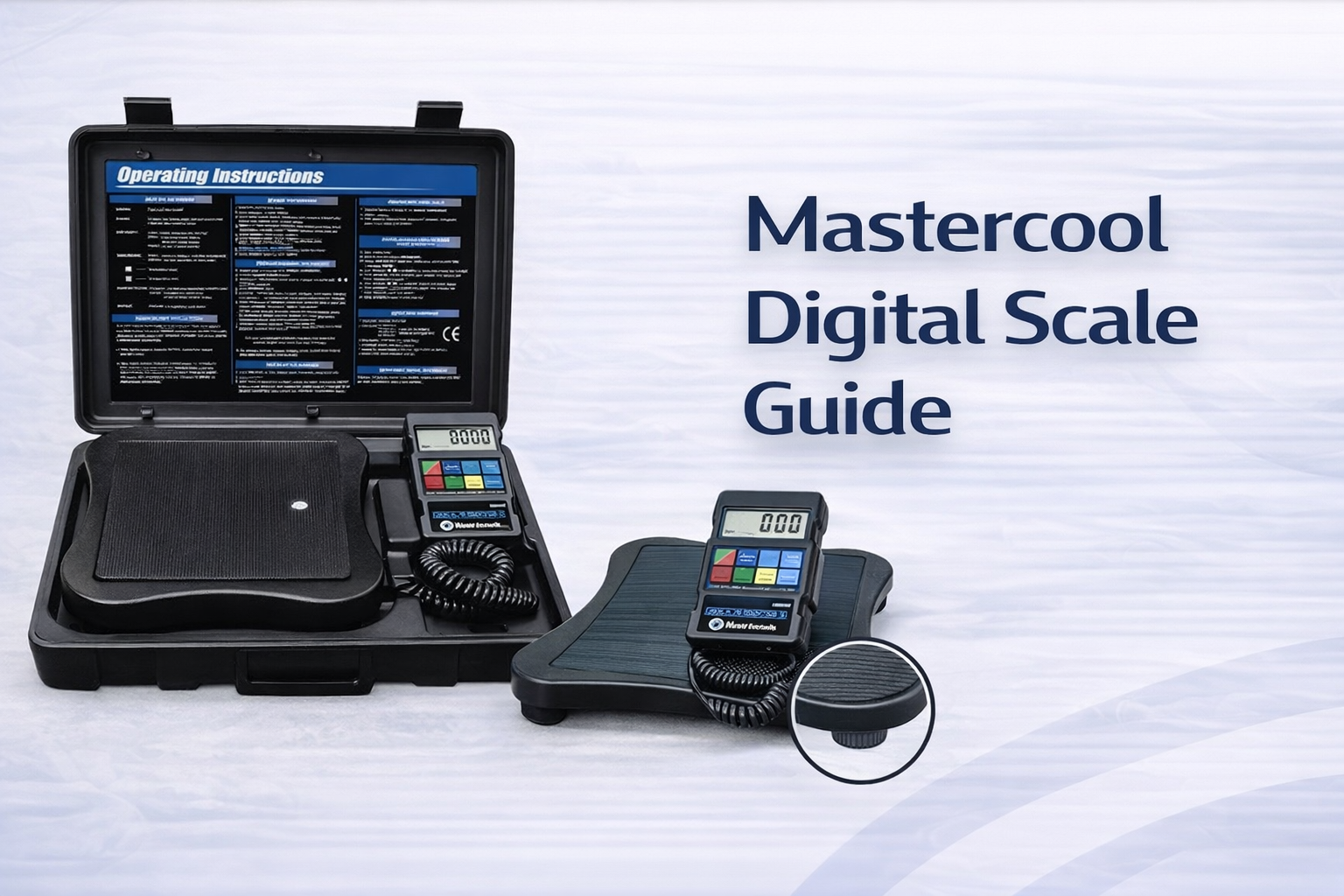
Precision Charging by Weight
Accurate refrigerant charging is one of those trade habits that saves more trouble than most customers ever see. When the charge is right, systems start cleaner, run closer to design, and are less likely to come back with nuisance faults, poor cooling, or compressor stress. When the charge is off, even by a small amount, you can lose time chasing symptoms that were created during commissioning. That is why a good mastercool digital refrigerant scale matters. It helps take guesswork out of charging and recovery work, and it gives you a better chance of getting the job right the first time.
A lot of problems start with tools that are “close enough” on paper but frustrating in the field. Generic scales may be fine for light bench work, but HVAC jobs are different. You are often working beside condensers, on rooftops, in plant rooms, or out in a driveway with hoses, cylinders, sun glare, dust, and the usual time pressure. A proper mastercool charging scale is built around that reality. It is not only about showing a number on a screen. It is about stable readings, easy zeroing, decent weight capacity, and a platform that does not feel sketchy when a cylinder is sitting on it.
This guide is written for Australian techs, apprentices, and business owners who want a clear view of the Mastercool range without the fluff. We will cover how the models differ, which features actually matter, and how to choose the right scale for residential work, commercial work, and heavier charging jobs. If you are starting with the flagship end of the range, the Mastercool 98210-BL Accu-Charge II is the natural reference point. If you want to see the wider brand lineup in one place, the Mastercool professional tools collection is a useful place to compare how the scales sit alongside the rest of the brand.

The goal here is not to push one model at everyone. It is to explain why pros use charging by weight, why Mastercool scales are popular with HVAC technicians, and how to avoid choosing a model that is either underdone for your work or too expensive for what you actually need. We will also keep the advice grounded in local job conditions. Brisbane humidity can make long commissioning days feel harder. Sydney coastal air is rough on tools over time. Melbourne cold snaps can turn a simple charge adjustment into a fiddly late-afternoon job. The right scale helps because it gives you one less variable to fight.
If you have been searching for a mastercool refrigerant scale, mastercool digital scale, mastercool scale review, or the best mastercool scale for Australian work, this article is built to answer those questions naturally. We will stay focused on the Mastercool digital refrigerant scale category and keep the advice practical, job-focused, and easy to use on a real workday.
Why Mastercool for Refrigerant Scales?
Mastercool has built a strong reputation in HVAC because the brand tends to focus on tools that solve real service and installation problems rather than adding features that only look good in a catalogue. That matters with scales. Charging and recovery work depend on accurate weight readings, but field use also demands stable platforms, readable screens, reliable controls, and enough toughness to handle transport and daily use. A professional refrigerant scale from Mastercool is appealing because it aims at that trade-off between accuracy, durability, and practical features.
Professional-grade accuracy is the first reason many techs look at the brand. Even when you are not charging down to a tiny fraction, you still want a tool that gives you confidence the reading is right. That matters on modern systems with tighter charge requirements, on warranty-sensitive work, and on jobs where overcharging or undercharging can quickly turn into a callback. It also matters when you are doing repeated work across multiple systems and want consistent process, not constant second-guessing.
The second reason is trust in field use. A scale can be accurate in a clean workshop and still be annoying on site. Buttons that are awkward with gloves, flimsy cable connections, slippery platforms, or screens that wash out in strong sun can all slow you down. Mastercool scales are popular because they are generally chosen for real HVAC workflow. That includes digital options, Bluetooth-linked control on higher-end models, and platforms that suit refrigerant cylinder work rather than general consumer weighing tasks.
Durability is another big part of the brand position. Australian technicians move gear in and out of vans, across roofs, through ceiling spaces, and into plant rooms every week. Tools get bumped, stacked, heated in the back of the van, and exposed to everything from Queensland humidity to dry inland dust. A scale does not need to be indestructible to be worthwhile, but it does need to feel like it belongs in trade work. That is one reason a mastercool scale australia search is usually coming from someone who wants a proper field tool, not a cheap generic option.
Bluetooth and digital convenience are also part of why the brand stands out. On some jobs, being able to read data more easily, reduce unnecessary movement around the cylinder, or work with wireless features can make charging cleaner and faster. That does not mean every tech needs the most advanced option. It does mean the brand gives you a path from basic digital charging through to more feature-rich setups without leaving the category altogether.
Value for money matters too. In HVAC, cheap tools often become expensive when they slow you down, fail mid-job, or create uncertainty in your readings. At the same time, not every buyer needs the most premium model. Mastercool tends to be attractive because there are models aimed at different budgets. That makes it easier to match the tool to the type of work you do most. If you mainly handle residential splits, your best choice may be different from a contractor doing larger commercial charging and recovery jobs every week.
Local support availability is part of the decision as well. In Australia, tool choice is not only about the spec sheet. It is also about whether you can get the model through a trusted supplier, confirm accessories, sort out adapter questions, and get practical help when comparing options. That is where an established category supplier can be a real advantage. A scale is a simple idea, but the details still matter when you want the right fit for your daily work.
In plain terms, Mastercool works for many fridgies because the range covers the basics well. You get digital charging options, trade-focused design, and a choice between more economical and more advanced models. That combination is why the brand keeps coming up in conversations about the best mastercool scale for day-to-day HVAC charging.
Mastercool Scale Range Overview
The Mastercool range makes more sense when you stop looking for one “best” unit and instead think about which model suits the way you work. The lineup commonly discussed by Australian buyers usually centres on three models: the 98210-BL Accu-Charge II, the 98201 High Precision, and the 98315 wireless scale with solenoid control. Each one sits in a slightly different place in the market, which is helpful because not every tech needs the same balance of price, features, and charging workflow.
The 98210-BL Accu-Charge II is the premium Bluetooth-focused option in this group. It is the model many buyers look at first because it is designed for technicians who want stronger control, easier visibility, and a more advanced workflow than a basic wired platform gives them. For a lot of residential and commercial service work, this is the model that feels closest to a flagship everyday tool. If you want a deeper product-level look at that platform, the Mastercool 98210-BL complete guide is useful background.
The 98201 High Precision sits at the more economical end of the digital charging conversation. That does not mean it is a toy or a throwaway option. It means it is better suited to buyers who want accurate charging by weight without paying for premium extras they may not use every day. For many residential techs and smaller operators, that balance makes a lot of sense. If that sounds closer to your needs, the Mastercool 98201 High Precision is the obvious model to check first, and the related Mastercool 98201 detailed guide gives more context on where it fits.
The 98315 is commonly referenced as the wireless option with solenoid control. That makes it especially interesting for buyers who want a more automated or streamlined charging process on jobs where walking back and forward between the cylinder and the controls wastes time. On busy workdays, that kind of control can be more than a luxury. It can make charging cleaner, reduce interruptions, and help on installations where the setup is spread out or awkward.
Capacity is one of the simplest differences to understand. In this part of the range, buyers usually look at capacities around 100 kg to 110 kg, which covers normal refrigerant cylinder work for most Australian service and installation jobs. That is plenty for the majority of domestic and light commercial applications. The real question is not only maximum weight. It is whether the platform feels stable, the display remains easy to trust, and the control setup matches how you work.
Feature comparison also matters. Some buyers prioritise Bluetooth. Others care more about straightforward digital charging without extra layers. Some want wireless control with solenoid capability because it suits their job flow. Others just want a solid, readable scale that starts fast, zeros quickly, and survives daily transport. That is why it helps to view the range through use case rather than hype.
Price points in Australia usually follow the feature ladder. Economy digital models sit at the lower end, Bluetooth and higher-precision options move into the mid-to-premium range, and wireless or more automated control usually costs more again. The important thing is to judge value by labour saved, charging confidence, and reduced mistakes rather than by sticker price alone. A more expensive model can still be better value if it suits the work you do every week.
If you want to compare beyond one model page, the refrigerant scales collection helps put the category in context, while the digital scales for HVAC category is useful if your main focus is electronic charging workflow rather than general brand browsing.
Across the commonly discussed Mastercool digital scale range, buyers usually compare capacity around 100 kg to 110 kg, digital display style, Bluetooth or wireless control, and whether the model is built for straightforward weighing or a more automated charging process. Exact inclusions can vary by model and supplier, so it is always smart to confirm the current package before ordering.
Seen this way, the range is easy to understand. The 98201 is the simpler value-minded option. The 98210-BL is the more advanced Bluetooth choice. The 98315 is aimed at buyers who want wireless control and solenoid-style convenience. None of them are “best” in isolation. The right one depends on the jobs you do most.
Mastercool Model Comparison Table
A buyer-focused table is often the quickest way to narrow the range. The key is to compare practical decision points rather than drowning in small details. For most Australian HVAC buyers, the main questions are weight capacity, Bluetooth or wireless operation, expected accuracy class, price tier, and the kind of work the model best suits. That is what really shapes daily value in the field.
| Model | Capacity | Bluetooth | Accuracy Class | Australia Price Tier | Best For |
|---|---|---|---|---|---|
| 98210-BL Accu-Charge II | 110 kg | Yes | Commonly cited as high precision | $$$ | Wireless-friendly precision charging for technicians who want premium control |
| 98201 High Precision | 100 kg | No | Commonly cited as economy digital accuracy | $$ | Residential service and install work where value matters |
| 98315 Wireless with Solenoid | Varies by model reference | Yes | Varies by setup | $$$$ | Automation-minded charging work where remote control is a real advantage |
The 98210-BL usually appeals to technicians who want a mastercool digital refrigerant scale with stronger control features and a more premium feel in daily use. It is the sort of model that suits busy operators who charge often enough to appreciate the difference in workflow. The 98201, by contrast, is easier to justify when you mainly want accurate charging without stepping up into advanced wireless-style convenience.

The 98315 is the one to look at if remote operation and solenoid-linked control genuinely improve the way you work. That might be overkill for a small residential-only operator. It can make more sense for larger installations, awkward setups, or contractors who want a more automated charging process. The important point is not which one sounds fanciest. It is which one removes friction from your normal jobs.
If you want broader reading before deciding, the refrigerant recovery methods guide is a good reminder that weighing, charging, and recovery are all part of one process. A scale works best when it supports the rest of your workflow rather than sitting in isolation.
It is also worth remembering that price tier does not equal value by itself. A budget-friendly model can be the best mastercool scale for one technician and the wrong choice for another. The right way to compare is to think about how often you charge by weight, how much time you lose on fiddly setups, and whether Bluetooth or wireless control would actually save labour on your jobs.
Key Features Across Mastercool Range
Once you step back from the model numbers, a few core features explain why Mastercool scales are taken seriously in HVAC work. The first is the backlit LCD display. That might sound basic, but it matters a lot in the field. Charging work does not always happen in nice indoor light. Sometimes you are beside an outdoor unit in strong sun. Other times you are in a darker plant room, a service corridor, or finishing late on a winter afternoon. A display that stays readable without squinting is a real quality-of-life improvement.
Auto-zero and tare functions are just as important. Refrigerant charging by weight depends on a clean starting point. If the scale is awkward to zero, slow to settle, or prone to drifting, the whole process becomes more frustrating than it needs to be. Good tare control lets you work faster and more confidently because you are not constantly rechecking the basics. On a busy day, those small time savings add up.
Overload protection is another practical feature. Cylinders are not always handled gently, and tools get used by different techs with different habits. A scale that has some protection built into it is simply better suited to the real world. It will not fix careless handling, but it can help protect the tool from the kind of accidental overloading or rough use that happens when gear is being moved around in a rush.
Durable non-slip platforms also make a big difference. Refrigerant cylinders need to sit securely. A platform that feels slick, flexy, or unstable is annoying at best and unsafe at worst. That is one reason dedicated HVAC scales beat general-purpose consumer scales. The platform needs to suit actual service work, not just give a number on a screen. Mastercool charging scales are attractive because they are designed for the cylinder-and-hose reality of refrigerant handling.
Power options matter too. Battery operation is useful because it keeps the tool portable and simple on site. At the same time, some buyers like the reassurance of AC power options or compatible adapters depending on the model and kit. In Australia, that can matter if you are doing longer jobs, working in workshops, or want to reduce the risk of a flat battery turning into downtime. The right approach depends on your routine, but it is worth checking how the scale fits your power preferences before you commit.
Protective carrying cases are another underrated feature. A scale may sit quietly under a cylinder during the job, but most of its life is actually spent being moved, stored, lifted, and packed. A good case helps protect the platform, cable, and controls from bumps in the van and rough handling between jobs. That is not glamour. It is basic tool longevity.
Bluetooth features deserve special mention because they are one of the main reasons buyers step up from a simple digital scale. For some techs, Bluetooth is not essential. For others, it improves visibility, reduces awkward movement, and makes the charging process cleaner. If that side of the range is what interests you, the Mastercool Bluetooth features article is worth reading before you choose.

A scale can be accurate in theory and still waste time in practice. Poor display visibility, awkward tare control, and a slippery platform can turn a simple charging job into a fiddly one. Field-friendly design matters almost as much as the number on the spec sheet.
That is really the story across the Mastercool range. The brand is not only selling a weight platform. It is selling a tool designed around how refrigerant charging actually happens on site. That is why the features that look small in a spec list often have the biggest effect during a real workday.
Mastercool Scales for Australian Conditions
Australian job conditions are one of the best reasons to choose a proper HVAC scale instead of a generic option. Rooftop work can mean heat, glare, and UV exposure. Coastal service work can mean moisture, salt in the air, and more corrosion over time. Mobile technicians need tools that pack away cleanly, survive transport, and are quick to set up when the next job is already waiting. A mastercool refrigerant scale suits that environment better because it is built with field use in mind.
Rooftop durability matters because HVAC tools spend a lot of time outside. In summer, metal surfaces get hot fast. Plastic parts can feel the stress of UV and heat, and a weak display quickly becomes annoying when the sun is bouncing off the unit casing. That is where a clear digital display, decent casing, and stable platform become more than convenience features. They help the tool stay usable in tough light and temperature conditions.
Humid coastal environments create a different kind of pressure. Around Sydney, Newcastle, the Gold Coast, and other coastal areas, tools quietly age faster if they are poorly protected or left carelessly in damp van conditions. A scale still needs basic care, but a field-focused design gives you a better starting point than a flimsy consumer unit. That is important if your tools are in and out of vehicles every day and regularly exposed to outdoor work.
Portability is another major issue for Australian technicians. A lot of work is mobile. You might be in a suburban backyard in the morning, on a commercial roof after lunch, and in a plant room before knock-off. That means the scale needs to be easy to carry, easy to store, and not so awkward that you start leaving it behind when the day gets busy. Carrying cases, clear controls, and tidy design help more than people realise when the workday is full of small movements and repeated setup.

Display clarity in bright sun also deserves its own mention. Many charging mistakes do not come from not knowing what to do. They come from poor visibility, distractions, or rushing the last stage of the job. A backlit display that stays readable outdoors is a simple but useful advantage, especially when the sun is harsh or the work area is awkward.
Power considerations matter locally as well. Battery operation is often the simplest field answer, but some buyers look for 240V-friendly AC adapter options or compatible powered setups for workshop use and longer jobs. That is worth checking before you buy, especially if your team tends to leave battery management until the last possible moment. It is not a huge issue when you plan well, but it is one of those small details that can make a tool easier to live with over time.
Australian refrigerant work also sits inside a licensing and handling framework. The scale itself is only one part of good practice, but accurate charging by weight supports cleaner work and more consistent results. If you want the official licensing context around refrigerant handling, the ARCtick refrigerant licensing information is the right reference point.
All of this is why a mastercool scale australia search often comes from working techs, not casual buyers. They want a tool that can handle real transport, real weather, and real charging work. In that setting, practical durability matters just as much as the reading itself.
Which Mastercool Scale for Your Work?
This is the section that matters most for most buyers. The right Mastercool scale depends far more on your daily workload than on which model sounds most impressive. Residential techs, commercial contractors, and larger installation teams do not all need the same features. The smarter move is to match the scale to the jobs you do every week, not the biggest or fanciest job you might do once in a while.
For residential technicians, the 98201 often makes the most sense. If your work is mostly split systems, routine charging, service calls, and install work where accuracy matters but you do not need premium wireless convenience every day, the simpler economy digital option is easier to justify. It helps you charge by weight properly, keeps the tool spend sensible, and still gives you the advantages of a dedicated mastercool digital scale over a generic platform.
For commercial contractors and busy mixed-work technicians, the 98210-BL usually looks stronger. This is the model for buyers who want more control, better workflow, and features that can save labour over time. If you are charging more often, moving between different site conditions, or working in situations where visibility and wireless convenience improve the process, the premium Bluetooth model is easier to defend. In that kind of workflow, paying more up front can be smarter than constantly fighting a basic tool.

For larger installations or jobs where setup efficiency really matters, the 98315-type wireless approach can be appealing. If the work area is awkward, the charging process is more involved, or your team values remote control and solenoid-linked convenience, the higher-tier option can make sense. This is not about showing off. It is about whether the added control removes wasted movement and reduces fiddly interruptions on site.
Budget allocation should always come back to return on accuracy. A poor charge can cost you time, refrigerant, and confidence in the final result. A better scale helps because it makes charging by weight more repeatable. But return on investment also depends on use frequency. If the scale comes out on most jobs, a premium option is easier to justify. If you only use it occasionally, the simpler model may be the more sensible purchase.
That is also where comparison shopping becomes useful. If you are specifically weighing up a mastercool vs fieldpiece scale question, the smartest approach is not to guess based on brand alone. Compare the workflow, the control style, the kind of jobs you do, and how often the extra features will actually save time. The Mastercool brand comparison article is a better place to explore that angle without dragging this guide away from the Mastercool range itself.
Another good checkpoint is to think about how your charging habits fit with the rest of your process. If you want a broader category view before deciding, the refrigerant scale buying guide is helpful for understanding what matters across the market, not just inside one brand.
Do not choose a scale by features alone. Choose it by workflow. If Bluetooth or wireless control will save you time on most jobs, it is worth paying for. If it will only sound nice in theory, a simpler model is often the smarter buy.
In simple terms, the 98201 suits value-focused residential work, the 98210-BL suits technicians who want premium daily usability, and the 98315 suits buyers who genuinely benefit from more automation. That is the cleanest way to choose without overthinking it.
Choose Mastercool Quality
Mastercool has earned its place in this category because the range speaks to real HVAC work. The brand gives you dedicated charging tools, practical field features, and a ladder of options that makes sense from entry-level digital right through to Bluetooth and wireless control. That is why the mastercool digital refrigerant scale category keeps coming up in conversations about accuracy, durability, and everyday usefulness on Australian jobs.
If you want the simplest summary, it goes like this. The 98201 is the sensible choice for many residential technicians who want dependable digital charging by weight without paying for extras they may not need. The 98210-BL is the stronger all-round option for technicians who charge often and want better control and a more refined workflow. The 98315 suits buyers who genuinely benefit from wireless operation and solenoid-style convenience on bigger or more awkward jobs.
What matters most is not chasing the fanciest model. It is choosing the tool that fits your work, your job mix, and the way your team actually charges systems. In Australian conditions, that means thinking about transport, rooftop use, bright sun, humidity, and the pace of mobile service work. A good scale helps because it gives you stable readings, cleaner charging, and less second-guessing when the day is already full.
If you want help narrowing the range, the best next step is to review the shop Mastercool scales collection, compare the model features against your normal job flow, and talk to the team if you want to confirm which option best suits your workload. That keeps the decision practical and low-pressure. The right Mastercool charging scale is the one that helps you charge accurately, work efficiently, and avoid preventable callbacks.