
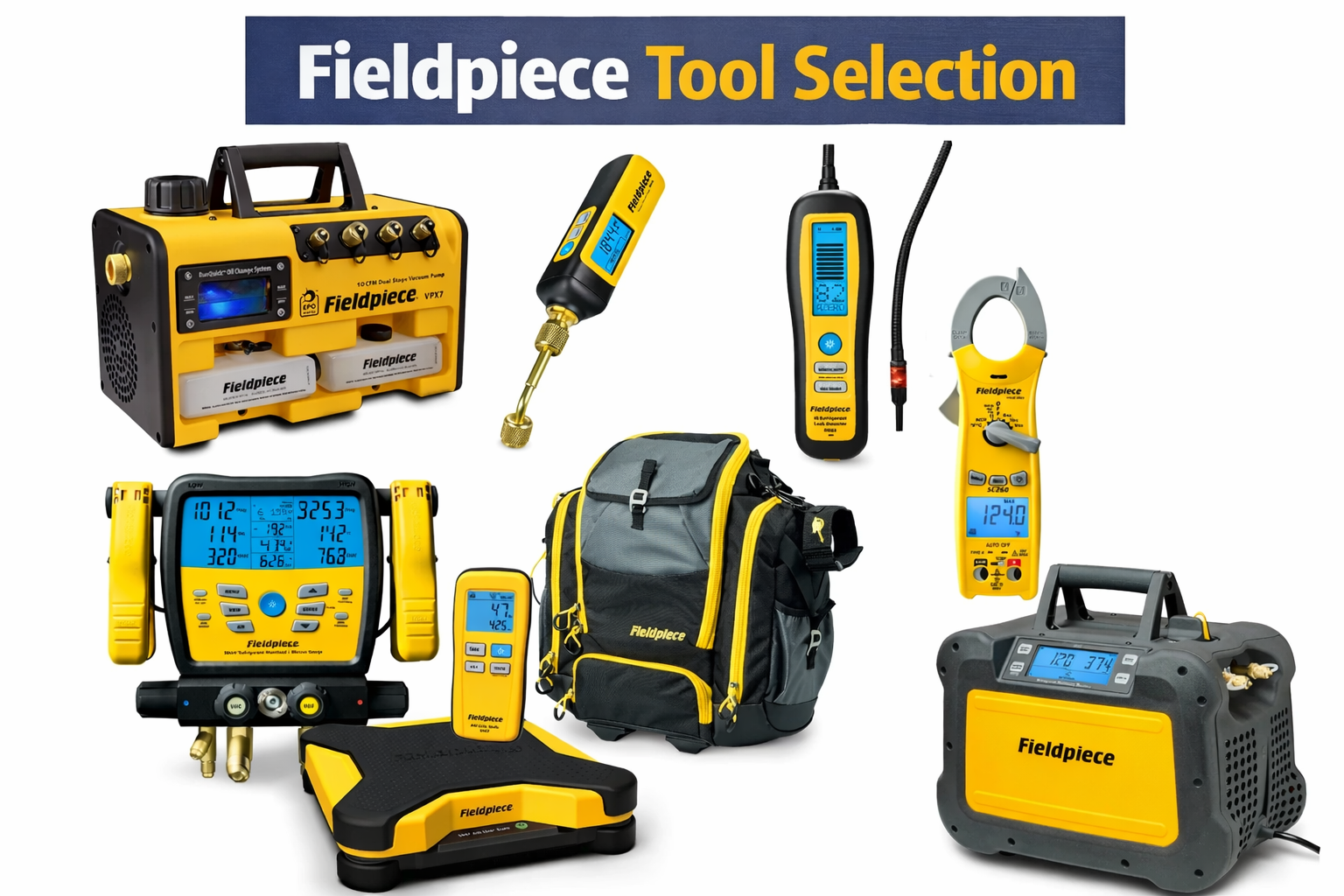
Building Your Fieldpiece Toolkit
If you are asking which Fieldpiece tools you really need, you are already asking the right question. Most HVAC techs do not struggle because there are no good tools on the market. They struggle because there are too many choices, too many bundle options, and too many strong opinions from people with a different job mix, a different budget, or a different stage of career. One tradie says start with a manifold. Another says buy a clamp first. Another says go straight to the full wireless setup. That can get expensive fast, especially when you are still building your kit.
The truth is simpler than a lot of buying guides make it sound. The right tools are the ones that stop wasted time, prevent call-backs, and help you prove what is happening on the system. In Australia, that matters even more because job conditions are rarely gentle. Brisbane humidity punishes poor evacuation habits. Sydney coastal air is rough on exposed gear. Melbourne cold snaps expose weak electrics and control faults. A tool that only looks good in the catalogue is not enough. You need tools that hold up in real trade conditions and fit the kind of calls you actually do every week.
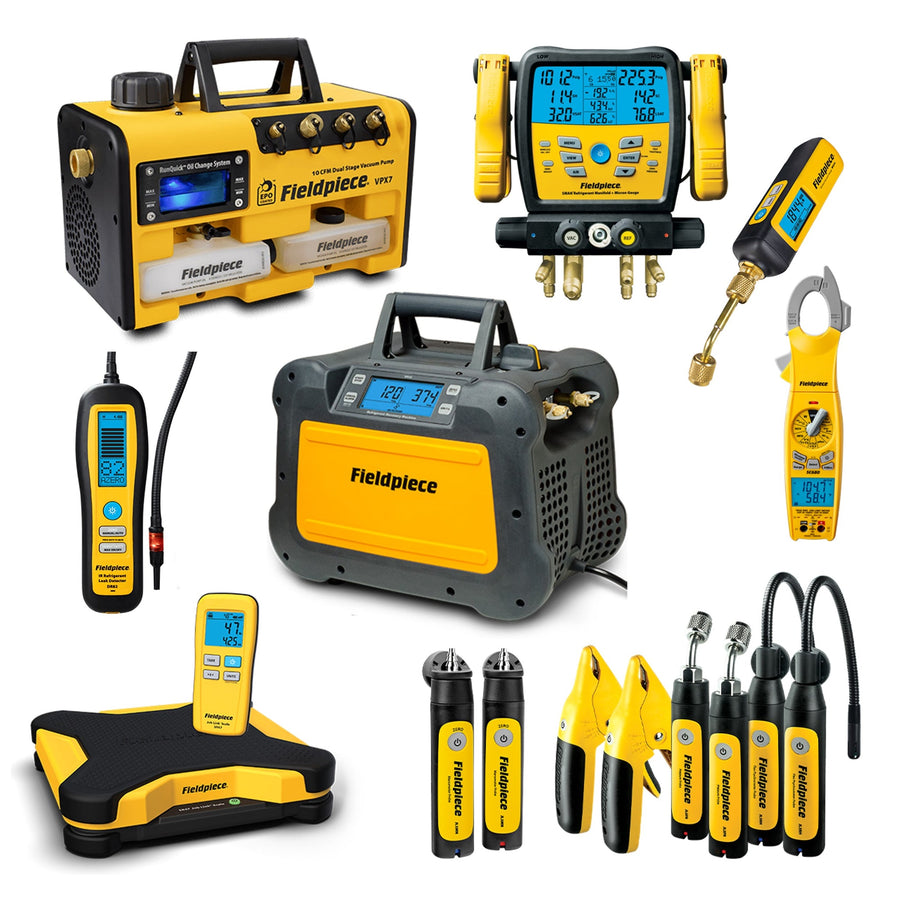
This guide is built around that question: which Fieldpiece tools should you buy first, which ones can wait, and which ones only make sense when your work becomes more advanced. We will cover the essential core tools, show how requirements change between residential, commercial, and refrigeration work, compare apprentice and professional setups, explain how to think about cost without guessing, and briefly compare Fieldpiece against Yellow Jacket, Imperial, and Testo where that helps the decision. The aim is not to talk you into the biggest kit. The aim is to help you choose a smarter one.
If you want the wide-angle view first, the Fieldpiece tool range is the best place to see how broad the current lineup is in Australia. You can then narrow down from there instead of buying randomly. HVACShop’s own essential HVAC tool guide also gives useful context for how Fieldpiece tools are being positioned locally across service, install, recovery, and evacuation work.
The biggest mistake most people make is buying for the dream workload instead of the real one. A first-year apprentice does not need the same tool spend as a refrigeration tech doing daily supermarket plant work. A residential installer does not need the same priorities as a commercial diagnostics specialist. Fieldpiece makes excellent tools, but that does not mean you need every Fieldpiece tool. It means you should choose the Fieldpiece tools that match your actual job type, budget, and upgrade path.
Essential Fieldpiece Tools for Every HVAC Tech
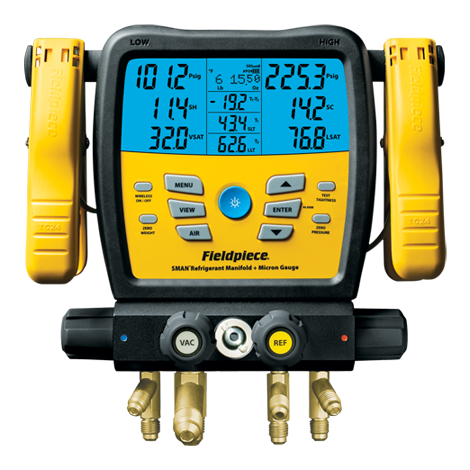
If you strip the buying decision back to essentials, a few Fieldpiece tools stand out as genuine core recommendations. The first is the Fieldpiece manifold options path, especially around the SM480V level if you want a modern refrigerant-side hub. A good manifold matters because it sits in the middle of charging, diagnostics, evacuation verification, and documentation. If your manifold is weak, every refrigerant-side decision gets harder. That is why the manifold is often the tool people remember first when they think about professional HVAC work.
The second essential is the Fieldpiece SC440 clamp meter. For a lot of technicians, this is the most realistic first electronic diagnostic tool because electrical faults show up everywhere. Contactors, capacitors, fan motors, control voltage, inrush, flame sensor checks, and general fault-finding all reward a clamp meter that is built for HVAC work rather than general household testing. The SC440 fits that sweet spot well because it is capable enough for daily service work without forcing you into the most premium purchase straight away.

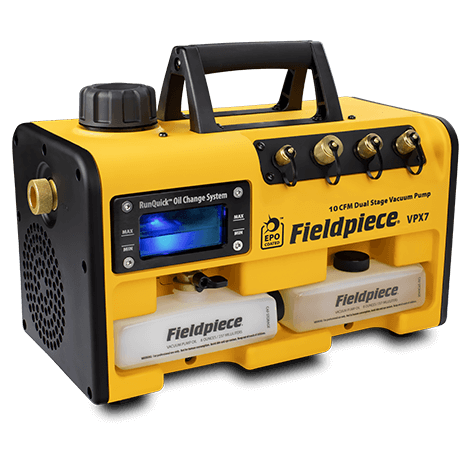
The third essential is the Fieldpiece VPX7 vacuum pump, or at least the decision to prioritise a proper vacuum pump rather than treat evacuation as an afterthought. The reason this matters in a selection guide is simple: evacuation quality prevents repeat faults. A strong vacuum pump saves time and protects the quality of the install or repair. If you are regularly installing, changing out, or opening systems, poor vacuum gear costs you more than good vacuum gear.
The fourth essential is a proper micron gauge, which is why the MG44 keeps turning up in serious Fieldpiece workflows. The important part is not that it is wireless. The important part is that it measures vacuum at the system port instead of misleading pump-side locations. That gives you a truer picture of what the system is actually doing during evacuation. For techs who still rely on “pump sounds fine” logic, this is one of the most valuable upgrades they can make.
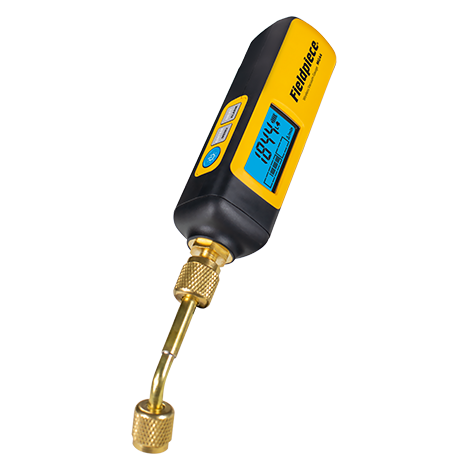
The fifth essential is some kind of probe kit or wireless measurement setup, especially if you are trying to reduce time lost walking between test points. That is where Fieldpiece’s wireless ecosystem becomes practical rather than flashy. A basic probe kit helps you see more of the system at once, speeds up snapshots, and reduces the back-and-forth that eats time on big days. The Job Link wireless ecosystem is especially useful once you start doing repeated charging, commissioning, and diagnostics across multiple locations on the same system.
One tool that sits just outside the “everyone must own this on day one” list is the Fieldpiece MR45 recovery unit. The reason is not quality. It is job mix. It makes excellent sense for many service techs, especially on commercial and refrigeration work, but if your current workload does not involve regular recovery tasks, it can be a second-stage buy rather than an immediate first-stage one.
Put simply, the core recommendations come down to function. A manifold helps you diagnose and charge. A clamp meter helps you test electricals. A vacuum pump and micron gauge protect evacuation quality. A probe kit reduces wasted time and improves system visibility. That is why these tools matter. They cover the calls and decisions most HVAC techs face every week.
A practical core Fieldpiece setup usually includes a manifold, clamp meter, vacuum pump, micron gauge, and either a probe kit or a clear upgrade path into wireless measurement. That combination covers refrigerant-side diagnosis, electrical testing, evacuation quality, and day-to-day service work without overbuying too early.
Fieldpiece Tools by Job Type
Choosing by job type is often more useful than choosing by brand category. Residential installs, commercial service, and refrigeration work all place different demands on the tool bag. That is why “which Fieldpiece tools” has no one-size-fits-all answer. The right selection depends on the kind of systems you touch most often, how much diagnosis versus install work you do, and how far you are from needing full documentation and wireless workflow support.
| Job Type | Essential Tools | Optional / Next-Step Tools | Why This Mix Works |
|---|---|---|---|
| Residential installs | Manifold, vacuum pump, micron gauge, basic clamp meter | Probe kit, wireless scale, recovery unit | Keeps commissioning, evacuation, and first-start checks clean without overbuying |
| Commercial service | Manifold, clamp meter, recovery unit, vacuum gauge | Wireless probes, scale, Job Link workflow, premium kit | Supports faster diagnosis, recovery, and proof on more complex systems |
| Refrigeration work | All core tools including recovery, vacuum, clamp, manifold, micron gauge | Full wireless ecosystem, leak detection, premium kits | Refrigeration rewards full visibility, strong recovery gear, and tighter workflow control |
For residential install work, the basic requirement is pretty clear. You need a manifold, a vacuum pump, a micron gauge, and a clamp meter you trust. That gets you through commissioning, evacuation, electrical checks, and routine start-up work without guessing. The Fieldpiece vacuum pack is the kind of entry option that makes sense here because it supports the vacuum side without forcing a full premium buy immediately. That is often the smartest starting point for installers who want quality but need to watch spend.
Commercial service changes the priority. Electrical diagnosis, refrigerant recovery, and speed between test points matter more, so the value of the MR45 and the wireless side of the Fieldpiece ecosystem rises quickly. On bigger systems, walking back and forth wastes more time and introduces more room for confusion. That is where Fieldpiece wireless tools start earning their keep. Recovery, electrical testing, and reporting also matter more in commercial service than they do on simple domestic change-outs.
Refrigeration work is where the “buy all the core tools” answer starts to make real sense. Recovery matters more often. Vacuum quality matters more often. Leak checks and repeat verification matter more often. Because refrigeration work punishes shortcuts harder than light residential work, the full set of core Fieldpiece tools is easier to justify. In other words, the more critical the system uptime and refrigerant control become, the harder it is to keep working efficiently with a half-built kit.
Apprentice vs Professional Tool Sets
An apprentice does not need the same Fieldpiece toolkit as a fully qualified technician, and pretending otherwise is one of the fastest ways to waste money. For most apprentices, the right starting point is a clamp meter plus access to shared site tools or company-owned bigger gear while skills are still developing. The SC440 is an ideal example of this because it is a daily-use tool that teaches real HVAC electrical testing rather than pushing the apprentice into the most premium purchase straight away. A good clamp meter builds habits that stay useful for the rest of the career.
The next step for most apprentices is either vacuum-side ownership or a better refrigerant-side diagnostic tool, depending on what the employer already provides. If the workplace already supplies manifolds and pumps, the apprentice may be better off buying the SC440 first and then a vacuum gauge or probe kit later. If the workplace supply is weak or inconsistent, then a proper personal vacuum setup can be the better early move because it directly affects install quality and learning. There is no universal answer, but there is a clear rule: apprentices should buy tools that teach correct process, not just flashy features.
Australian apprentice wages are another reason staged buying matters. Apprentice income is tighter, tools are expensive, and it is easy to end up with one premium item but no balanced kit around it. That is why a timeline works better than a wish list. Stage one is electrical basics and vacuum credibility. Stage two is better refrigerant-side measurement. Stage three is wireless workflow or full system matching. That kind of budget progression suits the reality of apprentice cash flow much better than trying to mirror a senior tech’s van from the start.
Professional technicians have a different problem. They are not just buying tools. They are buying time back. That is why the upgrade path often leads to matched kits rather than isolated single products. Once you are doing daily service, longer drives, more customer communication, and more repeat measurement, a full matched system can pay off more clearly. The Fieldpiece advanced HVAC kit is aimed at that professional “everything works together” stage, while the Fieldpiece Beast Mode kit makes sense for tradies who want a more aggressive premium setup.
The best upgrade timeline is therefore about workload, not status. Apprentice does not always mean “cheapest possible”, and professional does not always mean “buy everything now.” The real question is what problem the next tool solves. If the next tool saves time every week, improves diagnosis, or prevents call-backs, it deserves priority. If it just looks impressive on the van shelf, it can wait.
Fieldpiece Tool Investment Strategy
Most people think about tool buying as product choice, but the smarter way is to think about it as investment sequence. A starter kit should cover the tasks you do most often, not the tasks that sound most impressive. For many technicians, that means clamp meter first, then vacuum quality, then refrigerant-side workflow, then connected reporting. When you build in that order, the spend feels controlled and the value appears faster.
Kit versus piecemeal buying is one of the biggest decisions in this process. Buying one tool at a time spreads the pain and gives you more flexibility. The downside is that you can end up with mismatched workflows and a higher total spend over time. Kits remove that mismatch problem. HVACShop’s kit pages show Fieldpiece being sold as a local, coherent system rather than just isolated products, and that is useful for technicians who want fewer compatibility headaches.

Starter kit pricing and individual tool costs will always shift, so the smartest buying guide avoids pretending today’s sticker is permanent. What matters more is structure. Single tools lower the entry cost. Matched kits often improve overall value if you know you will need the full tool chain anyway. In plain English, the best Fieldpiece buying guide advice is this: buy piecemeal when you are still discovering your workflow, and buy bundled when your workflow is already clear.
ROI calculations also need to be honest. The real return from a tool is not its resale value. It is time saved, mistakes avoided, and trust won. If a good clamp meter stops one wrong diagnosis, that has value. If a better vacuum setup avoids one repeat trip, that has value. If wireless tools save fifteen minutes on several jobs a week, that has value. None of those gains feel dramatic in one moment, but over months they matter more than the difference between one good purchase and one average one.
Financing options in Australia are part of that decision too. Flexible payment can make sense when the tool choice is already justified by workload. That does not mean every premium kit becomes a smart buy just because it can be split over time. It means staged or flexible payment can be helpful when you already know the tool is going to solve a real bottleneck in your workflow.
Do not buy for your dream van. Buy for your slowest repeated task. The Fieldpiece tool that removes that bottleneck first is usually the one that earns its cost back fastest.
Fieldpiece vs Competitor Brands
Fieldpiece does not exist in a vacuum. Yellow Jacket, Imperial, and Testo all matter in the Australian HVAC conversation. The smarter question is not “which brand wins everything?” The smarter question is “what is each brand strongest at?” That is the only comparison that actually helps someone choosing tools.
Fieldpiece's strongest advantage is that it is highly focused on HVACR-specific diagnostics and connected workflow. That is why the brand feels especially strong when you want clamp testing, refrigerant-side tools, evacuation verification, and wireless reporting to sit inside one system. For technicians who want one ecosystem rather than a mixed bag of unrelated brands, that is a real strength. Leak detection is another area where that ecosystem logic applies — if you are weighing Fieldpiece detectors like the DR82 or SRL8 against Inficon options like the TEK-Mate or D-TEK Stratus, the Inficon vs Fieldpiece leak detector comparison covers both ranges in full.
Testo is the closest ecosystem comparison because it also offers connected app-based workflows and strong smart probe logic. Where Testo often feels strongest is in app guidance and broad connected measurement coverage. Where Fieldpiece often feels strongest is in the HVACR-specific feel of its tool chain and the way its wireless pieces line up with the daily work of a service technician. That is why the Testo comparison is useful, but it does not make Yellow Jacket or Imperial irrelevant.
Yellow Jacket remains extremely strong in classic HVACR charging and recovery categories. For many techs, Yellow Jacket still means dependable core refrigerant-side hardware. Fieldpiece’s edge is not that Yellow Jacket lacks good tools. It is that Fieldpiece gives you a more integrated modern electronic and wireless workflow around those tasks.
Imperial is a different kind of competitor. Imperial is often part of the conversation for bending, flaring, swaging, and tube-handling gear rather than digital manifolds, wireless scales, or connected clamp meters. So when people ask “Fieldpiece vs Imperial tools,” the useful answer is that they overlap less than some buyers think. Fieldpiece is stronger in modern diagnostic ecosystem thinking. Imperial is stronger in classic specialty hand-tool territory.
Warranty comparison also reflects that difference. The smart move is to compare warranty by product category, not by logo alone. Hand tools, electronic tools, manifolds, and wireless devices do not always live under the same warranty logic even inside one brand. That is why a selection guide should push you to confirm current terms, not assume every product in a catalogue is covered the same way.
For Australian availability, Fieldpiece currently has a very clear local path through HVACShop’s range and kit structure. That makes the buying experience simpler for techs who want to standardise without piecing together five different distributors. That kind of local clarity is one reason “why choose Fieldpiece tools” is a fair question in Australia right now: the brand does not only make strong tools, it is also being sold locally in a way that makes system-building easier.
Fieldpiece Warranty and Support Australia
Warranty and support do not sound exciting, but they matter more once you start building a real toolkit instead of just buying one or two items. The best warranty is only useful if you understand what it applies to, how to register the product if needed, and where you go when something stops working. That is why the after-sales side deserves a place in any proper Fieldpiece tool selection guide.
For Australian buyers, local service confidence also comes from the seller. HVACShop’s Fieldpiece collection pages position the range as something tradies can buy with local assistance rather than through a vague overseas path. That matters because local advice on compatibility, lead times, and kit choice is often worth more than a small headline discount on a random marketplace listing. It also matters when you are buying for a team rather than for yourself.
Calibration services are worth thinking about too, especially for measurement-heavy tools like manifolds, scales, and electrical meters. The safest advice here is practical: if periodic calibration or verification matters to your business, confirm the current local pathway before standardising a fleet. Service options can depend on the specific tool type and distributor support model, so it is better to ask before buying than assume later. That is not a knock on Fieldpiece. It is simply good fleet-planning discipline.
Replacement parts availability also matters more once the kit gets larger. Support pages, repair request processes, and local distributor-backed selling all help, but the smartest move is still to check that the parts and accessories you care about most are easy to source. This is especially true for leads, hoses, sensors, and wear items. A brilliant tool becomes a frustrating tool very quickly if the small parts around it are hard to get when you need them.
The same logic applies to workplace tool requirements. Buying good tools is only part of the safety story. Using them correctly, maintaining them properly, and keeping them fit for purpose is the rest. For that broader reminder, workplace tool requirements and site safety guidance from Safe Work Australia are a useful reference point. Support is not only about fixing broken gear. It is about making sure the tools on your van stay safe, reliable, and fit for the work you are doing.
A strong support pathway matters most when your toolkit starts working as a system. Once you rely on the same brand across diagnosis, evacuation, and reporting, downtime on one key tool can slow the whole workflow.
Build Your Fieldpiece Toolkit
The best way to choose Fieldpiece tools is to start with the work you do most, then build the kit that removes the biggest repeated waste from that work. For many techs, that means clamp meter plus vacuum credibility first. For others, it means manifold plus wireless probes because the biggest time leak is walking and re-checking. For more advanced service and refrigeration techs, it often means moving toward a matched Fieldpiece workflow so recovery, evacuation, charging, and reporting all feel more joined up.
The recommended starting point for most Australian HVAC technicians is therefore simple. Start with a reliable electrical tool like the SC440, then make sure your refrigerant-side process is not weak. That means good manifold thinking, strong vacuum habits, and a micron gauge you trust. Once those basics are solid, the Job Link side and the bigger kits make much more sense, because they are building on correct process rather than trying to replace it.
If you already know you want a broader matched setup, then the clearer options are the brand collection and kit paths rather than piecing things together blind. HVACShop’s shop Fieldpiece tools collection remains the best place to compare the range in one view, while the advanced, Beast Mode, and vacuum pack options are the cleanest way to decide whether you want to start small, go premium, or build in stages. That gives you a selection process that is grounded in job type, budget, and workflow instead of hype.
So when someone asks which Fieldpiece tools they really need, the honest answer is not “all of them.” The honest answer is this: buy the Fieldpiece tools that make your current work faster, cleaner, and more reliable, then add the next piece when it removes the next real bottleneck. That is the smartest way to build a Fieldpiece toolkit that actually earns its place on the van.