
Testo Temperature Probe Kit: Surface, Air and Immersion Guide
Most HVAC/R technicians carry more than one temperature probe. Pipe surfaces, motor housings, air streams, and liquid temperatures each need a different probe shape and measurement method. Buying individual probes one at a time can leave gaps in your kit. You might have the right tool for pipe work, then get caught out when you need an air probe for duct diagnostics or an immersion probe for a chilled water check.
A Testo temperature probe kit solves this by giving you a matched set that covers three measurement categories in one purchase. It includes probes for surface temperature, air temperature, and immersion or penetration temperature. All probes in the kit use Type K Class 1 thermocouples, which means they share the same industry standard connector and voltage curve. They work interchangeably with any Type K input meter you already own.
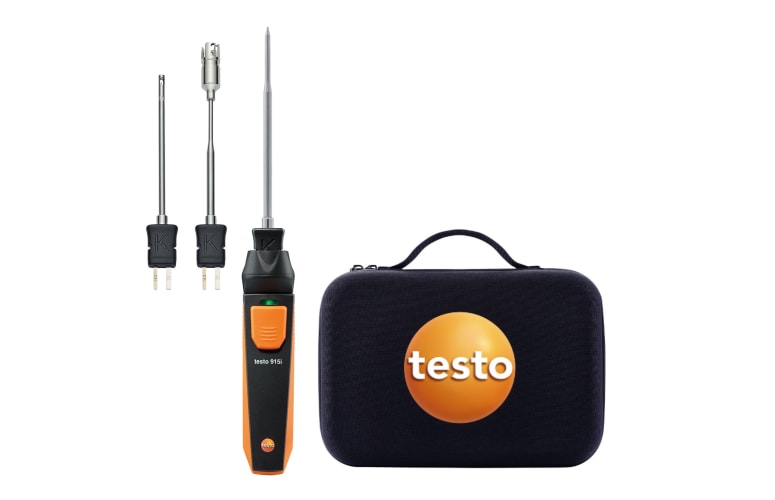
The Testo temperature probe kitTesto Temperature Probe Kit with Immersion/Penetration, Air and Surface Probe contains a surface probe, air probe, and immersion or penetration probe in one matched set. It is designed to cover the main temperature measurement tasks an HVAC technician handles on site.
Written by Rica Francia Macaspac, HVAC Shop content writer, in consultation with Aussie HVAC tradies and industry experts. Published: May 2026 · Last reviewed: May 2026.

What Is in the Testo Probe Kit
The kit contains three probes. Each one is built for a different measurement environment.
The surface probe is a sprung contact probe with a flexible tip for direct measurement on solid surfaces. It is commonly used on motor housings, compressor casings, electrical panels, pipe surfaces, and heat exchanger bodies.
The air probe has a slim tip geometry that is made for air stream measurement. It is used for supply and return air temperatures, duct temperatures, ambient room air, and outdoor air temperature checks.
The immersion/penetration probe is designed to be inserted into liquids, pastes, semi solid materials, and soft foodstuffs. In HVAC work, it is most often used for chilled water temperature checks and cooling tower basin measurements.
All three probes are Type K Class 1 thermocouples. Class 1 is the higher accuracy tolerance class under IEC 60584, so it gives tighter accuracy than the standard Class 2 Type K specification. This matters when you are working to close tolerances, such as refrigerant charging, commissioning checks, and fault diagnosis where one or two degrees can change the outcome.
| Probe | Measurement Range | Application |
|---|---|---|
| Surface, sprung contact | −50°C to +350°C | Motor housings, compressor casings, pipe surfaces, panels |
| Air | −50°C to +400°C | Supply and return air, ducts, ambient air, outdoor air |
| Immersion/penetration | −50°C to +400°C | Liquids, pastes, chilled water, cooling tower basins |
Surface Probe in the Kit
The surface probe included in the kit uses a spring loaded tip that maintains consistent contact pressure against the surface being measured. The spring mechanism is important because it gives you repeatable contact force without needing to press hard on the probe. This reduces measurement variation caused by different operator technique.
The sprung tip is flexible enough to follow slightly curved or uneven surfaces. This improves thermal coupling on motor housings that are not perfectly flat and on compressor casings with cast surface textures.

For surface measurement on flat or broad metal surfaces, such as large motor frames, electrical cabinet panels, and VFD enclosures, a widened tip Type K surface probe provides a larger contact area. This can give more consistent readings where a point contact tip only samples a small patch of the surface.
The kit surface probe covers −50°C to +350°C. That is enough for standard HVAC surface temperature work, including high temperature discharge measurement on compressors. This is especially useful on Darwin and outback WA jobs where ambient heat can push compressor operating temperatures higher.
Tradie Pro Tip: The spring loaded tip in the kit surface probe is more forgiving than a rigid flat tip on cast or textured surfaces. On older compressor casings with rough surface finishes, which are common on commercial equipment that has been in the field for ten plus years, the sprung mechanism helps maintain contact where a rigid tip may rock and give inconsistent readings.
Air Probe Applications

The air probe in the kit is designed for measuring temperatures in air streams rather than on solid surfaces. Three design features separate it from a surface probe.
First, the tip has very low thermal mass. It is slim and uses very little metal, which allows it to respond quickly to changes in air temperature without lagging behind the air stream. Second, the tip shape allows it to sit in the air stream with minimal blockage and good heat transfer between the moving air and the sensor.
Third, in duct applications, the probe tip should not point directly at a heat source such as an electric heater. If it does, the probe may pick up radiant heat instead of measuring the air temperature. Position the tip so it measures the air stream, not a nearby surface.
Common air temperature measurement tasks in HVAC work include supply air temperature at diffusers and grilles, return air temperature at return air intakes, duct temperature at multiple points for air balancing, outdoor ambient air temperature for equipment performance comparison, and room temperature spot checks during commissioning.
In Brisbane and across Queensland, outdoor ambient measurements are a standard part of system performance checks. A 35°C day and a 40°C day can produce meaningfully different cooling capacity results, so documenting the ambient temperature at the time of service supports warranty and performance discussions later.
For demanding outdoor or field applications where the air probe may be exposed to weather, a robust Type K air temperature probe offers a more rugged option for harsh environments.
Immersion Probe Uses
The immersion/penetration probe is the most specialised of the three probe types in the kit. It is designed to be inserted into the medium being measured rather than pressed against a surface or held in an air stream.

For chilled water system work, the immersion probe is used to measure entering and leaving water temperatures at air handlers, fan coil units, and chillers. The probe can be inserted through a thermowell or used for spot checks at accessible water sampling points. On large Sydney CBD commercial buildings where chilled water systems serve multiple floors, accurate entering and leaving water temperature measurement is essential for plant room performance verification.
Cooling tower basin temperature is another common application. It is used when checking basin water temperature as part of cooling tower performance monitoring and Legionella risk management protocols.
The pointed tip design also allows penetration into insulation, foam materials, and semi solids where a surface probe would only sit on top rather than measure internal temperature. For glycol loop systems used in low temperature refrigeration, the immersion probe checks temperature at service points in the chilled glycol circuit.
Thermal mass matters with immersion measurements. Allow time for the probe tip to settle to the liquid temperature. The liquid should be circulating or well mixed for the most representative reading. For related temperature measurement tools beyond the probe kit, browse the full HVAC Shop thermometer range.
Tech Specs: All three probes in the kit are Type K Class 1 thermocouples per IEC 60584. Class 1 gives tighter accuracy tolerances than the standard Class 2 specification. Confirm the specific accuracy tolerance for each probe type against the current Testo datasheet for the kit SKU. Temperature ranges in the table above are indicative.
Type K Thermocouple Compatibility

All three probes in the kit use the standard miniature Type K thermocouple connector. This is the global standard for Type K thermocouple instruments. Any meter with a Type K thermocouple input will accept these probes and measure correctly. You are not locked into a proprietary ecosystem, and the probes will work with any major instrument brand that uses the standard miniature Type K input.
A single Type K meter can accept the surface, air, and immersion probes from this kit one at a time without needing recalibration or setting changes. The meter reads the same Type K voltage curve from all three probes, so you can swap probes while using the same meter and the same accuracy class.
If you need more cable length, such as when reaching a measurement point deep inside a plant room or connecting to a data logger some distance from the probe, a 5m Type K thermocouple extension cableExtension cable, 5m, for thermocouple probe Type K maintains the Type K signal without adding avoidable error. Use only Type K extension cable with Type K probes. Other thermocouple extension cables can introduce voltage errors and cause incorrect readings.
One practical note on colour coding is worth knowing. Under Australian and IEC convention, Type K thermocouples use a green connector. Under US convention, they use yellow. The connector colour may differ, but the thermocouple type and signal are the same. This helps when you are using instruments from multiple regions or sourcing probes internationally.
For Testo meters with Type K inputs, the full Testo HVAC instruments and probes range is available from HVAC Shop.
Did You Know? ARCtick licensed technicians using these probes for refrigerant charging and commissioning work should make sure their licence is current under Australian regulations. The probes themselves do not handle refrigerant, but the charging and commissioning tasks they support do. Visit arctick.org to confirm your ARCtick licence status.
When to Choose the Kit vs Individual Probes
The kit is the right choice in most cases. It suits technicians who are building temperature measurement capability from scratch, doing varied work across surface measurement, air measurement, and liquid temperature checks, and wanting a matched compatible set with known specifications. It usually delivers better value than purchasing each probe individually and saves the time spent checking compatibility across separate purchases.
Individual probes make more sense when you already own two of the three probe types and only need one specific addition. They also make sense when you need a specialised variant that the standard kit does not include. A magnetic probe for motor monitoring, an angled probe for tight coil access, or a waterproof probe for harsh outdoor environments are common additions that require purpose built probe designs.
Multiple copies of the same probe type are another reason to buy individual probes. For example, two clamp probes allow simultaneous suction and liquid line measurement during refrigerant charging, which is a workflow the kit does not support straight out of the box.
For technicians who do motor temperature monitoring alongside standard HVAC diagnostics, the magnetic Type K surface probe is the specialised addition most likely to complement the standard kit. It provides hands free mounting on motor housings, which none of the three kit probes can replicate.
Frequently Asked Questions: Testo Temperature Probe Kit