
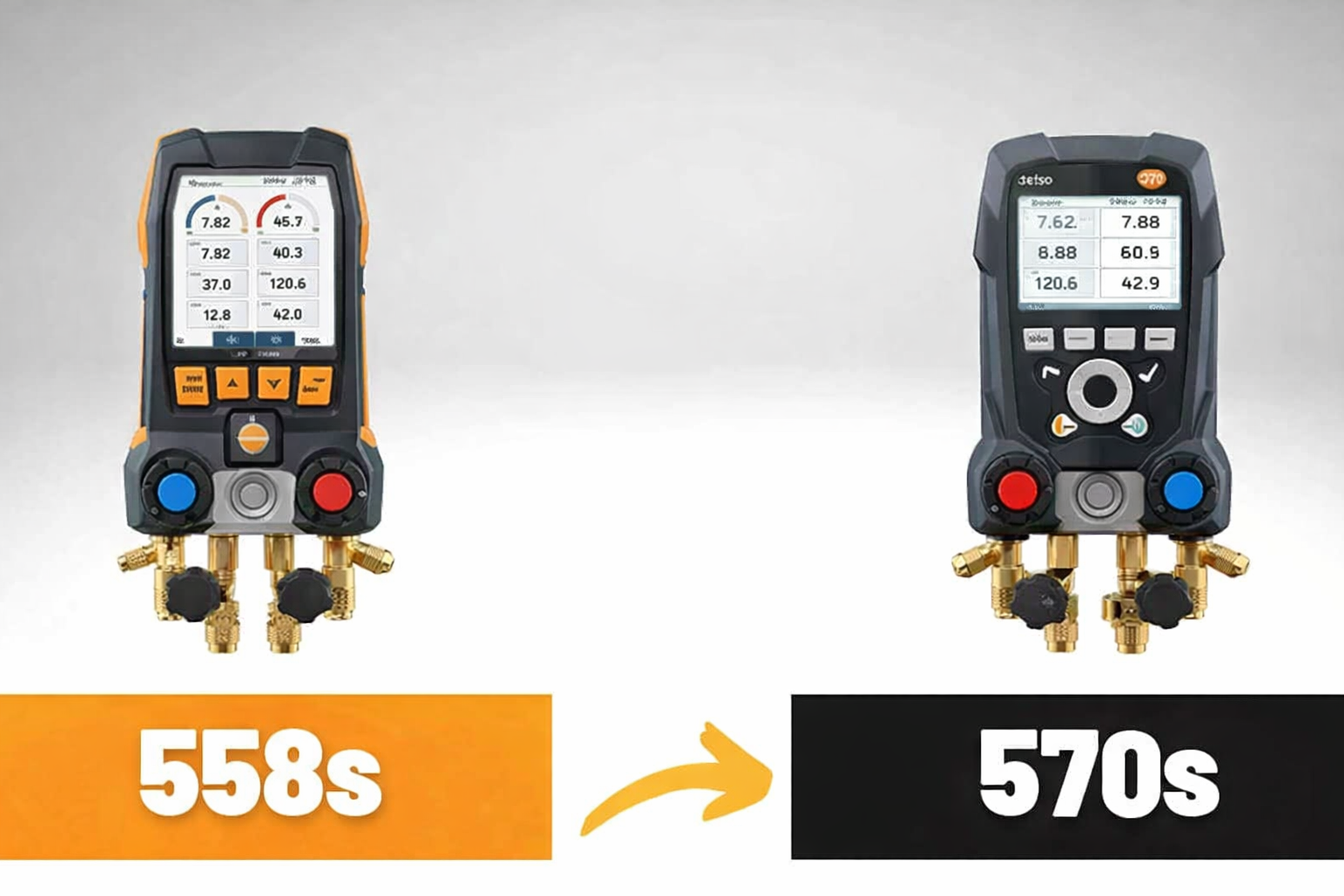
Pro-Grade Testo Manifolds
If you are comparing the testo 558s vs 570s, you are already shopping in the serious end of the manifold market. This is not the usual “entry model versus premium model” conversation. It is a higher-level choice between two pro-grade Testo platforms that overlap in some key areas, but pull in different directions once you look at workflow, logging, reporting, and how the tool fits real commercial HVAC work in Australia.
The confusion is understandable. Both units are 4-way digital manifolds. Both support wireless measurement through the wider refrigeration portfolio. Both sit on the same broad modern Testo platform with app connectivity, A2L and A3 compatibility, IP54 protection, and the same basic pressure range and accuracy class. On paper, that can make the decision look smaller than it really is. In the field, though, the difference becomes clearer very quickly.
The 558s leans hard into guided workflow. It is built to feel intuitive on the tool itself, with touchscreen control, clear measurement graphs, and a job flow that suits techs who want speed and clarity on site. If you want more background on where it sits in the range, this Testo 558s complete guide for Australian HVAC technicians is a useful place to start before getting deeper into the premium comparison.
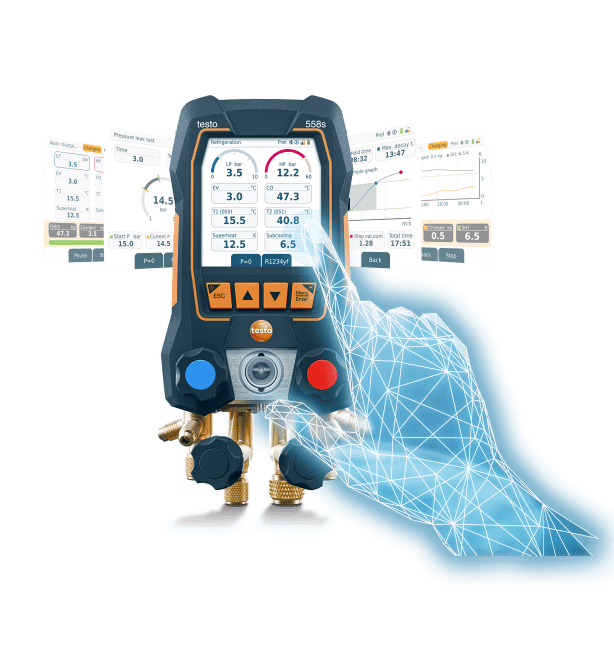
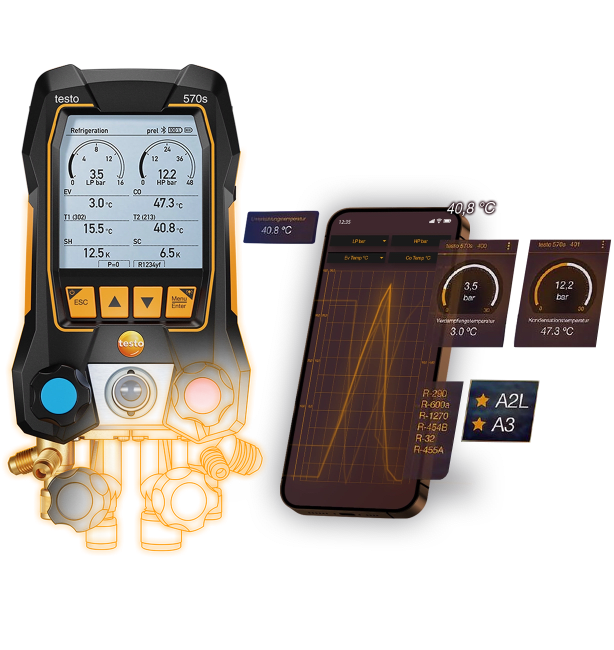
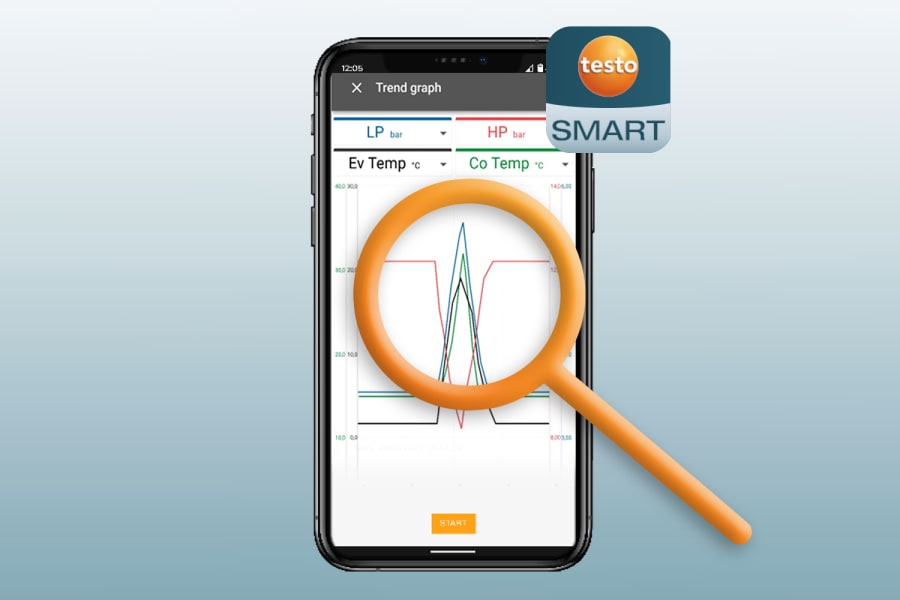
The 570s takes the conversation in a different direction. It is the data-heavy option. Testo positions it around long-term measurement, intelligent error analysis in the Smart App, long runtime, large memory, and a more reporting-oriented mindset. That is why this is not just a simple “which one has the nicer screen?” decision. It is really a question of whether you want the smoother guided-workflow tool or the stronger logging-and-analysis tool.
This guide is written for Australian techs, contractors, and facilities people who want a proper answer to 558s or 570s without drifting into catalogue fluff. We will walk through what each model does best, where the real differences sit, and how to decide based on commercial HVAC work, client reporting needs, budget, and the kind of jobs that fill your week.
Testo 558s: Guided Workflow Platform
The 558s makes the strongest case for itself through ease of use. Testo describes it as giving an “intuitive app feel” in the manifold itself, with touchscreen control, a large colour display, clear measurement graphs, and the option to fall back to keypad operation when you are working with gloves. That sounds like a small convenience until you are on a plant room call, balancing tools in one hand, reading pressures in poor light, and trying not to waste time jumping in and out of menus. That is where the 558s earns its place.
It is also well past the “basic refrigerant gauge” stage. The 558s stores 96+ refrigerants on the official Australian product page, supports favourites for quicker recall, and ties together superheat, subcooling, tightness testing, evacuation, filling, Delta T and other measurement programs from one manifold body. That is a big reason why the testo 558s display and workflow conversation matters so much. Buyers are not really asking whether the screen looks nice. They are asking whether the tool helps them move faster and think more clearly when the job gets busy.
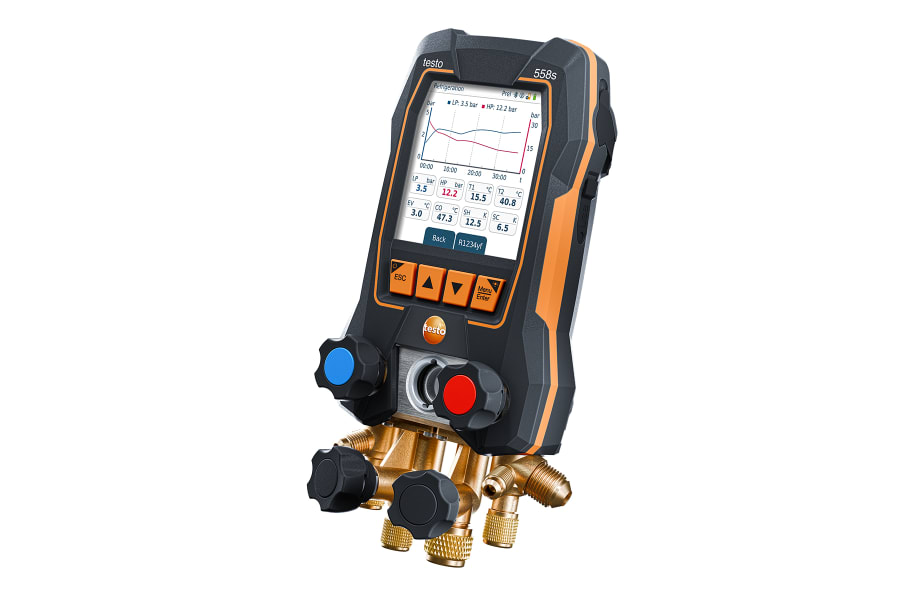
The data side of the 558s is solid, but it is not the main reason people buy it. Officially, it can record readings for up to 30 minutes as trend curves, and that can be extended to 72 hours. That gives it enough logging for many diagnostic and commissioning tasks, especially when paired with Smart App export on site. If you want the local product view, the Testo 558s smart vacuum kit with hoses gives the current Australian retail context, while our comparison on Testo 558s vs 557s guide for Australian HVAC techs shows where the 558s sits against the more mid-tier smart option in the same family.
From a build and measurement point of view, the 558s is properly commercial-grade. On the official Testo AU page it shares the same -1 to 60 bar pressure range, ±0.25% fs accuracy, IP54 protection class, 150 m radio range, and 3 x 7/16" UNF plus 1 x 5/8" UNF port arrangement as the 570s. That means the step from 558s to 570s is not about escaping an under-specced platform. The 558s is already a serious manifold. The real question is whether its guided, touchscreen-led workflow is the better fit for how you work.
It also carries a more moderate premium than the 570s conversation usually does. HVAC Shop currently lists the 558s HVAC Manifold Kit at A$1,699.99, and Testo AU lists multiple 558s kit configurations around the same general professional tier depending on included probes and hoses. That gives the 558s a useful middle position: clearly premium, but still easier to justify than the data-heavy top end if your business mostly needs fast diagnostics and smooth job flow rather than long-run monitoring.
Testo 570s: Data Logging Powerhouse
The 570s is the model buyers look at when guided menus are no longer the main event. This manifold is built around long-term measurement, larger memory, and post-measurement analysis. Testo AU describes it as the “optimal solution for long-term measurements” on refrigeration systems, air conditioning systems, and heat pumps, and says it combines intelligent error analysis in the Smart App with up to 360 hours of runtime. That is the first big clue about who it is really for.
In practical terms, the 570s suits people who do not just want to see what the system is doing right now. They want to catch what it does over time. That matters on larger commercial work where faults are intermittent, loads change during the day, and one snapshot can miss the real problem. Instead of treating the manifold as a quick-read field tool, the 570s treats it more like a serious diagnostic recorder that also happens to be a manifold. Its large screen, graphical progression display, long battery life, and app-based anomaly detection all support that role.
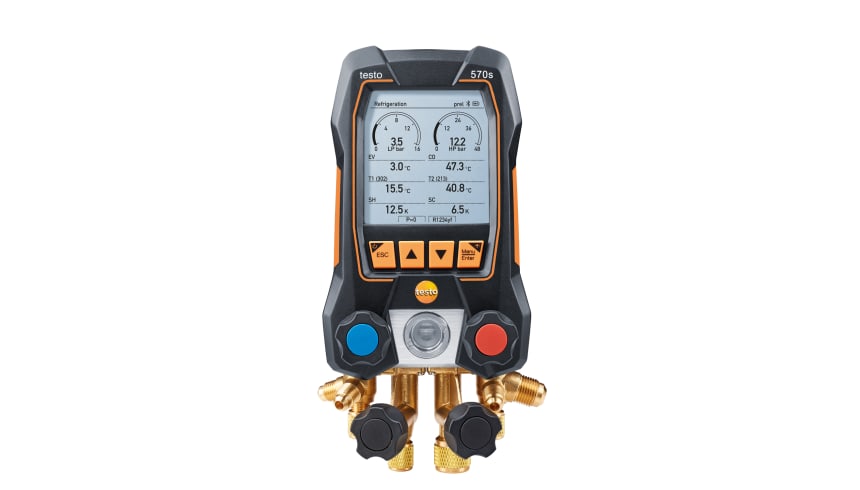
The 570s also carries a bit of history in the market. A lot of buyers come into the testo 570s vs 558s search with the older Testo 570 reputation in mind. Earlier 570 kits were widely associated with 999 hours of internal memory and optional EasyKool PC software for graphing, protocol creation, and refrigerant updating. In the current 570s material, Testo emphasises large data memory, long-term measurement, Smart App analysis, and professional reporting rather than foregrounding EasyKool in the same way. So if an EasyKool-style PC workflow matters to your business, it is smart to confirm the exact export path on the current datasheet and supply package before ordering.
This is also why the 570s feels like the highest tier in the everyday manifold conversation. It is not mainly about looking better on a shelf. It is about being better suited to long-term monitoring, client-facing reports, and jobs where you need more than a quick superheat and subcooling check. The Smart App’s professional reporting tools matter here because the value of the 570s is not only what it measures. It is what you can show the client, the facilities manager, or your own service records after the measurement is done.
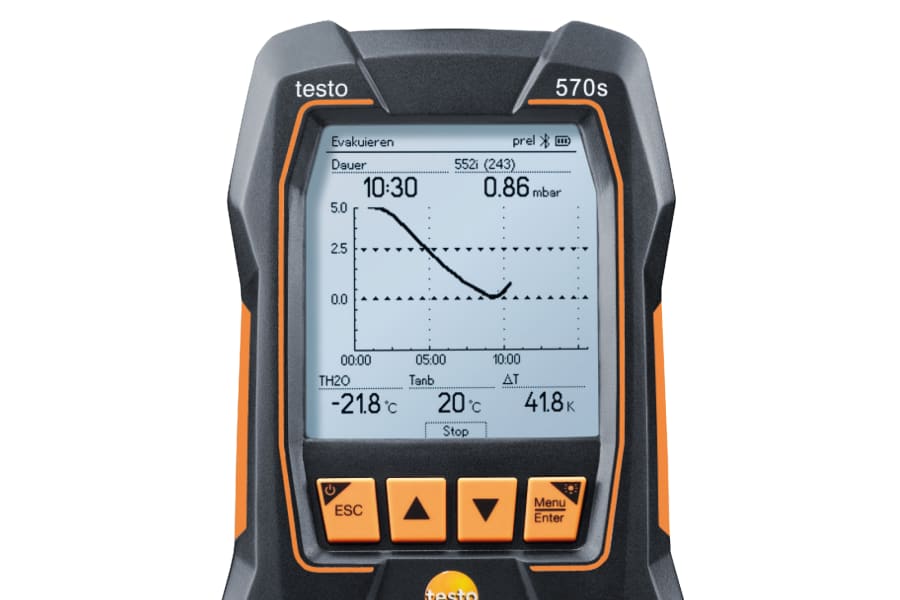
There is one more Australian buying detail worth knowing. On Testo AU, the 570s base manifold remains listed, but the Smart Vacuum Kit and the Smart Vacuum Kit with clamp meter are both marked “Product no longer available.” That does not make the 570s irrelevant, but it does mean availability and kit comparison can be less straightforward than with the 558s. In plain English, the 570s is still a serious option, but you may need to think more carefully about configuration, sourcing, and whether you are comparing bare manifold against full kit.
558s vs 570s: Feature Comparison
Before you look at the table, one point matters: this is not a “good, better, best” ladder in the usual sense. The two tools overlap heavily on core measurement ability. Both have the same pressure range, the same stated pressure accuracy, the same IP54 rating, the same key port layout, and the same general Bluetooth-connected ecosystem. The meaningful difference is how they help you work, how they log data, and how much of your business depends on long-term monitoring and polished documentation.
| Capability | Testo 558s | Testo 570s | Who has the edge? |
|---|---|---|---|
| On-tool workflow | Touchscreen, clear menus, app-like feel, keypad backup | Large screen with graphical progression, but more data-focused positioning | 558s for ease |
| Refrigerant coverage | 96+ refrigerants stored, favourites supported | Modern premium platform with A2L/A3 suitability | Close |
| Guided measurement programs | A strong selling point | Capable, but not the main buying story | 558s |
| Short-run trend visibility | 30-minute trend curves, extendable to 72 hours | Built for long-term measurement and large-memory use | 570s for logging depth |
| Runtime | Up to 70 hours with backlighting and Bluetooth | Up to 360 hours headline runtime position | 570s |
| Reporting focus | Fast on-site Smart App report export | Better fit for heavy reporting and longer evidence trails | 570s |
| Australian buying simplicity | Easy to understand and easy to find as a current retail kit | More dependent on exact configuration and current availability | 558s |
| Value for most commercial contractors | Strong | Excellent when logging/reporting is central | Depends on use case |
Tech Specs
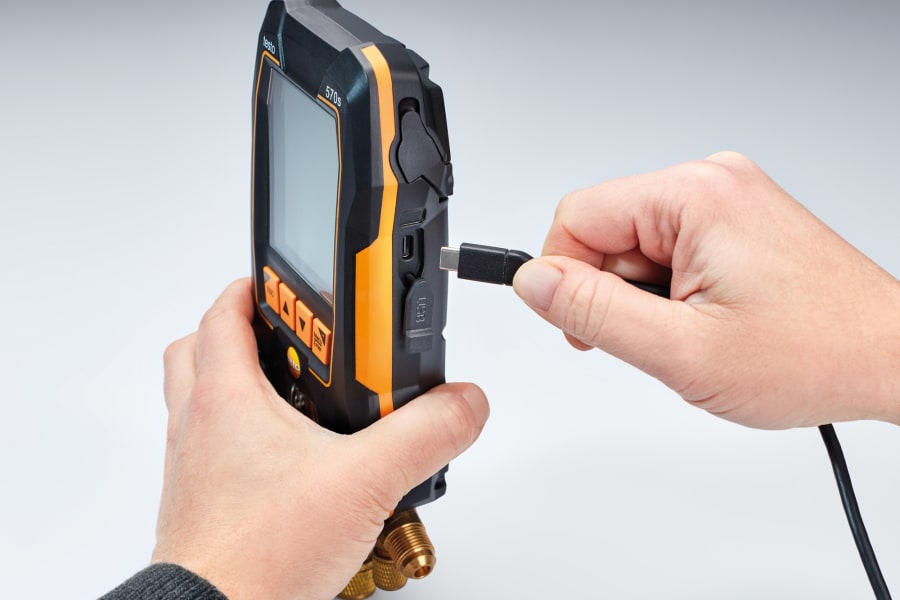
Official Testo AU specs put both manifolds at -1 to 60 bar pressure range, ±0.25% fs accuracy, IP54 protection, 150 m radio range, and the same core port layout. So the testo 558s vs 570s difference is much more about workflow, runtime, and data handling than about one model having a dramatically stronger basic pressure platform.
If you strip the comparison back to one sentence, it looks like this: the 558s is the better choice for guided programs, on-tool clarity, and faster everyday diagnostics, while the 570s is the better choice for long-run data capture, deeper evidence, and more demanding reporting workflows. That is the cleanest way to answer testo 570 vs 558s without turning the whole conversation into a spec-sheet shouting match.
When to Choose 558s
The 558s is the right answer for a lot of commercial HVAC contractors because most commercial work still happens in normal service rhythm. You arrive, connect, diagnose, verify, adjust, document, and move on. Even on larger systems, you often want the tool to speed up your thinking rather than turn every call into a long-run monitoring exercise. That is where the 558s shines. Its guided programs, touchscreen-led navigation, and fast Smart App export make it feel lighter in use even though it is still a premium instrument.
It is especially strong when you deal with multiple system types across the week. One day you are on a commercial split. Next day you are on a heat pump. Then it is a refrigeration service call with a client waiting for a quick answer. In that kind of schedule, guided workflow matters. It reduces the chance of tapping around in the wrong screen, missing a simple setup step, or slowing yourself down when the real value is being able to diagnose confidently and get on with the job.
The 558s also makes sense if you want a premium manifold but still need to keep budget under control. It is not cheap, but it is easier to justify when your business benefits more from smooth daily use than from long-term logged evidence. This is the exact sort of buyer who ends up reading our guide to Testo 558s feature guide for Australian HVAC technicians and then checking the Testo 558s kit guide for Australian HVAC technicians to make sure the included setup matches the work in the van.
There is also a very practical Australian reason to lean 558s. A lot of site work is messy, rushed, and weather-affected. Brisbane humidity drags out checks. Sydney coastal jobs mean salt, glare, and awkward roof access. Melbourne cold snaps mean gloves and less patience for clunky controls. In those conditions, clear menus and simple navigation are not “nice extras”. They reduce small mistakes and save time on the kind of jobs that make up the bulk of real trade work.
Pro Tip
Choose the 558s when your main pain point is job flow, not evidence depth. If you spend more time moving from system to system than you do leaving a manifold in place for long-run capture, the 558s usually feels like the smarter premium buy.
One more checkpoint: if you are reading this and thinking both models sound more premium than you really need, step back before overspending. Our article on the Testo 557 vs Fieldpiece comparison for Australian HVAC technicians is useful for buyers who want to compare against a less data-heavy, less premium path before committing to the high end.
When to Choose 570s
The 570s is the better answer when you do work where “what happened over time” matters just as much as “what is happening right now”. Large commercial installations, long-duration monitoring, intermittent faults, and client reporting are the classic cases. On those jobs, a manifold is not just a service instrument. It becomes part of your evidence trail. That is where the 570s starts to justify its place.
Think about a supermarket case problem, a plant room complaint that only appears under load change, or a site where the facilities manager wants more than verbal reassurance. In those situations, the 570s makes sense because it is built around long-term measurement, large data memory, intelligent error analysis, and a longer-runtime operating style. That lets you capture a fuller story, not just a single service snapshot.
It is also the better fit where reporting is part of the commercial value you offer. The Smart App’s reporting tools matter more when you are working for facilities teams, contractors managing service agreements, or clients who expect documented proof rather than just a quick explanation beside the condensing unit. That reporting value is one of the real reasons some buyers see the 570s as the best testo manifold pro option. Not because every pro needs it, but because the pros who do this kind of work will feel the difference immediately.
There is also a compliance and process angle. On larger commercial HVAC and refrigeration work, good tools do not replace proper refrigerant handling obligations, but they do support cleaner records and more defensible service practice. That is one reason it is worth keeping ARCtick refrigerant handling licensing requirements in mind when you are setting up measurement and reporting workflow for jobs involving refrigerant handling in Australia.
The 570s is not the right pick simply because it is “more”. It is the right pick when maximum features line up with real business needs: long-term monitoring, deeper fault capture, more structured reporting, and a service model where your documentation is part of what the client is paying for. If that is not your world, the extra capability may sit there unused. If it is your world, the 570s can be the difference between a rough guess and a well-supported diagnosis.
558s vs 570s: Australian Investment
The investment question is where many buyers get stuck, because the shelf-price story is not as neat as they expect. HVAC Shop currently lists the 558s HVAC Manifold Kit at A$1,699.99, which gives a clear local benchmark for the guided-workflow model. The 570s is trickier because Testo AU still lists the base manifold, but its Smart Vacuum Kit pages are marked “Product no longer available,” which means Australian buying paths can depend more on exact kit configuration and reseller availability than on one neat public list price.
That is why the price difference can feel significant even when headline numbers do not tell the full story. With the 558s, you are usually buying a premium manifold for faster field workflow. With the 570s, you are often really buying into a different way of working: longer logging, more analysis, more professional reporting, and sometimes a more involved measurement setup overall. Comparing them as if they were two identical kits with different badges can lead you in the wrong direction.
Return on investment is also different. The 558s pays you back through speed, ease, and lower daily friction. The 570s pays you back through stronger evidence, long-run fault capture, and reporting value on commercial clients. If your business wins work and keeps clients because you can show a cleaner diagnostic trail, the 570s case gets stronger. If your business wins by moving quickly, working cleanly, and reducing wasted time across many standard jobs, the 558s often looks smarter.
Another factor is positioning. The 570s can support a more high-end diagnostic image because it fits long-term monitoring and professional reporting more naturally. But there is no point paying for professional positioning if the work itself does not demand it. Plenty of excellent contractors will make more money from a 558s because it fits their workload better, gets used harder, and avoids tying up capital in features they do not monetise.
Did You Know?
Part of the 570s reputation still comes from the older Testo 570 era, where 999-hour memory and EasyKool PC workflows were central talking points. The current 570s continues the data-heavy mindset, but the official Australian messaging now leans more on long-term measurement, intelligent Smart App analysis and extended runtime.
If you want to compare these tools inside the broader brand ecosystem rather than in isolation, the Testo HVAC instruments and digital manifolds for Australian technicians are worth reviewing. That wider view often makes the decision easier because you can see whether you are buying a manifold only, or building a bigger connected workflow around probes, vacuum measurement, scales, and reporting habits.
Choose Your Pro Testo Platform
So which one should you choose?
Pick the 558s when you want the premium manifold that feels easiest to use on the job. It is the better answer for contractors who value guided menus, strong on-tool visibility, quick app reporting, and a premium platform that still makes sense as a daily commercial workhorse. It is the model that best suits techs who want fewer little workflow annoyances and more confidence moving through service and commissioning tasks.
Pick the 570s when logging and reporting are central to the job. If you do long-duration monitoring, chase intermittent faults, leave stronger evidence trails for clients, or need the manifold to support a more report-heavy diagnostic process, the 570s is the more natural fit. That is the cleanest answer to both testo 558s vs 570s and the reverse search, testo 570s vs 558s.
The simplest way to frame the whole decision is this: the 558s is the premium workflow manifold, while the 570s is the premium logging manifold. Neither choice is wrong. The wrong choice is buying the data-heavy tool when you really needed speed, or buying the smoother workflow tool when your business really needed deeper evidence.
If you are leaning 558s, read the Testo 558s complete guide for Australian HVAC technicians again, then compare the actual local package on the Testo 558s smart vacuum kit with hoses. If you are still unsure whether the 558s or 570s better suits your workload, talk to our team to confirm compatibility, job fit, and the smartest setup for your Australian service work.