
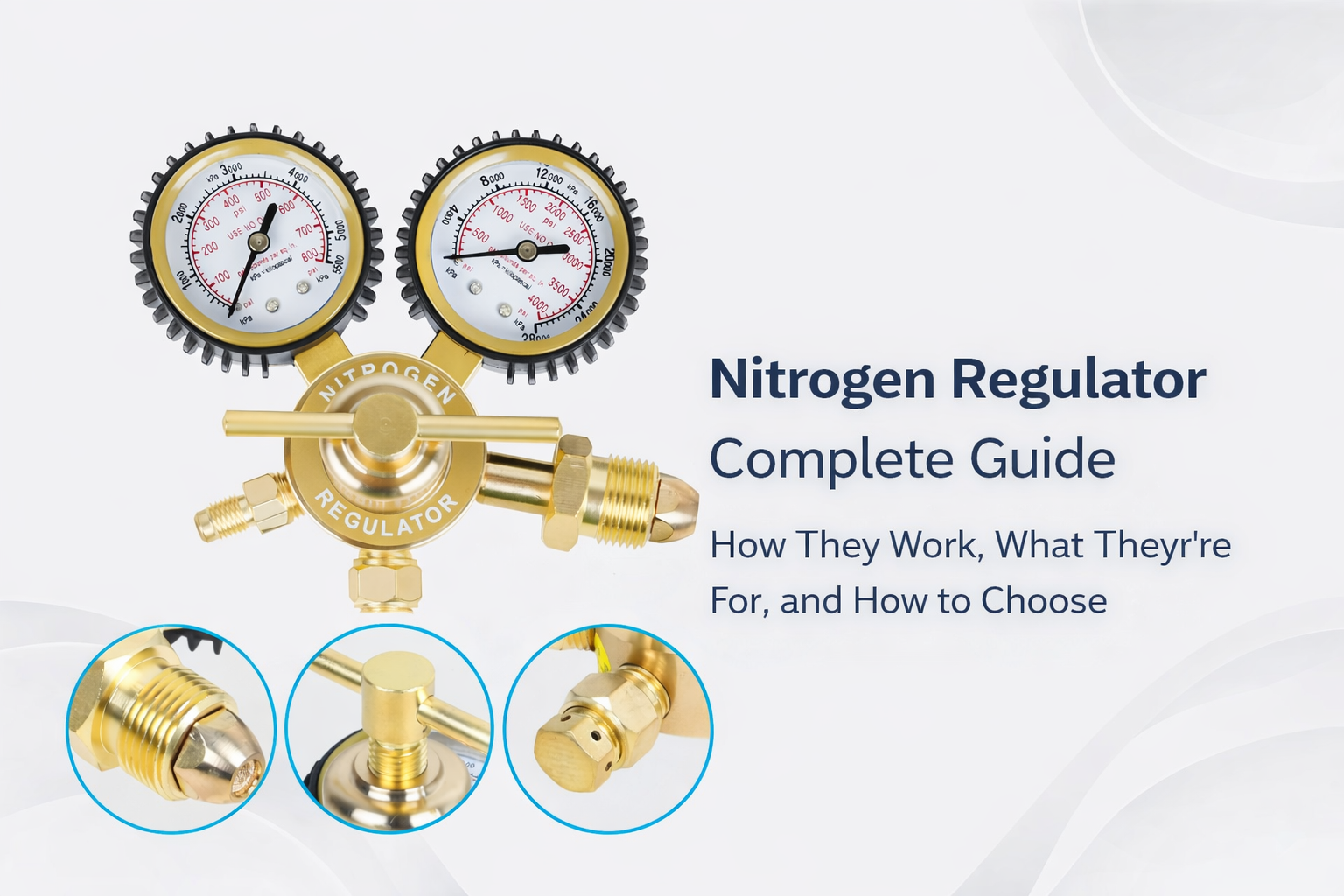
Essential Pressure Control: The HVAC Nitrogen Regulator Guide
If you work in HVAC or refrigeration in Australia, you’ll use nitrogen sooner or later. You’ll use it to pressure test, to find leaks, and to gently purge while brazing so you don’t cook the inside of the copper. And for every single one of those jobs, the quiet hero in the back of the van is the nitrogen regulator.
A full nitrogen cylinder holds serious, lethal pressure. If you try to “wing it” with the wrong setup, a cheap regulator, or stripped threads, you can do real damage. You can violently over-pressurise a system, blow out weak joints, destroy compressor valves, or turn a simple leak test into a noisy, dangerous mess. The scary part is, a failing regulator can feel fine in the moment, then slowly bleed pressure and bite you later as a call-back.
This guide is here to make that risk much smaller. We’ll walk through what a nitrogen regulator is, how the internal mechanism actually works, the core HVAC uses, and how to choose a model that survives real Aussie job sites. No fluff. Just the stuff that helps you do cleaner work and get home on time.
When you’re ready to compare options, start with our Nitrogen Regulators and Pressure Control range so you can see the common styles side-by-side. Building a full service kit? Our guide to Essential HVAC Tools for Professionals will ensure you haven't missed any basics.
What is a Nitrogen Regulator?
A nitrogen regulator is a heavy-duty pressure control valve that sits directly between a high-pressure nitrogen cylinder and your HVAC manifold hoses. Its job is simple: take massive, unusable cylinder pressure (often 2000+ PSI) and step it down to a safe, highly controlled outlet pressure that you can actually use.
In HVAC, we use nitrogen because it’s dry and completely inert. It doesn’t burn, it doesn’t support combustion, and it doesn’t react with copper the way oxygen does. Crucially, because it’s dry, it prevents you from pumping atmospheric moisture into a system while you’re testing it. That matters heavily on muggy Queensland days or when a system has been open to the elements for hours.
Single-Stage vs. Two-Stage Regulators
There are two common regulator styles you’ll see in the trade:
- Single-Stage: Reduces pressure in one single step. These are incredibly common and widely used. The minor drawback is that as the cylinder empties, the outlet pressure can shift slightly, meaning you need to keep an eye on your gauges during long tests.
- Two-Stage: Reduces pressure in two separate steps. The goal here is dead-steady outlet pressure, regardless of how empty the main cylinder gets. If you are doing long, overnight commercial pressure tests, that stability is a massive advantage.
How Nitrogen Regulators Work (The Internals)
Even though a regulator looks like “two gauges and a brass knob”, there’s a lot going on inside. Understanding this helps you troubleshoot issues like pressure creep.
- High-Pressure Inlet (Cylinder Gauge): This connection screws onto the cylinder valve. One gauge shows the raw cylinder pressure, letting you know how much gas you have left.
- The Diaphragm & Seat: Inside the brass body is a valve seat controlled by a heavy spring and a diaphragm. High-pressure gas pushes on one side; the spring balances it on the other. This creates the safe, reduced pressure output.
- The Control Knob (T-Bar): Winding the control knob in (clockwise) compresses the spring, increasing the outlet pressure. Winding it out (anti-clockwise) releases the spring, lowering the pressure.
- Low-Pressure Outlet (Delivery Gauge): This second gauge shows the exact pressure you are sending down your yellow service hose and into the HVAC system.
Pro Tip: If your outlet pressure slowly creeps up after you’ve stopped turning the knob, don’t immediately jump to "I have a system leak". First, close the valve on your manifold and watch the regulator gauge. If the pressure continues to creep up, the internal seat of the regulator is worn out or dirty and the tool needs replacing.
Essential HVAC Applications
Nitrogen regulators show up for three core HVAC tasks. If you want step-by-step handling tips, read our guide on How to Use Nitrogen Regulators.
| HVAC Job | Why It Matters | What the Regulator is Doing | Common Mistake to Avoid |
|---|---|---|---|
| Brazing Purge | Prevents internal black scale (oxidation) that blocks TX valves and cap tubes. | Provides a highly controlled, very low pressure (2-5 PSI) to trickle gas through the pipe. | Turning the pressure up too high and blowing the liquid silver solder right out of the joint. |
| Leak Testing | Finds micro-leaks before evacuation, saving hours of wasted vacuum pump time. | Builds high static pressure calmly, allowing you to monitor for a steady gauge drop. | Pressurising too fast, causing thermal expansion that tricks you into thinking there is a leak as the gas cools. |
| Pressure Testing | Scientifically proves the system can handle OEM working pressures. | Lets you set and hold an exact target test pressure safely. | Guessing test pressures instead of checking the indoor unit's data badge. |
Key Features to Look For
Not all regulators are created equal. A cheap unit might look identical on the shelf, but will behave terribly on the tools.
- HVAC-Specific Pressure Range: Buy a regulator that comfortably covers the 400-600+ PSI test pressures required for modern R410A and R32 systems. Welding regulators cannot safely reach these pressures.
- Gauge Readability: If the gauge face is tiny, foggy, or the needle bounces around, you can't trust your leak test. Look for large, high-contrast gauges.
- Smooth Adjustability: The T-Bar knob should wind in smoothly. If the pressure jumps violently from zero to 300 PSI with a tiny twist, the internal spring is junk and the tool is dangerous.
- Solid Brass Construction: Regulators live a hard life in the back of a ute. Choose forged brass bodies that can handle being knocked around in a crate.
Nitrogen Regulator Brands in Australia
Australian tradies have a few solid options when it comes to professional HVAC regulators. Here is what to look for based on your daily grind.
Bradley NR1000 (The Professional Workhorse)
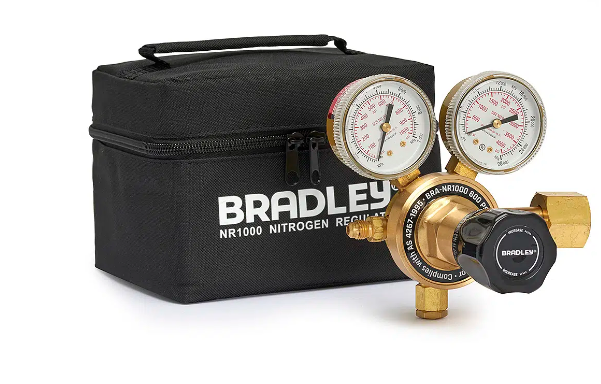
The Bradley NR1000 Nitrogen Regulator is positioned purely for heavy-duty HVAC workflows. If you are doing daily pressure testing and need dead-stable control with massive, highly visible gauges, this is the unit that most commercial techs trust.
Mastercool 53004 (The Familiar Standard)
The Mastercool 53004 Nitrogen Regulator is incredibly well known. Familiarity is a genuine advantage if you are equipping an entire fleet of vans and want every apprentice using the exact same gear to build muscle memory.
Mastercool 53040 (The Complete Kit)
Some teams prefer buying a ready-to-go kit to eliminate setup guesswork. The Mastercool 53040 Complete Testing Kit bundles the regulator with dedicated testing hoses and adapters, making it brilliant for standardising a crew's workflow.
Did You Know? Many “the test won’t hold” dramas are not leaks in the copper pipework at all. They are micro-leaks in old manifold hoses, loose valve cores, or the regulator connection itself. Always leak-test your own setup with bubble spray before assuming the system has a leak!
Invest in Quality Regulation
A nitrogen regulator is one of those tools that quietly protects your reputation. It controls lethal cylinder pressures, gives you a clear window into the system via the gauges, and guarantees you aren't leaving black soot inside a customer's new compressor.
If you take one thing from this guide, make it this: never treat pressure control as an afterthought. Match the regulator to your specific workflow, always use a slow, controlled pressure build-up, and buy a unit built to survive the Aussie trade.
Ready to upgrade? You can browse our full collection of Nitrogen Regulators Australia-wide right here.
Frequently Asked Questions (FAQ)
What does a nitrogen regulator do in HVAC work?
It reduces very high cylinder pressure (often 2000+ PSI) down to a controlled, safe outlet pressure that you can use for brazing purge, leak testing, and pressure testing. The main benefit is absolute control: you can build pressure calmly, monitor it accurately, and avoid blowing apart weak joints.
Single-stage vs two-stage nitrogen regulator: what’s the difference?
A single-stage regulator reduces pressure in one step. The outlet pressure can vary slightly as the main cylinder empties, so you need to watch and adjust it. A two-stage regulator reduces pressure in two distinct steps to keep the outlet pressure dead-steady, which is highly useful on long, overnight commercial tests.
Why does outlet pressure sometimes creep up after I set it?
Pressure creep happens if the internal regulator seat is worn out, dirty, or not sealing correctly. A practical way to check is to close the manifold valve to isolate the regulator from the system and watch the gauge. If it still rises without you touching the knob, the internal mechanism is failing.
How should I set up nitrogen for a brazing purge?
Use the regulator to set a very low outlet pressure (around 2-5 PSI) to create a gentle whisper of flow through the pipework. The most common mistake is turning the pressure up too high and blowing the liquid solder out of the joint. You are simply trying to displace oxygen, not pressurise the pipe.
What should I check before buying a nitrogen regulator in Australia?
Confirm it is specifically rated for high-pressure HVAC testing (not low-pressure welding). Check the inlet rating, the maximum outlet range (must comfortably reach 600+ PSI for R32/R410A), and the gauge readability. Finally, confirm the cylinder connection type matches your local gas supplier's bottles.