
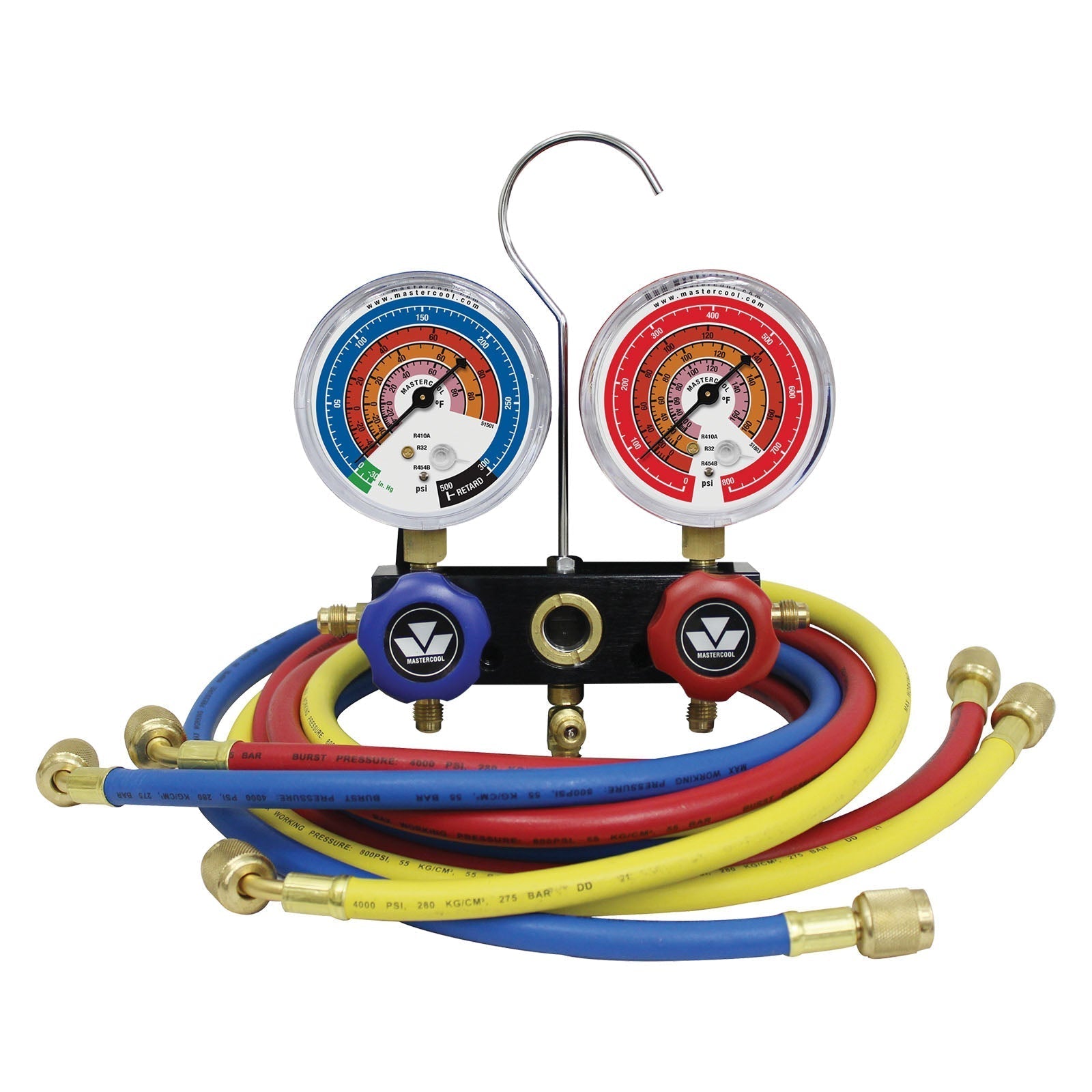
R32 Compatible Manifolds: Mastercool Modern Systems Guide
R32 is now the main refrigerant used in new homes and small businesses across Australia. This is changing what tools you need. Most of your old R22 and R410A gear still works fine with R32. But manifold gauges are different. Using the wrong gauge on R32 is not just bad for performance. It is a real safety risk.
This guide explains why R32 needs special manifold gauges. It shows you how to check if your current gauges are safe for R32. It also covers how charging an R32 system is different from an old R22 job. Want the step-by-step reading technique first? Check out the Mastercool manifold gauge reading guide. It covers superheat and subcooling in full detail.
Written by Rica Francia Macaspac, HVAC Shop content writer, in consultation with Aussie HVAC tradies and industry experts. Published: June 2025 · Last reviewed: June 2025.

Why R32 Needs Different Manifolds
The move from R22 to R410A was mostly about pressure. R410A runs at about 60 percent higher pressure than R22. This forced the whole industry to upgrade their tools. R32 is a bit different. It runs at a pressure close to R410A, well above R22. But R32 also has a flammability rating that R410A does not have. These two facts together make manifold compatibility a real issue, not just a sales pitch.
The Pressure Difference from R22
R22 runs at fairly low pressure. On a normal Australian summer day, suction pressure sits around 70 to 90 PSI. Discharge pressure sits around 200 to 250 PSI. Manifold gauges built for R22 are designed for these lower numbers.
R32 runs much higher. Suction pressure is usually 100 to 130 PSI. Discharge pressure often hits 350 to 450 PSI. An old R22 gauge used on an R32 job might hit or pass its safe limit. This is a real risk on hot summer days in Darwin, western Sydney, or inland Queensland. The gap is not small. It is big enough to stress a gauge that was not built for it.
R410A and R32 run at similar pressures. So a gauge rated for R410A is usually fine for R32 too. The risk is with older gear made only for R22. When in doubt, check the gauge's rated maximum pressure. Compare it to the refrigerant you are using right now, not the one it was sold for years ago.
R32's A2L Flammability Classification
R32 is rated A2L. This means it is mildly flammable under the official safety rules. This is a different safety category to R22 and R410A, which are both rated A1, meaning non-flammable. R32 can catch fire under certain conditions. It needs more energy to ignite than truly flammable gases, and only a narrow range of conditions will set it off. But the risk is real in a way it simply is not with R22 or R410A.

This rating matters a lot for tools with motors, like recovery machines and vacuum pumps. Those need spark-free motors for R32 work. For manifold gauges, the issue is different. The seals and valve parts inside need to handle R32's chemistry. R32 behaves differently to R22 and R410A. Old seal materials can swell, wear out, or fail early when used with R32 over time.
A gauge with worn seals will not break suddenly. Instead, it leaks slowly. This gives you wrong readings. It also lets refrigerant escape every time you connect or disconnect. Under ARCtick rules, you must try to stop refrigerant leaking out. A slow leak from worn seals breaks this rule without you even noticing. The gauge will still look and feel normal, right up until your readings stop making sense.
ARCtick Compliance Requirements
Under ARCtick rules, you must use the right gear for the refrigerant you are handling. This is not just a suggestion. It is a real rule that covers the manifold gauge you connect to an R32 system. If your gauge is not rated for R32, you could be breaking the rules if refrigerant escapes or the gear fails on the job.
The fix is simple. Check that your manifold is rated for R32 before you connect it. For new gear, just check the spec sheet. For older gear, you need a quick check, which we cover in the next section. The Mastercool 2-valve digital manifold with thermocouples is rated for the pressures and refrigerants used in Australia today, including R32. Check the product page for the latest specs.
R32 is also not the last word on refrigerants. New options like R454B and R32 blends are entering the commercial market. Some of these run at similar or higher pressures than pure R32. Buying a manifold with strong pressure ratings now means you will not have to upgrade again the moment the next refrigerant arrives.
Tradie Pro Tip: Got a mix of old R22 jobs and new R32 split systems? Keep it simple. Use one manifold set rated for modern high-pressure refrigerants on every job. This means you never have to stop and ask "is this gauge rated for this system." It also keeps your van kit simple to manage.
Checking R32 Compatibility
Checking R32 compatibility comes down to three things: pressure rating, refrigerant labels, and seal materials. All three need to pass before you use an old manifold on R32 work. A gauge that passes on pressure but has the wrong seals is still the wrong tool.
Pressure Rating Verification
Start by finding the manifold's rated maximum pressure. Look on the gauge face, the body label, or the product documents. You want a high-side rating that easily covers the R32 system's expected discharge pressure. As a simple rule, look for a rating of at least 700 kPa, around 500 PSI, on the high side. This gives you a safe margin above normal R32 pressures in Australian summer conditions.
Gauges rated for R410A usually clear this mark easily, since R410A and R32 run at similar pressures. Gauges rated only for R22 almost never clear it. Old R22 gauges were usually rated to around 400 to 500 kPa on the high side. That is too low for R32 in Australia's warm climate. If the rating label is missing or hard to read, treat the gauge as unverified. Do not use it on R32 until you can confirm the rating with the maker.
Refrigerant Compatibility Markings
Modern manifold gauges usually list which refrigerants they support. Look on the gauge face, on a label, or in the product documents. Look for R32 listed by name. Do not assume that a gauge rated for R410A automatically covers R32 too.

For digital manifolds, this also matters for temperature readings. The unit needs the correct R32 data built in to show the right saturation temperature next to the pressure reading. An older digital manifold may not have R32 in its database, even if the hardware can handle the pressure. Always check the refrigerant list in the unit's menu before trusting its readings for R32.
The refrigerant gauges collection at HVAC Shop lists Mastercool digital and analog manifolds with current compatibility details. Always check the specific product listing before buying for R32 work.
Valve Sealing Materials
The valve seats and O-ring seals inside a manifold are made from rubber-like materials called elastomers. Different elastomers react differently to different refrigerants and oils, including the POE oil used with R32. Old R22-era manifolds often used a material called NBR. This material does not fully suit R32 or its oil. Over time, the wrong seal material swells or breaks down. This causes slow leaks through the valve, even when the valve is closed.

Good seal materials for R32 and POE oil include HNBR, EPDM, or Viton. The right choice depends on the maker's specs. If you are checking an older manifold for R32 use, the seal material should be listed in the product documents. If you cannot find it, call the maker and ask. This is one detail worth the phone call, rather than guessing.
The table below gives you a quick checklist. Use it on gear you already own, or before buying new gear.
| Compatibility Check | What to Look For | Where to Find It | Pass / Fail Indicator |
|---|---|---|---|
| High-side pressure rating | Rated maximum working pressure of at least 700 kPa, around 500 PSI, on high side | Gauge face, manifold body label, product documentation | Pass: rated at least 700 kPa. Fail: rated for R22 only, or label missing or unreadable |
| Refrigerant compatibility listing | Explicit mention of R32 in listed refrigerant types | Gauge face scale labels, product spec sheet, digital manifold refrigerant menu | Pass: R32 listed explicitly. Fail: only R22 listed, or R32 absent from digital menu |
| P-T database (digital manifolds) | R32 selectable in the refrigerant list on the digital display | Manifold display menu, navigate to refrigerant selection | Pass: R32 appears as a selectable option. Fail: not listed, or only older refrigerants available |
| Internal seal material | HNBR, EPDM, or Viton, confirmed compatible with R32 and POE oil | Product documentation, manufacturer's material specification | Pass: compatible elastomer confirmed. Fail: NBR seals, unspecified material, or documentation unavailable |
| Hose pressure rating | Hose rated pressure matches or exceeds manifold gauge rating | Hose body marking or packaging specification | Pass: hose rated equal to or above manifold gauge rating. Fail: mismatched rating, or low-pressure hose on high-pressure manifold |
Hose Compatibility: The Often-Missed Component
Hose compatibility is the step most people forget. This is because the hoses are a separate part from the manifold gauge. A tech who buys a brand new R32-rated manifold but keeps their old R22-era hoses has only done half the job. The weak point is still there.
R32-safe hoses need to match the manifold's pressure rating. They also need the right lining material inside. Look for hoses marked clearly for R32 and R410A use. Check that the rated pressure matches or beats your manifold's rating. Hose ratings are usually printed or stamped right on the hose. If you cannot see a pressure rating on the hose, replace it before doing any R32 work. Do not assume it is fine.
Tech Specs Note: When you upgrade to R32 gear, treat the manifold, hoses, and couplers as one matched set. Do not upgrade them one at a time. The weakest part in the chain sets the real safe pressure for the whole setup. A great manifold connected through a weak hose and a bad coupler is still not safe for R32.
Documentation and Certification
Keep your manifold's product documents as part of your gear records. If you work on commercial sites, your equipment may get checked during a safety audit or inspection. Being able to show that your gauge is rated for the refrigerant you are using is a basic professional standard. Most commercial contractors keep this paperwork in their service vehicle, alongside calibration records and ARCtick licence papers.
If you are buying new gear for R32 work, the refrigerant gauges collection at HVAC Shop lists current Mastercool specs. Our team can also confirm the right fit for your job before you buy.
R32 System Charging Workflow
The basics of reading a manifold gauge do not change for R32. Pressure-temperature relationships, superheat, subcooling, and diagnosis all work the same way. You can find the full step-by-step technique in the Mastercool manifold gauge reading guide. This section just covers where R32 needs extra care compared to older refrigerants most techs trained on.
Pressure-Temperature Relationships Unique to R32
R32's pressure-temperature curve is different from both R22 and R410A. This means the same pressure reading points to a different saturation temperature on each refrigerant. This matters in practice. A tech with years of R410A experience may read the same pressure on an R32 system and expect the wrong number, simply out of habit.
On a digital manifold, this is easy. Just select R32 in the menu, and the unit handles the lookup for you. On an analog manifold, you must read the correct R32 column on your pressure-temperature chart. Do not use the R410A column out of habit. These are truly different curves, not close enough to swap. Using the wrong one gives you the wrong saturation temperature, and that gives you the wrong superheat and subcooling numbers too.
Superheat and Subcooling Targets for R32
Superheat and subcooling targets for R32 systems depend on the maker, just like every other refrigerant. The basic rule stays the same: use superheat for fixed-orifice systems, and subcooling for TXV systems. This matches how it works with R410A. What changes is the exact target number. These numbers vary by maker and system, and you will find them in the installation manual and the data plate charging chart.
As a rough guide, many residential R32 systems use a target superheat close to R410A figures. This is often somewhere between 5 and 15 degrees Celsius for fixed-orifice systems under standard test conditions. Do not treat this as a fixed rule though. The right move on any R32 job is to pull the actual charging chart from the unit's documents. Use the exact target for that model, measured at the real conditions on site that day. Using a generic number across every R32 system is how you end up with a system that looks charged but runs poorly.
Liquid Charging vs Vapour Charging for R32
R32 is a pure refrigerant, not a blend. This means you can charge it as liquid or vapour without worrying about its mix changing. R32 will not separate into different parts the way some blended refrigerants do when charged as vapour. So the choice between liquid and vapour charging for R32 is mostly about speed and access, not about protecting the refrigerant's makeup.
That said, many makers of R32 home units prefer liquid charging. This is especially true for the first charge of a new line set, since it gives a more accurate result. Always check the installation manual for the exact unit you are working on. Some units specify a certain service port and valve position for liquid charging. Following the maker's exact method matters both for charge accuracy and for keeping the warranty valid.
Safety Limits and Pressure Ceilings
Because R32 runs at higher pressure, the safety limits built into the system are also higher than on R22 gear. The high-pressure cutout on most R32 home units is set above 4,000 kPa. That is well beyond anything you would see on a normal working system. This high number simply gives the system room to move before a true fault would trip the cutout. Knowing this stops you from wrongly diagnosing a healthy R32 system as having a pressure problem. The numbers will look high compared to old R22 habits, but that is just how R32 works.

The A2L rating means any work with R32 during charging or recovery must follow safe practice for a mildly flammable gas. In short, this means working in well-ventilated spaces, keeping away from anything that could spark, and using spark-free recovery gear. The manifold gauge itself does not need spark-free certification. But the space you work in, and the other equipment you use, do need to be safe. Check Safe Work Australia for full guidance on safe R32 handling for your specific job site.
R32 vs R22 Workflow Comparison
The core steps of manifold gauge work stay the same on R32 as on R22. Connect, let it settle, read, calculate, adjust, check. The differences are in the small details. Pressure readings will be higher, but that is normal, not a fault. You need to pick the correct refrigerant on your chart or digital display. Charging targets come from the maker, not from memory. And you need to think about A2L safety in the work area. None of this makes R32 work harder than R22 work, once you know it. It just means your first few R32 jobs are worth doing with the manual in hand, rather than relying on old habits.
For gear built to handle R32 properly, the Mastercool 2-valve digital manifold with thermocouples has R32 in its database. It is rated for the pressures used in Australian homes and light commercial sites. You can see the full Mastercool range at HVAC Shop to compare digital and analog options. Or get in touch with our team to find the right model for your work.
Did You Know? R32 has a global warming potential of 675. That is much lower than R410A, which sits at 2,088. This is one big reason the industry is shifting from R410A to R32 in home units. It is also why ARCtick's rules about stopping refrigerant leaks matter more with every new piece of gear that hits the market. A slow R32 leak still costs the environment less per kilogram than an R410A leak. But it still counts.
Want the bigger picture on manifold selection, including digital versus analog and two-valve versus four-valve setups? The Mastercool manifolds digital vs analog guide covers model selection across the full range, before you dive into the R32-specific detail covered here.
Frequently Asked Questions: R32 Compatible Manifolds
Want to see the full Mastercool manifold range with the latest R32 compatibility details? Visit the refrigerant gauges collection at HVAC Shop, or contact our team to find the right model for your R32 work.