
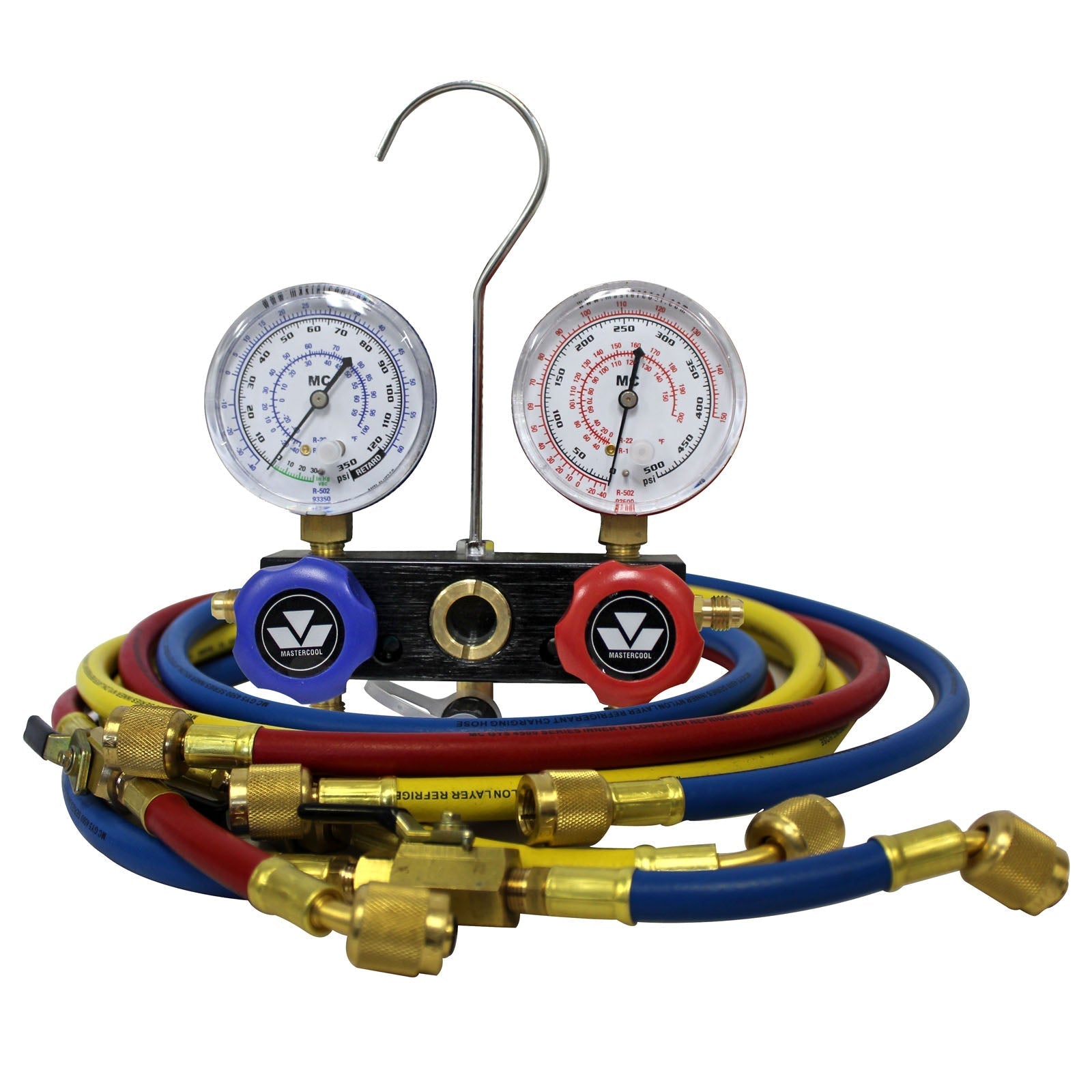
Mastercool Manifolds: Digital vs Analog Guide Australia
You reach for your manifold gauge set on every job. That includes a quick diagnostic on a residential split system. It also includes commissioning a full commercial VRF system. The right manifold makes a real difference. Diagnosis is faster. Charging is more accurate. You spend less time second-guessing a reading.
Mastercool's manifold range covers both analog and digital options, in 2-valve and 4-valve configurations. R32 compatibility is built into the modern lineup. This guide walks through why manifold selection matters. It covers what's available in the Mastercool range. It also compares digital and analog, so you can choose the right tool for your typical work.
Building out your full Mastercool kit? The Mastercool range at HVAC Shop covers manifolds alongside recovery machines, vacuum pumps, and scales. Together they give you a complete diagnostic and charging setup.
Written by Rica Francia Macaspac, HVAC Shop content writer, in consultation with Aussie HVAC tradies and industry experts. Published: June 2025 · Last reviewed: June 2025.

Why Manifold Selection Matters
A manifold gauge set is the interface between you and the refrigerant circuit. Every pressure reading, every diagnosis, and every charging decision flows through this tool. So choosing the right one isn't a minor equipment decision. It directly affects how quickly and accurately you can do the job in front of you.
Charging Accuracy and the Manifold's Role
You might charge by weight using a scale. Or you might fine-tune a charge based on superheat and subcooling. Either way, the manifold is how you read system pressures and verify the charge is correct. A poorly calibrated gauge or a sticky needle adds error to every decision made from that reading. It doesn't matter how careful your technique is elsewhere.
Digital manifolds remove some of the interpretation error that comes with reading an analog needle against a printed scale. This matters most in low light, like a dim plant room or a roof cavity. The reading is the reading, shown as a number. There's no needle position left for you to interpret.
Diagnosis Speed on Service Calls
On a service call, speed matters. The faster you connect, read, and interpret pressures, the faster you can diagnose the problem and quote the fix. A manifold that needs manual calculation of saturation temperatures slows you down. A manifold that calculates and displays this automatically speeds every diagnostic job up.
This matters most for technicians doing high call volumes. Residential service work is a good example, where time on site directly affects how many jobs you complete in a day. The speed difference compounds across a working week. It's easy to underestimate this until you've used both tool types side by side.

R32 Capability and Modern Refrigerant Demands
R32 is now the standard refrigerant across most new Australian residential and light commercial installs. So manifold compatibility with R32's pressure range and gauge scale markings is a basic requirement, not an optional feature. An older manifold built around R22 pressure ranges may not display R32 pressures accurately. It might not display them at all.
Mastercool's current manifold range is built with R32 and other modern refrigerants in mind. The gauge scales and digital displays cover the pressure ranges these refrigerants operate at. Always confirm the specific refrigerants and pressure ranges on the current product specification before buying for R32-specific work.
Future-Proofing Your Kit
Australia's refrigerant landscape keeps shifting. A2L refrigerants are becoming more common. Older refrigerants are being phased down under environmental regulation. A manifold you buy today, limited to older refrigerant pressure ranges, may need replacing sooner than one built with broader, more current coverage.
This is a genuine factor to weigh. Compare the upfront cost of a basic analog manifold against a digital model with broader refrigerant and pressure coverage. The cheaper option today may become a limiting factor sooner, as the refrigerant mix in your typical jobs keeps changing.
Tradie Pro Tip: Before buying any manifold, check the gauge faces or digital display specs against the refrigerants you actually work with day to day. Don't just go by the refrigerants that were common when you started your trade. A manifold that doesn't clearly display R32 pressure ranges will slow you down on most new installation work in Australia right now.
Mastercool Manifold Models
Mastercool's manifold range runs from simple 2-valve manual gauges through to fully digital 4-valve sets with integrated thermocouples. Understanding the difference between valve counts, and between digital and analog readouts, helps you match the tool to your typical work. That way you avoid buying more capability than you need, or less than the job demands.
2-Valve Manifolds
A 2-valve manifold covers high-side and low-side pressure measurement. This is the standard setup for most residential and light commercial service and charging work. The two-valve design is simpler to operate and lower cost than a 4-valve equivalent. It handles the majority of split system and light commercial diagnostic and charging tasks competently.

The Mastercool 2-valve digital manifold with thermocouples combines the simpler two-valve setup with a digital pressure display and integrated temperature probes. That gives you superheat and subcooling calculation without needing a separate thermometer for most standard jobs.
4-Valve Manifolds
A 4-valve manifold adds two extra ports. These are typically used to connect a vacuum pump and a recovery machine or refrigerant cylinder at the same time, alongside the standard high and low side connections. That means you can evacuate, charge, and monitor pressures without repeatedly connecting and disconnecting hoses between stages of the job.

For technicians doing full installation work, where evacuation and charging happen in sequence on the same visit, a 4-valve manifold saves real time. It eliminates hose reconfiguration between stages. For straightforward service and diagnostic calls, where you're just checking pressures, the extra valves often go unused.
Digital Manifolds with Thermocouples
Digital manifolds with integrated thermocouple inputs combine pressure reading with direct temperature measurement from the pipe surface. The unit calculates superheat and subcooling automatically. You don't need to manually look up saturation temperatures on a separate pressure-temperature chart, or do the maths by hand.

This automatic calculation is especially useful for apprentices and technicians newer to superheat and subcooling diagnosis. It removes a step where calculation errors commonly happen. Experienced technicians benefit too, simply through the time saved on every diagnostic job across a working week.
Analog Alternatives
Analog manifolds remain a practical, reliable choice for many technicians. Some simply prefer a mechanical gauge, with no batteries to charge and no screens to fail. A well-made analog manifold, with a clearly printed pressure-temperature scale, gets the job done reliably for technicians comfortable reading needles against printed scales.
The trade-off is an extra manual step. You need to look up saturation temperatures and calculate superheat and subcooling by hand. There's also the reading precision limit of a needle against a printed scale, compared to a digital numeric display.
R32 Compatibility Across the Range
R32 compatibility depends on the specific gauge scale printed on an analog manifold, or the pressure range and refrigerant tables programmed into a digital unit. Always check the current product specification for confirmed R32 compatibility. Don't assume every manifold in a brand's range automatically supports it.
You can find the full range of Mastercool manifolds and gauges, with current specs and refrigerant compatibility detail, through HVAC Shop's refrigerant gauges collection.
Tech Specs Note: Valve count, refrigerant compatibility, pressure ranges, and thermocouple accuracy vary across the Mastercool manifold range. Confirm the exact spec of any model against the current product documentation before buying. This matters most if your work involves a wide mix of refrigerant types across different system ages.
Digital vs Analog Comparison
The decision between digital and analog comes down to how you balance accuracy, ease of use, and diagnostic capability against upfront cost and simplicity. A simpler tool has fewer parts that can fail. Both approaches remain in regular professional use across Australian HVAC-R work.
Accuracy Comparison
Digital pressure sensors generally offer finer resolution and more consistent accuracy across the gauge's full range. A mechanical needle gauge, by contrast, can develop reading drift or calibration error over time and with physical knocks. A digital readout also removes the step of judging needle position against printed graduations, which is itself a source of small reading errors.
That said, a well-maintained analog gauge from a reputable manufacturer stays accurate enough for the great majority of HVAC-R diagnostic and charging work. The accuracy gap between quality digital and analog tools is smaller than the gap between either option and a poorly maintained or knocked-around gauge of any type.
Superheat and Subcooling Display
This is where digital manifolds with integrated thermocouples show their clearest practical advantage. The automatic calculation and direct display of superheat and subcooling values removes a manual lookup and calculation step from every diagnostic job. That reduces both time spent and the risk of calculation error under job-site pressure.
On an analog manifold, the process has more steps. You read the pressure. You look up the matching saturation temperature on a printed pressure-temperature chart. Then you subtract or add against your measured pipe temperature, taken with a separate thermometer. It's a workable process that experienced technicians do quickly, but it's still more steps than a digital unit that calculates and displays the result directly.
Ease of Use for Different Experience Levels
Digital manifolds are generally easier for apprentices and less experienced technicians to use correctly. The display does more of the calculation work, which cuts the chance of an error in the manual pressure-temperature lookup process. This can make digital tools a sensible investment for trade businesses bringing on junior staff still building confidence with diagnostic calculations.
Experienced technicians who've spent years reading analog gauges often work just as quickly with them, since the process has become second nature. The ease-of-use advantage of digital is more pronounced for those still building that experience.
Troubleshooting Capability
Many digital manifolds offer extra troubleshooting features beyond basic pressure and temperature reading. Examples include data logging across a job, the ability to record readings over time to track a system's behaviour, and built-in refrigerant databases covering a wide range of refrigerants. These features can speed up complex diagnostic work, particularly on commercial systems where understanding behaviour over time matters.
Analog manifolds rely entirely on the technician's experience and judgement for troubleshooting interpretation. This isn't a limitation for an experienced fridgie. But it does mean the tool itself doesn't offer extra diagnostic support beyond the pressure reading.
Long-Term Reliability and Cost
Analog manifolds have fewer parts that can fail. There are no batteries to maintain and no electronic display to damage from impact or moisture. For technicians working in harsh conditions, like coastal salt exposure on Sydney and Gold Coast jobs or dusty WA conditions, the mechanical simplicity of analog can be a genuine durability advantage over a sensitive electronic display.
Digital manifolds generally cost more upfront. They also need occasional battery replacement or charging, and the electronics add an extra failure point compared to a purely mechanical gauge. Quality digital units from established brands are built to handle typical trade conditions. Still, the electronics add a layer of potential failure that analog tools simply don't have.
The table below summarises the practical comparison points, to help you match the right manifold type to your typical work and conditions.
| Factor | Analog Manifold | Digital Manifold |
|---|---|---|
| Reading accuracy | Good when well maintained; subject to needle drift over time | High; consistent across the gauge range |
| Superheat and subcooling calculation | Manual lookup and calculation required | Automatic, direct display with thermocouple models |
| Ease of use for apprentices | Requires learning pressure-temperature chart use | More forgiving; reduces calculation error |
| Durability in harsh conditions | Fewer failure points; no battery or display to damage | Quality units are robust but carry electronic failure risk |
| Upfront cost | Lower; check HVAC Shop for current pricing | Higher; check HVAC Shop for current pricing |
| Best suited for | Experienced technicians, harsh environments, budget builds | Apprentices, complex diagnostics, commissioning documentation |
Did You Know? Many established commercial contractors keep at least one analog manifold in the kit as a backup, even when their main tool is digital. A mechanical gauge has no batteries to fail. So there's always a working manifold on hand if a digital unit's battery dies mid-job, or the electronics fail unexpectedly on site.
For ARCtick-licensed technicians, accurate pressure and temperature readings underpin the documentation requirements around refrigerant handling and system commissioning. Whichever manifold type you choose, consistent calibration checks and proper care of the tool support both your day-to-day accuracy and your compliance record-keeping.
Working around refrigerant systems also carries general workplace safety considerations, particularly around pressure equipment and electrical components on digital units. Refer to the Safe Work Australia resources for broader guidance on safe equipment use applicable to HVAC-R trade work.
Want to compare current stock and pricing across the full Mastercool manifold and gauge range? Visit the refrigerant gauges collection at HVAC ShopManifold Gauge, AC Gauges & Air Conditioning Gauges.
Frequently Asked Questions: Mastercool Manifolds
Want to compare current stock and pricing on Mastercool's digital and analog manifold range? Visit the refrigerant gauges collection at HVAC Shop or contact our team to confirm which configuration suits your typical work.