
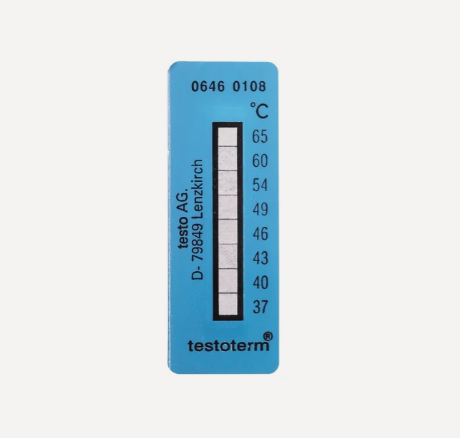
A temperature strip looks simple enough — peel it, press it, read it. But get the reading wrong and you might clear a cold chain shipment that's been sitting at the wrong temperature for six hours, or sign off on refrigeration equipment that's quietly running hot. In real-world Australian worksites — from sweltering Darwin warehouses to humidity-soaked Brisbane cool rooms to Melbourne facilities running tight QA audits — a misread strip can mean a failed compliance check, a spoiled product batch, or worse, a safety incident. The good news is that reading a temperature strip accurately isn't complicated once you understand what the strip is actually telling you and what to look for.

Reviewed by the HVAC Shop Technical Team | Published: May 2026 | Last reviewed: May 2026
The Science Behind the Strips
Before you can read a temperature strip confidently, it helps to understand what's happening inside it. There are two main types in common use across Australian trade and industrial applications, and they work in fundamentally different ways.
The first type uses liquid crystal technology. These strips contain a layer of thermochromic liquid crystals — materials that change their molecular orientation in response to heat. As temperature rises through the strip's rated range, specific sections of the crystal layer reflect different wavelengths of light, producing colour changes that correspond to temperature values. The transition is typically reversible: cool the surface down and the strip's colour will shift back. This makes liquid crystal strips well suited to applications where you need ongoing, real-time monitoring — checking a pipe surface temperature during a service call, for example, or monitoring process equipment throughout a shift.

The second type uses irreversible chemical colour-change technology. These strips contain heat-sensitive chemicals that undergo a permanent phase change at a defined threshold temperature. Once the strip has been exposed to that temperature — even briefly — it changes colour permanently. There's no going back. This is the technology used in most cold chain compliance labels, sterilisation indicators, and pharmaceutical transport monitoring. If the strip has changed, you know the temperature threshold was breached, full stop. These strips are sometimes called time-temperature indicators or irreversible temp labels. For a practical comparison of when irreversible labels are the better tool and when live thermometers give more useful information, our guide to irreversible labels vs thermometers covers the decision in full.
One of the most important factors affecting accuracy across both types is surface contact. A temperature strip reads the surface it's bonded to — not the ambient air around it. If there's a gap, a dust layer, an oil film, or any insulating material between the strip and the surface, the reading will lag behind the actual surface temperature. On a job in a QLD warehouse where pipe surfaces accumulate condensation and grime, that contamination layer matters. The thin, highly sensitive self-adhesive Testoterm foils used in HVAC and refrigeration applications are engineered to maximise surface contact and minimise thermal lag — but even those perform best on clean, dry, smooth surfaces.
Liquid crystal temperature strips were originally developed for medical applications — specifically for non-invasive fever detection — before the technology was adapted for industrial and HVAC use. The same colour-change principle that tells a nurse a patient's forehead is running hot now helps a fridgie confirm a suction line is performing within spec.
Understanding which type of strip you're working with before you take a reading isn't just a nice-to-know — it changes how you interpret the result. A liquid crystal strip showing a colour at the moment of reading tells you the current surface temperature. An irreversible strip that has changed colour tells you the maximum temperature that surface reached since the strip was applied. Confusing the two is one of the most common mistakes made in the field.
Step-by-Step Guide to Reading Your Strip
Getting an accurate reading starts well before you look at the strip's display window. Placement, timing, and knowing what you're looking for all contribute to whether the reading is reliable or not.
Proper Placement
Apply the strip directly to a clean, dry surface that represents the temperature zone you're trying to measure. For HVAC and refrigeration work, this typically means pipe surfaces, compressor housings, or heat exchanger panels. For cold chain and logistics applications, you'll usually be applying to the product packaging or directly to the shipping container interior wall. For medical or forehead-style strips, you're working with skin — which introduces its own variables like sweat, ambient airflow, and the time the strip is held in place.
Press firmly across the full length of the strip to eliminate air pockets. Air is an excellent insulator, and any gap between the strip's adhesive layer and the surface creates a thermal buffer that slows the strip's response. On curved pipe surfaces — common in refrigeration line sets — use your thumb to work from the centre outward so the strip conforms to the curve rather than bridging across it. If you're placing a strip in a cold room in Sydney or a freezer store in Melbourne, give your hands a moment to stabilise first; pressing a warm hand firmly onto a strip applied to a very cold surface can locally warm the strip and skew the reading.

Identifying the Active Colour
Once the strip has had time to equilibrate to the surface temperature — typically 30 to 60 seconds for most adhesive strips, though check the manufacturer's datasheet for the specific product you're using — look at the display window. On a liquid crystal strip, you'll usually be looking for a green or blue-green colour, which indicates the strip is actively reading within its calibrated range. Some strips show a tan or brown colour at the low end of their range, transitioning through green and then to blue as temperature rises.
The key is to identify the highest numbered block that is showing a clear, saturated colour — not a partial or transitional shade. If the block showing 28°C is green and the block showing 30°C is showing a faint greenish tinge, the reliable reading is 28°C. Partial colour activation in the adjacent block means the surface temperature is somewhere in between, but you should always record the last clearly activated block as your reading.
On irreversible strips, the reading is simpler but requires a different kind of attention. Look for a colour change from the strip's baseline state — typically a shift from white, cream, or clear to a defined colour (often black, red, or brown depending on the chemistry). The number of activated indicators tells you whether one, several, or all temperature thresholds have been breached.
Reading Numerical Values vs. Colour Blocks
Some temperature strips display discrete numerical temperature values alongside each colour block. Others use a continuous colour gradient without numbers. Where numerical values are present, record the number associated with the last clearly activated block. Where only colour blocks are present, refer to the strip's included legend or the manufacturer's colour-to-temperature conversion chart. Never estimate from memory — colour perception varies between individuals and lighting conditions can shift how a colour reads to the eye. A strip that looks clearly green under fluorescent warehouse lighting might look slightly different under the warm incandescent light of a plant room. When in doubt, check under natural or neutral white light.
If you're working in a dimly lit plant room or inside a refrigerated unit, carry a small LED torch with a neutral white output (around 4000–5000K colour temperature). Reading colour-change strips under warm yellow light or coloured ambient lighting introduces interpretation error. A neutral white light source gives you the most accurate colour read every time.
Once you're confident reading strip results correctly, the next step is ensuring labels are applied and handled correctly in the first place. Our guide on how to use Testoterm labels correctly covers surface preparation, full contact application, avoiding common placement errors, and the logging and replacement workflow after activation.
Common Mistakes When Checking Temperatures
Even experienced technicians make these errors. Knowing what goes wrong — and what the consequence is on a real job — is the fastest way to tighten up your process.
Removing the Strip Too Early
This is probably the single most common mistake. The strip needs time to reach thermal equilibrium with the surface it's applied to. Pull it up after ten seconds and you'll get a reading that reflects the temperature of the strip itself as it was stored, not the surface you're trying to measure. On a hot day in Brisbane where strips have been sitting in a van or a toolbag in direct sun, those strips can be significantly warmer than the surfaces you're applying them to. If you read them before equilibrium, you'll get a falsely high result. On a cold store application in Adelaide, the reverse applies — a strip stored at ambient temperature will read too warm until it's had time to cool to the surface temperature.
The fix is straightforward: follow the dwell time specified on the product datasheet. For most commercial temperature strips this is 30 to 60 seconds, but some industrial-grade strips designed for very low-temperature applications may require longer. Set a timer rather than guessing — it takes discipline on a busy job, but it's the difference between a valid reading and a data point you can't trust.
Placing on Dirty or Contaminated Surfaces
Oil, grease, dust, condensation, frost, and surface coatings all act as thermal insulators between the strip and the actual surface. In HVAC and refrigeration work this is a constant reality — compressor housings accumulate oil mist, pipe surfaces in coastal NSW installations develop salt residue, and refrigeration evaporators can have frost layers that are millimetres thick. A strip placed over any of these contaminants will read the temperature of the contamination layer, not the surface underneath.
Before applying any strip, wipe the target area with a clean, dry cloth. If there's a greasy film, a quick wipe with an isopropyl alcohol swab (allowed to evaporate fully before applying the strip) will restore a clean surface without leaving a residue of its own. On coated surfaces — galvanised steel, painted aluminium panels, plastic housings — be aware that the coating's thermal conductivity differs from the substrate, which can affect how quickly the strip equilibrates. In a QA audit context, surface preparation is part of your method. If you're doing NATA-referenced temperature verification work, document your surface preparation steps as part of the record.
Storing Strips Incorrectly
Temperature strips are consumables, and they degrade if stored improperly. The most common storage failures in Australian conditions are heat exposure and moisture. A box of strips left in a vehicle in summer — where the interior can exceed 70°C on a hot day in Darwin or Perth — can pre-activate irreversible strips or permanently damage liquid crystal strips before they've even been used. Strips exposed to high humidity without their original packaging can also suffer adhesive failure, which means they won't make proper contact with the surface when applied.
Store strips in a cool, dry location away from direct sunlight. The original packaging matters — it's usually designed to protect the strips from both light and humidity. Once you open a pack, use the strips promptly rather than leaving them exposed on a workbench. If you're working on a large installation project where strips will be applied over several days, keep the unused strips in their sealed packaging in a cool bag or a temperature-controlled storage area. According to Safe Work Australia guidelines, correct storage and handling of temperature-sensitive monitoring equipment is part of maintaining a safe and compliant work environment — particularly in industries where temperature records form part of a safety management system.
Most commercial liquid crystal temperature strips have a storage life of 18 to 24 months from manufacture when stored correctly (typically below 25°C, away from direct sunlight, in original sealed packaging). Irreversible chemical strips may have shorter or longer shelf lives depending on the chemistry — always check the product datasheet and the batch expiry date before use, particularly for medical, pharmaceutical, or food-safety applications where strip integrity directly affects compliance outcomes.
Interpreting Transitional Colours as Definitive Readings
A temperature strip that is mid-transition — with two adjacent blocks showing colour simultaneously — is not giving you a clear reading. Some technicians record the higher value, assuming "close enough." Others record the lower. Neither is right, and the inconsistency means your records can't be reliably compared across readings or technicians. The correct approach is to wait for the transition to stabilise (if the strip is still equilibrating), or if the reading is genuinely sitting between two blocks, record both values and note "reading between X°C and Y°C" in your log. For medical or pharmaceutical cold chain compliance, this ambiguity may require a repeat reading with a calibrated secondary instrument.
Comparison of Common Mistakes and Their Job Consequences
| Mistake | Typical Cause | Result on the Job | How to Avoid |
|---|---|---|---|
| Reading strip too early | Time pressure on job | Falsely high or low reading; invalid QA record | Use a timer; follow manufacturer dwell time |
| Dirty or contaminated surface | Skipped surface prep | Strip reads contamination layer, not substrate | Wipe surface; use IPA swab if greasy |
| Improper strip storage | Left in vehicle or open packaging | Pre-activated or adhesive-failed strips; wasted stock | Store below 25°C in sealed original packaging |
| Reading transitional colour | Impatience or poor lighting | Inconsistent records; failed audit | Wait for stable colour; use neutral white light |
| Confusing strip type | Mixed stock on site | Misinterpretation of reversible vs. irreversible result | Label storage; check product spec before use |
| Incorrect placement on curved surface | Rushing application | Air pockets under strip; thermal lag in reading | Press firmly from centre outward; smooth strip to surface |
Conclusion & Selecting Reliable Strips
Reading a temperature strip accurately comes down to a handful of fundamentals: understand what type of strip you're using, prepare the surface properly, allow full dwell time before reading, and interpret the colour in good lighting using the manufacturer's guide — not guesswork. These aren't complicated steps, but they're the ones that separate a reliable field record from a number that gives you false confidence.
The broader point is that the strip itself is only as good as the process around it. A premium, precision-engineered strip applied to a greasy surface with a ten-second dwell time will give you a worse result than a basic strip applied correctly to a clean, prepared surface with a full minute to equilibrate. Technique matters as much as product quality — but product quality still matters.
When it comes to choosing the right strip for your application, the key variables are temperature range, reversibility, adhesive type, and sector-specific compliance requirements. For HVAC and refrigeration technicians, you generally need strips that can handle a wide operating range and bond reliably to metal pipe surfaces — including in the condensation-prone environments common to Brisbane cool rooms and coastal NSW plant rooms. For cold chain and logistics work, irreversible indicators are the standard because you need a permanent record of whether a threshold was ever breached during transit. For medical and paediatric use, you're working to TGA-relevant standards and the strip's contact characteristics for skin application matter more than surface adhesive strength.
Reusable liquid crystal strips make sense in applications where you're doing repeated spot checks on the same equipment — they're cost-effective and convenient for routine monitoring. Disposable irreversible strips are the right choice where the reading needs to form part of a permanent compliance record, or where the strip will be applied to equipment or packaging that won't be revisited before the temperature event you're trying to detect has already happened.
Whatever your application, don't mix strip types on a single site without clearly labelling which is which. Mixed stock is one of the most consistent sources of misinterpretation errors in the field. If your team is running both liquid crystal reusable strips and irreversible cold chain indicators on the same project, store them in clearly separated, labelled containers. Brief every technician on which strip is which before work begins.
If you're working across multiple sectors — say, HVAC maintenance in the morning and cold room compliance verification in the afternoon — it's worth having a short checklist for each context rather than relying on memory at the end of a long day. A misread strip in a cold chain context can trigger a product recall. A misread strip in an HVAC context can mean a compressor runs hot without anyone noticing until it fails. The consequences scale with the application, but the solution is always the same: slow down, follow the method, and read what the strip is actually telling you.
If you're not sure which strip type best fits your application — or if you need to confirm compatibility with a specific surface, temperature range, or compliance framework — talk to our team to confirm the right product for your needs. Our technical team works across HVAC, refrigeration, logistics, and industrial sectors and can point you toward the right specification without guesswork.