
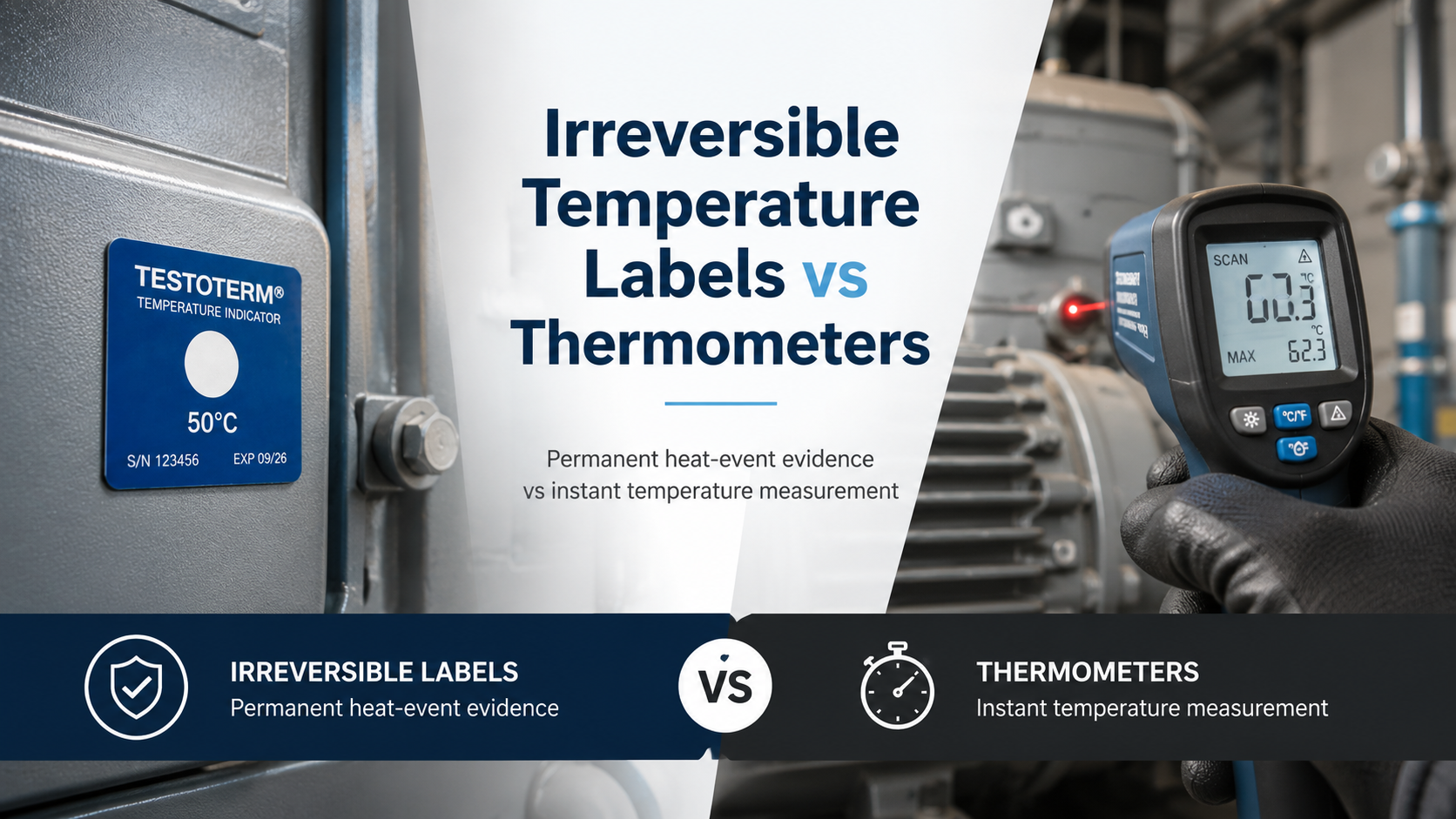
Irreversible temperature labels and thermometers both measure temperature — but they answer completely different questions. A thermometer tells you what a surface or air volume is doing right now. An irreversible temperature label tells you whether a surface exceeded a rated threshold at any point since the label was applied. These are not the same question, and the tools that answer them are not interchangeable. Understanding the difference helps HVAC technicians, facilities managers, and maintenance teams choose the right tool for each situation — or, in many cases, understand why both tools belong in the same workflow. The live temperature measurement tools available through HVACShop complement the Testoterm indicator range covered in this guide.
Reviewed by Rica Francia Macaspac | Published: May 2026 | Last reviewed: May 2026

The Core Difference
The fundamental difference between irreversible temperature labels and thermometers is the type of information they produce: past-event evidence versus current reading.
An irreversible temperature label — such as the Testoterm Measuring Points or Mini Indicators — permanently changes colour the moment a rated threshold temperature is reached. That colour change remains after the surface cools, after the equipment is switched off, and after weeks or months of subsequent operation. The label records that a specific temperature was exceeded at some point between application and inspection. It does not tell you when, for how long, or how far above the threshold the temperature went. But it does provide irrefutable physical evidence that the event occurred.
A thermometer — whether a contact probe, non-contact infrared gun, or data-logging instrument — shows the current temperature at the moment of measurement. It provides real-time diagnostic information that a label cannot. It can also log temperature trends over time if it is a data logger. But it cannot tell you what happened to a surface three weeks ago at 3am when the building was unoccupied and the equipment was running unattended.
Both tools are limited by what they are designed to measure. The right question is not which one is better — it is which one answers the question you are actually trying to answer.
When Irreversible Labels Are the Better Tool
Irreversible temperature labels are the better choice in four clear scenarios.

Unattended monitoring between service visits is the primary use case. Equipment that runs continuously — compressors, motors, condensing units, plant-room systems — experiences temperature events that may never occur during an attended service call. A system that trips on high-pressure protection at 2am on a hot night presents normally during a 9am service visit. A Testoterm label on the compressor shell or discharge line records whether a heat event occurred during that unattended period. A thermometer cannot provide that retrospective evidence without continuous data logging infrastructure. For single-threshold monitoring across many assets, the single-point irreversible temperature labels in the Measuring Points format provide a cost-effective passive monitoring solution.
Warranty and QA validation requires permanent, physical evidence that a component operated within rated temperature limits. A photograph of a Testoterm label showing no threshold activation is a simple, clear record that the component did not exceed a rated temperature during a warranty or commissioning period. A thermometer reading at a single point in time cannot provide the same assurance — it only proves the temperature at that moment, not across the entire period.
Transit and storage temperature monitoring for equipment, components, and sensitive goods requires evidence that temperature limits were maintained throughout the journey — not just at origin and destination. An irreversible label applied before transit and inspected on arrival provides that continuous-period evidence. A thermometer measurement on arrival provides a snapshot only.
Recurring heat complaints on difficult-to-diagnose equipment benefit from the label's always-on nature. If a system has a history of unexplained trips or heat-related faults that present normally during service visits, applying Testoterm labels across the likely heat-producing components creates a monitoring network that will capture the next event whether or not a technician is present.
When Thermometers and Probes Are Better
Live measurement instruments are the better choice whenever the information you need is current, dynamic, or requires precise calibrated measurement.

Active fault diagnosis during a service visit requires live temperature readings. Checking suction and discharge temperatures, compressor shell temperature, motor frame temperature, and air-on/air-off temperatures across a heat exchanger are all active diagnostic tasks that require real-time data. An irreversible label cannot support this work — it cannot show you what the equipment is doing right now.
System commissioning requires measured performance data — supply and return temperatures, temperature differential across coils, ambient conditions — that must be recorded at specific operating states. This is precise, calibrated measurement work that demands a thermometer, not a threshold label.
Air and surface temperature checks for compliance documentation, energy assessments, or comfort evaluation require accurate current readings. A contact probe, IR gun, or logging instrument is the correct instrument for these applications.
Trend analysis over time requires time-stamped data at regular intervals, which only a data-logging thermometer or continuous monitoring instrument can provide. An irreversible label records a single threshold event — it cannot produce a temperature curve, show rate of change, or provide timestamped records. For instruments that can provide time-series measurement, browse the test and measurement collection for data loggers and connected instruments available in Australia.
When to Use Both Together
The most effective HVAC maintenance workflows combine irreversible labels for passive between-visit monitoring and thermometers for active attended diagnosis. The two tools complement each other without overlap.

A practical example: a compressor on a commercial system has a history of high-pressure trips. Apply Testoterm labels on the compressor shell, the discharge line, and the motor end cap. On the next service visit, use a contact thermometer or clamp-on probe to check current operating temperatures across the same points during normal operation. The thermometer tells you whether the system is running hot right now. The labels tell you whether a heat event occurred since the last visit — even if the system is presenting normally at the time of your inspection.
For the compressor scenario, compact irreversible indicators in the Ø15 mm Mini Indicator format suit compact component surfaces where space is limited, while the live thermometer provides the diagnostic data during the attended visit. Together, they cover both the attended and unattended monitoring requirements without either tool trying to do a job it was not designed for.
This combined approach is particularly valuable on commercial portfolios in Australian cities — large office buildings in Sydney or Melbourne, retail centres in Brisbane, industrial facilities in Perth — where service intervals are defined by contract and equipment runs continuously between visits. The label programme provides coverage across the entire interval; the thermometer provides diagnostic precision during the service event.
Decision Table
| Factor | Irreversible Temperature Label | Thermometer / Probe |
|---|---|---|
| Evidence type | Past event — permanent record of threshold exceeded | Current reading — snapshot at moment of measurement |
| Attendance required | No — passive, always-on | Yes — or continuous data logging infrastructure |
| Reusable | No — one use per label, one-time irreversible result | Yes — repeated readings from the same instrument |
| Calibration | Factory-set threshold; ±1.5°C for Measuring Points | Calibrated instrument with traceable accuracy |
| Cost per monitoring point | Low — especially Measuring Points at 50 per booklet | Higher per-point if using probe time; data loggers add infrastructure cost |
| Documentation value | Physical permanent evidence — photographable, archivable | Reading at a point in time — requires logging to create a record |
| Unattended period coverage | Full coverage of the interval | Only at the moment of measurement |
| Live diagnostic use | Not applicable | Essential for active fault diagnosis and commissioning |
| Strip-style option | Testoterm temperature strips for multi-point range on wider surfaces | n/a |
Frequently Asked Questions
Do irreversible labels reset after the surface cools? No. The colour change is permanent. Once a threshold indicator activates, it remains activated regardless of subsequent cooling. This permanence is the source of their evidence value — a label inspected weeks after a heat event shows the same activation as one inspected immediately after.
Are Testoterm labels calibrated instruments? Testoterm Measuring Points carry an accuracy rating of ±1.5°C at the rated threshold temperature. They are not calibrated instruments in the sense of a NATA-traceable measurement device, and they should not be used as a substitute for calibrated measurement in formal compliance or regulatory applications that require instrument traceability. For those applications, a calibrated thermometer with traceable documentation is required.
Can a Testoterm label replace a thermometer for HVAC diagnostics? No. Testoterm labels provide threshold-exceeded evidence — they do not provide current temperature readings, trend data, or the precise measurements needed for system commissioning and performance diagnosis. Use labels for passive unattended monitoring and thermometers for active diagnosis. The two tools are complementary, not interchangeable.
How should unused labels be stored? Below +25°C in a clean, dry location away from heat sources. Do not store in a vehicle during Australian summer. Degraded or pre-activated stock from improper storage will not provide reliable results.
Can I use labels and thermometers on the same monitoring point? Yes — and for important monitoring points, using both is the recommended approach. Apply a Testoterm label for continuous between-visit evidence. Use a thermometer at that same point during attended visits for live diagnostic data. The two readings together give you a more complete picture than either alone. Browse the test and measurement collection for the full range of complementary instruments available in Australia.