
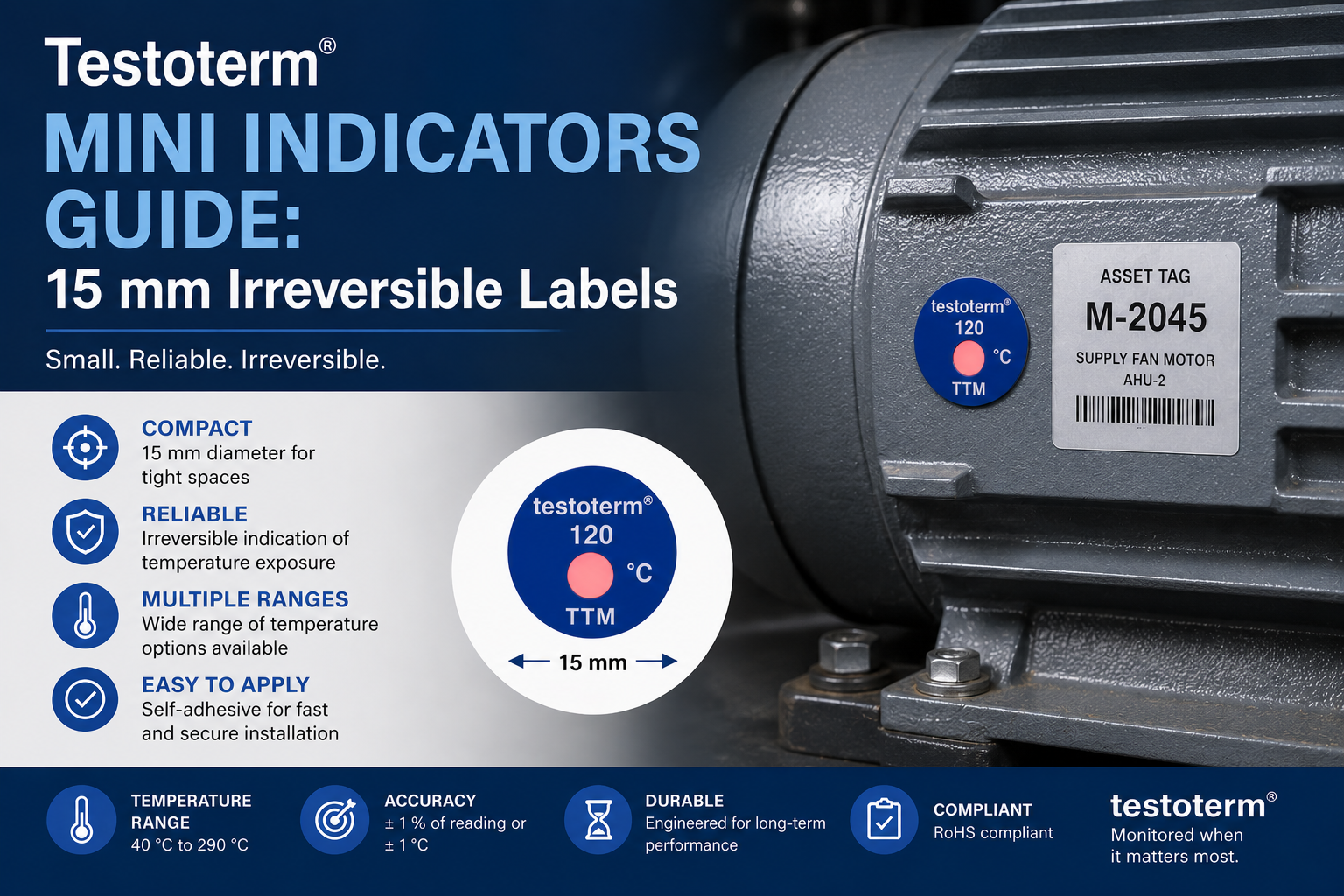
Testoterm Measuring Points are 14 x 14 mm self-adhesive, irreversible temperature labels designed for single-threshold surface monitoring. Each label carries one rated temperature threshold. When that threshold is reached, the label permanently changes colour — and that reading stays, permanently, regardless of whether the surface subsequently cools. At 50 labels per booklet, the Measuring Points format is built for volume monitoring: QA checks across multiple assets, warranty validation on newly commissioned equipment, recurring plant-room inspections, and any application where you need a reliable, cost-effective way to confirm whether a set temperature was exceeded on a large number of monitoring points. Browse the 14 x 14 mm Testoterm Measuring Points currently available through HVACShop for current threshold variants and pricing.
Reviewed by Rica Francia Macaspac | Published: May 2026 | Last reviewed: May 2026

What Testoterm Measuring Points Are
Testoterm Measuring Points are single-threshold irreversible temperature labels in a 14 x 14 mm square format, sold in booklets of 50. SKU 0646 1065. Each label contains a single heat-sensitive indicator point that permanently changes colour when its rated threshold temperature is reached. The reading is binary — either the threshold was exceeded or it was not — and the result is permanent.
The single-threshold design is what distinguishes Measuring Points from the multi-point Mini Indicators. Where a Mini Indicator shows approximately how hot a surface got across a range of threshold points, a Measuring Point answers a single question: did this surface exceed this specific temperature during the monitoring period? For many QA and warranty applications, that single yes/no is exactly the information required — and the simplicity of the reading reduces the chance of misinterpretation during a fast inspection run across many assets.
The 50-per-booklet pack size reflects the intended use pattern. Measuring Points are designed for applications where you need to monitor many surfaces or assets with the same threshold — a fleet of motors on the same equipment type, a row of control cabinet doors, or a production line of refrigeration units leaving a facility. At 50 per booklet, the per-label cost is lower than Mini Indicators, making volume monitoring practical without significant consumable expense.
When Single-Point Labels Are Better
Single-threshold Measuring Points outperform multi-point formats in four specific scenarios.

Warranty and QA validation is the clearest use case. When a newly installed piece of equipment needs to demonstrate that it has not exceeded its rated maximum operating temperature during a warranty period or commissioning phase, a Measuring Point at the rated maximum threshold provides a simple, documentable record. The label either shows a clean result (threshold not exceeded) or a changed result (threshold exceeded — investigate). There is no ambiguity in the reading, and the physical label can be photographed as part of the QA record.
Recurring fleet inspections across many identical assets benefit from the 50-per-booklet economy. A maintenance team inspecting 40 motors across a facility in Brisbane or a refrigeration contractor checking 35 condensing units across a supermarket portfolio can apply and read Measuring Points efficiently without the higher per-label cost of Mini Indicators. The 14 x 14 mm Testoterm Measuring Points at 50 per booklet make this volume monitoring cost-effective.
Logistics and transport monitoring — confirming that equipment or products did not exceed a temperature threshold during transit or storage — is another natural application. A single threshold label on a shipping container panel, a cold chain package, or an equipment crate confirms whether the monitored environment stayed within acceptable limits. The related guide on irreversible temperature labels for shipping covers this application in full.
Plant-room and switchboard inspections benefit from the simple read-and-replace workflow. An inspector walking through a plant room can check 20 Measuring Points in minutes — the binary activated/not-activated result requires no interpretation beyond confirming the colour change. This speed advantage matters on large sites where inspection time is limited.
Current Thresholds and Selection Logic
The Testoterm Measuring Points currently listed on HVACShop include the following thresholds: 65°C, 71°C, 77°C, 82°C, 110°C, and 121°C. Confirm current availability on the product page, as variants may be updated. The accuracy rating is ±1.5°C across the range.

| Threshold | Typical Application Context | Selection Note |
|---|---|---|
| 65°C | Refrigeration cabinets, electronics, low-temperature monitoring | Check ambient surface temperature first in hot Australian climates — outdoor surfaces can approach this threshold without fault |
| 71°C | Control panels, electronics, mild motor applications | Provides modest margin above 65°C ambient risk; confirm component rated max |
| 77°C | Motor housings, general HVAC equipment | Common choice for standard motor frame monitoring where normal operating temp is 50–60°C |
| 82°C | Motor windings, compressor housings, general equipment | Allows margin above typical normal operating range for many HVAC motors |
| 110°C | Compressor discharge areas, higher-temperature motor applications | Confirm equipment rated maximum; 110°C may be within normal range for some compressor types |
| 121°C | High-temperature compressor discharge, industrial equipment | Confirm component spec; this threshold suits applications where normal operation approaches 100°C |
Threshold selection should always be driven by the component's rated normal operating temperature, not guesswork. The target is a threshold that sits clearly above the normal operating range but below the component's rated maximum — an alert margin that activates only when something genuinely abnormal has occurred. Selecting a threshold too close to the normal operating temperature will produce labels that activate on every normal operating cycle, making the monitoring programme meaningless. For a broader discussion of threshold selection principles and industrial applications, the industrial temperature strips guide covers the selection logic in detail.
SKU: 0646 1065. Format: 14 x 14 mm square, self-adhesive, irreversible. Pack: 50 per booklet. Response time: 2–3 seconds at rated threshold. Accuracy: ±1.5°C. Available thresholds: 65, 71, 77, 82, 110, 121°C — confirm current listing on HVACShop or the Testoterm Measuring Points product page before ordering.
Measuring Points vs Mini Indicators
The decision between Measuring Points and Mini Indicators comes down to three factors: surface size and shape, whether you need a single threshold or a temperature range, and pack economy.
| Factor | Measuring Points (14 x 14 mm) | Mini Indicators (Ø15 mm) |
|---|---|---|
| Surface requirement | Flat or slightly curved, minimum 14 x 14 mm accessible area | Compact curved or flat, minimum ~15 mm diameter |
| Threshold information | Single threshold — exceeded or not | Multiple threshold points — shows temperature range reached |
| Pack size | 50 per booklet — suited to volume monitoring | 10 per booklet — suited to targeted single-component monitoring |
| Reading speed | Fast — binary result, no interpretation needed | Slightly more reading involved — identify which points activated |
| Best scenario | Fleet QA, warranty checks, recurring inspections across many assets | Small motors, bearings, compact components needing diagnostic ranging |

If you are monitoring one compact component and want to know approximately how hot it got within a temperature band, Testoterm Mini Indicators for compact components are the better choice. If you are applying labels across many identical assets and need a simple pass/fail threshold check, Measuring Points at 50 per booklet are more practical and cost-effective.
Placement Examples
Control cabinets and switchboards: Apply to the inside door surface near terminal blocks or relay clusters where localised overheating may occur. Ensure the label is visible from the door opening without requiring panel removal during inspection. Avoid placing directly on live conductors — apply to the panel surface near the component of concern.
Motor housings: Apply to the motor frame at the hottest accessible point — typically near the windings end, on the flat surface of the frame. Clean the painted metal surface thoroughly before applying. A motor running at normal temperature should not activate a threshold set with appropriate margin above normal operating range.
Compressor casings: Apply to the compressor shell or discharge area where surface temperature is representative of internal operating conditions. On compressors with limited accessible flat surface, the Measuring Point's 14 x 14 mm format may fit where a larger strip would not.
Relay and fuse areas in switchboards: Apply near but not on active components. The label monitors the ambient surface temperature of the surrounding panel area, which rises when nearby components overheat. This is a general indicator, not a precise measurement of the component itself.
Transport and logistics packaging: Apply to the outer or inner surface of packaging, shipping containers, or cold chain equipment where temperature exceedance during transit needs to be confirmed. For a detailed guide on this application, see irreversible temperature labels for shipping.
For all placements, the label must be visible for inspection without removing covers, panels, or guards where possible. A label that can only be read by partially disassembling the equipment defeats the purpose of passive monitoring. Plan placement for inspection accessibility before applying. For additional guidance on avoiding common placement mistakes, our article on how to read temperature strips accurately covers common errors in detail.
Logging and Replacement
An activated Measuring Point label is evidence of a heat event. That evidence has value only if it is recorded before the label is replaced. The logging workflow for Measuring Points is straightforward and should be standardised across any team using them for QA or warranty purposes.
Photograph the activated label alongside the asset tag or equipment nameplate before removing it. The photograph should clearly show the label's activation state and the equipment identification — this is the primary evidence record.
Record the threshold rating, asset ID, location, date of inspection, and date of original application in your maintenance management system, job sheet, or site register. Note whether the label was activated or not activated.
Replace activated labels with a fresh label of the same threshold (if the heat event has been investigated and resolved) or a different threshold (if the investigation suggests the original threshold was inappropriate). Do not leave activated labels in place — they have served their purpose and cannot provide further information.
Irreversible labels are evidence of an event, not a calibrated time-series log. They confirm that a threshold was exceeded — they do not record when it happened, how many times, or how far above the threshold the surface temperature went. For time-series evidence or trend analysis, a data logger or live measurement instrument is required alongside the label programme.
Standardise your threshold selection across asset types before starting a monitoring programme. If all motors of a given model type are monitored with the same threshold, comparison between assets becomes meaningful — you can identify which units are running hotter than the fleet average. If different thresholds are applied inconsistently, the comparison value is lost and the monitoring programme becomes harder to interpret.