
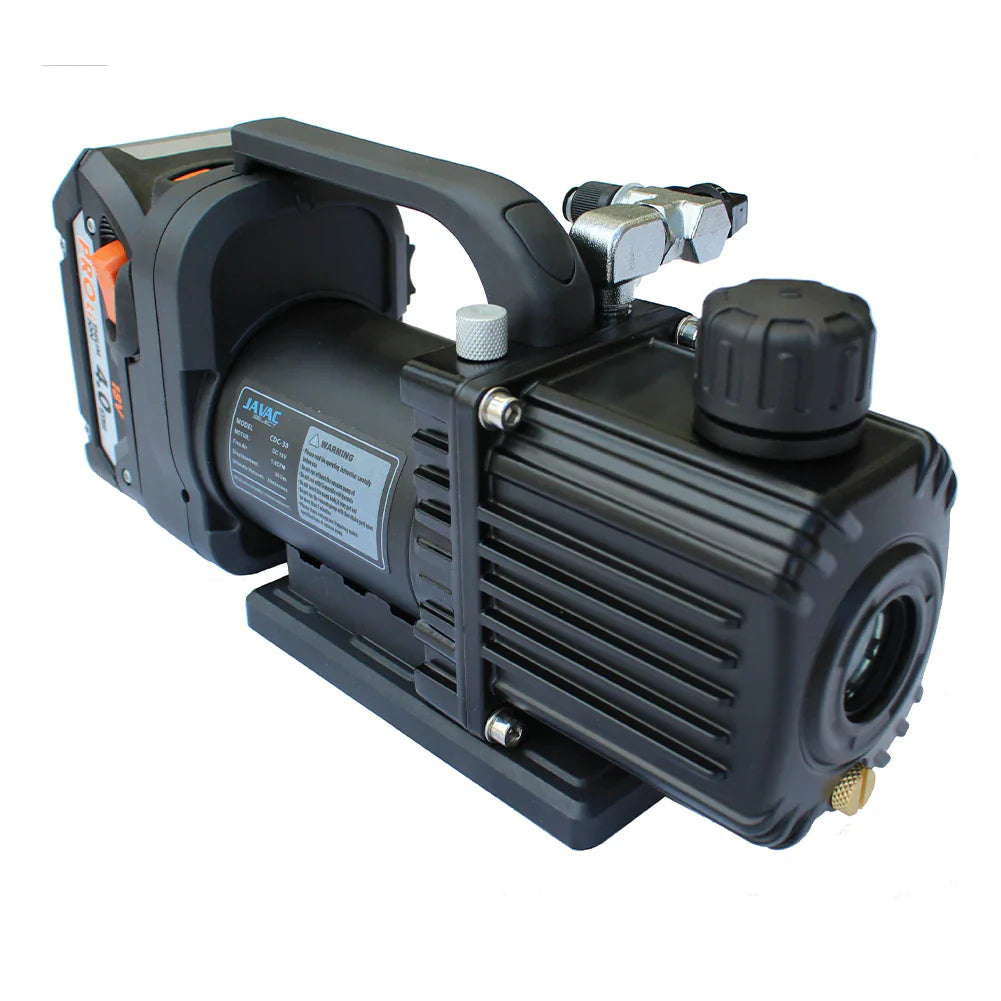
JAVAC CDC30: The Cordless Solution for Deep Vacuums
Pulling a deep vacuum quickly is critical for system efficiency and longevity. While corded pumps have been the standard, they can be hazardous or impractical on sites with limited power access. Enter the JAVAC CDC30 Cordless Vacuum Pump—a game-changer for technicians who need reliability without the tether.
Unlike standard entry-level pumps, the CDC30 is designed for professionals who refuse to compromise on performance just to go cordless. It ensures you have the right tool for risk-free, efficient environments, whether you are on a roof, a balcony, or a site with no power.
Top Features of the CDC30
- World-Class 2-Stage Design: The CDC30 stands out as the only battery-operated vacuum pump with a 2-stage operation, allowing for a much deeper vacuum than single-stage competitors.
- Ultimate Vacuum: Achieves a 15-micron ultimate vacuum rating.
- Battery Power: Powered by a standard AEG 18V battery (common in many power drills), offering approximately 50 minutes of runtime—plenty for standard split system installations.
- Gas Ballast Valve: A rare feature for cordless units, helping to manage moisture and protect oil life.
- Quiet Operation: engineered to run softly, reducing noise pollution on site.
Is the CDC30 Right for You?
Choosing between a corded and cordless pump depends on your daily workflow:
- The Specialist: If you install split systems and conduct service work where power points are scarce or safety is a concern (e.g., trip hazards), the CDC30 is an essential upgrade.
- The Backup: Even if you rely on a large corded pump for commercial rigs, the CDC30 is the perfect "plan B" for power outages or quick jobs.
- The Heavy Lifter: For technicians doing all-day, heavy commercial evacuations on multiple large circuits, a corded pump remains the primary workhorse, with the CDC30 as a versatile companion for difficult access areas.
1-Stage vs. 2-Stage: Why it Matters
When selecting a pump, understanding the "stages" ensures you get the performance you need.
- 1-Stage Pumps: Good for general use but may struggle to hit the deep vacuum levels required for critical moisture removal in modern refrigeration systems.
- 2-Stage Pumps (Like the CDC30): Use two processes—a high-vacuum stage pulls in gas and transfers it to a low-pressure chamber. This allows the pump to achieve a significantly deeper vacuum, removing more moisture and non-condensables.
While 2-stage pumps are an investment, they are indispensable for engineers working with specialized equipment where system purity is non-negotiable.
Why Buy from HVAC Shop?
The JAVAC CDC30 is unique in the market—combining 2-stage power with cordless freedom. Every unit supplied by HVAC Shop undergoes rigorous quality checks to ensure it meets Aussie standards.
Not sure if this is the right pump for your workload? Contact our team for expert advice on matching the right vacuum technology to your specific applications.
Frequently Asked Questions
Q1. How long does the battery last on the CDC30?
The CDC30 provides approximately 50 minutes of runtime on a fully charged AEG 18V battery. This is generally sufficient for a standard split system installation or service call.
Q2. Can a cordless pump really pull a deep vacuum?
Yes. The JAVAC CDC30 is a 2-stage pump capable of achieving an ultimate vacuum of 15 microns. This makes it comparable to many corded units for depth, suitable for residential and light commercial work.
Q3. What battery does it use?
It utilizes a standard AEG 18V battery. If you already use AEG power tools (drills, drivers), you can likely swap batteries between your tools and your vacuum pump.
Q4. When should I use a cordless pump over a corded one?
Cordless pumps are superior for safety (no trailing leads), working at heights (roofs/ladders), and sites without active power. For continuous, heavy-duty commercial use all day long, a corded pump is still recommended as the primary driver.