
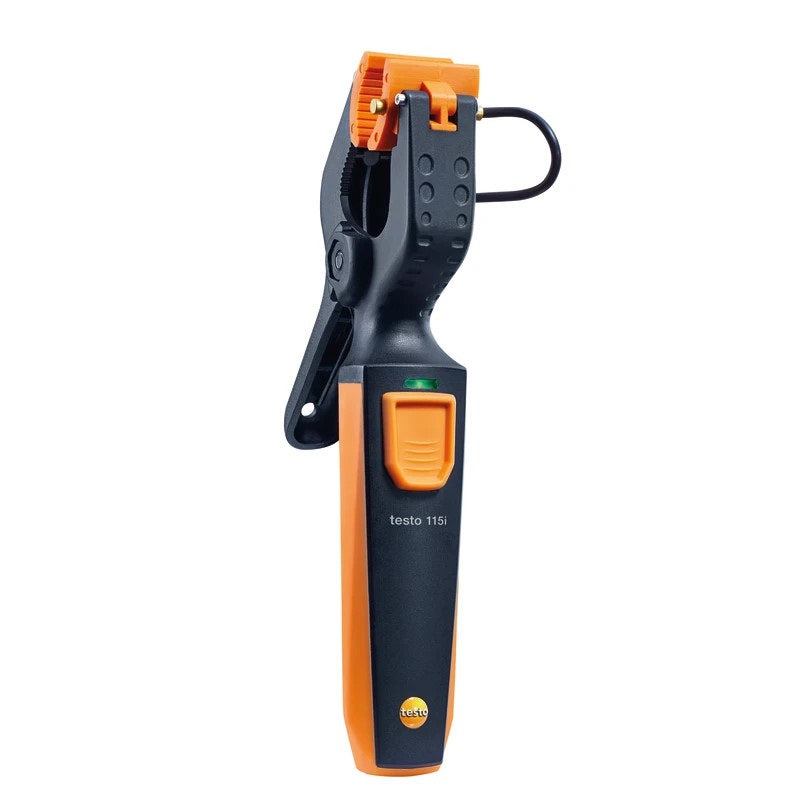
Testo 115i Clamp Thermometer: Pipe Temperature Guide for HVAC/R Technicians
The Testo 115i is a wireless clamp thermometer built for HVAC/R technicians who need fast, reliable pipe temperature readings without holding a probe in place while managing other tasks on site.
It is purpose-built for superheat and subcooling calculations, refrigerant charging workflows, and pipe surface temperature checks. These are the core temperature measurement tasks in day-to-day air conditioning and refrigeration service work.
If you're doing refrigerant charging, running superheat and subcool calculations from a tablet or phone, or want to eliminate probe-holding from your workflow, the 115i is worth understanding. This guide covers who should be using it, how it works, where it sits in an HVAC temperature measurement toolkit, and how to get the most out of it on site.
Browse the full Testo smart probes and HVAC instruments range to see what's available across the Testo Smart Probe lineup.
Written by Rica Francia Macaspac, HVAC Shop content writer, in consultation with Aussie HVAC tradies and industry experts. Published: May 2026 · Last reviewed: May 2026.

Who Should Use the Testo 115i Clamp Thermometer
The Testo 115i suits HVAC/R technicians who regularly work on split systems, multi-heads, and light commercial refrigeration where refrigerant charging and system commissioning are part of the regular workload.
It makes the most sense for technicians who do superheat and subcooling calculations on every charging job and want wireless data transfer to a smartphone or tablet running the Testo Smart App. The hands-free design keeps both hands free for manifold gauges and service valves, which is a real advantage when working alone on a rooftop pack or in a cramped plant room.
It also suits anyone who needs consistent, documented temperature logging. That covers commissioning records, compliance paperwork, or simply having a clean job history in the app when a callback comes up six months later.
The 115i uses a clamp-type design with a spring-loaded mechanism that grips the pipe and holds itself in position. The NTC sensor in the clamp makes direct contact with the pipe surface, giving stable readings that don't require ongoing manual pressure.
It is not a general-purpose surface probe. The 115i is designed for pipe temperatures on diameters between 6mm and 35mm and is not suited to motor housings, coil surfaces or flat component measurements. For those applications, a wired Type K clamp probe or a dedicated surface probe is the better fit.
Tradie Pro Tip: If you're ARCtick-licensed and doing refrigerant charging regularly, the 115i pays for itself quickly in time saved. Holding a probe against a suction line with one hand while managing gauges with the other is awkward work. The clamp removes that entirely and your readings are more stable for it.
Testo 115i Specifications
The table below summarises the key specifications from the official Testo 115i data sheet. Always confirm against the current datasheet for your application, particularly if you are working with non-standard refrigerants or require a formal calibration certificate.
| Specification | Value |
|---|---|
| Sensor type | NTC |
| Measuring range | -40°C to +150°C |
| Pipe diameter range | 6mm to 35mm (clamp) |
| Wireless connection | Bluetooth Smart (4.0) |
| Radio range | Up to 100 m (line of sight) |
| Battery life | Up to 150 hours |
| App compatibility | Testo Smart App (iOS and Android) |
| Display | Integrated LCD |

The official measuring range is -40°C to +150°C, which covers the full spread of suction and liquid line temperatures encountered in Australian air conditioning and refrigeration work. That includes cold room suction lines at the low end and hot discharge lines in a Darwin warehouse summer at the high end.
The NTC sensor provides high accuracy within this range, making it well-suited to the temperature measurements used in superheat and subcooling calculations. Technical specifications are sourced from the official Testo 115i data sheet, which should be consulted if you need precise accuracy tolerances or calibration certificate details.
How to Use Clamp Probes Correctly
Getting accurate pipe temperature readings from a clamp thermometer requires attention to a few practical details that are easy to overlook on a busy job site.

1. Clean the pipe surface
Remove any dirt, oil, oxidation, or paint from the section of pipe where the clamp will sit. Contamination between the clamp sensor and the pipe surface reduces thermal coupling and introduces measurement error.
A clean, bare metal surface gives the best contact. On older copper lines on Sydney coastal jobs or regional NSW farm sheds, surface oxidation can be significant. Take a few seconds to wipe it back before clamping.
2. Position the clamp correctly
Place the clamp midway between any fittings, brazes or valves and avoid positioning it directly on or next to a fitting. Fittings can sit at a different temperature from the pipe itself and will skew your reading.
For suction line superheat measurements, position the clamp close to the evaporator outlet, before the line picks up significant ambient heat. For liquid line subcooling, position the clamp close to the condenser outlet.
3. Ensure full contact
The clamp must make full contact with the pipe surface around the measurement area. A pipe that is too small for the clamp will give a loose, unreliable contact. A pipe that is too large won't close properly.
The Testo 115i is rated for pipe diameters between 6mm and 35mm. Verify you're within this range before relying on the reading.
4. Wrap insulation over the probe
Once the clamp is in position, cover the clamp and a short section of pipe either side with pipe insulation foam or a cloth wrap. This prevents ambient air from pulling your reading toward air temperature rather than true pipe temperature.
This step is especially important on cold suction lines and on QLD jobs where high humidity means warm ambient air has a strong influence on an uninsulated probe.
5. Allow time to stabilise
Wait for the reading to settle before recording. The NTC sensor in the 115i reaches stable readings relatively quickly, but on very cold suction lines or hot discharge lines there can be a short lag as the clamp equilibrates with the pipe surface.
A reading that is still moving should not be recorded. Give it the time it needs. A rushed reading that triggers a recharge wastes refrigerant and your time.
For pipes outside the standard clamp range, a Velcro Type K temperature probe provides a strap-mounted alternative that accommodates different pipe sizes and surface configurations.
Tech Specs: The 115i NTC sensor operates from -40°C to +150°C per the Testo datasheet. Confirm against the current spec sheet for your application. For discharge line monitoring in extreme summer conditions in Darwin or outback WA, approach the upper limit with care and cross-check with a wired reference if needed.
Superheat and Subcooling Applications
The Testo 115i is most commonly used for superheat and subcooling measurements during refrigerant charging. This is the most accuracy-critical temperature measurement task in HVAC/R service work.

Suction line temperature for superheat
Superheat is the temperature difference between the actual suction line gas temperature and the saturation temperature at suction pressure. To measure it, connect your manifold gauges to the system and record suction pressure. Convert suction pressure to saturation temperature using a refrigerant table or the Testo Smart App.
Clamp the 115i to the suction line close to the evaporator outlet, then subtract the saturation temperature from the suction line temperature. A correct superheat value, typically 5 to 15°C depending on system type, confirms the evaporator is working correctly and there is no flood-back risk to the compressor.
Liquid line temperature for subcooling
Subcooling is measured at the liquid line, after the condenser. Clamp the 115i to the liquid line close to the condenser outlet and record the temperature.
Subtract this from the saturation temperature at condensing pressure. Correct subcooling, typically 3 to 8°C depending on system design, confirms the condenser is doing its job and the refrigerant is in fully liquid state before reaching the expansion device.
A Testo Smart App workflow integrating the 115i with digital manifold gauges and pressure sensors can calculate superheat and subcooling automatically once all measurements are entered. For refrigerant gauges for superheat and subcool checks, HVAC Shop carries the full range of Testo and compatible charging equipment.
Clamp Probe vs Other Probe Types
Understanding where the 115i fits among other temperature measurement tools helps you build a complete kit rather than duplicating capabilities.
| Probe Type | Best Use | Hands-Free? | Wireless? |
|---|---|---|---|
| Testo 115i (NTC clamp) | Pipe temps, Smart App integration, wireless charging workflow | Yes | Yes |
| Wired Type K clamp | Pipe temps, wired meter connection | Yes | No |
| Flat surface probe | Motors, housings, panels, general surfaces | No | No |
| Magnetic surface probe | Ferrous housings, hands-free monitoring | Yes | No |
| Air probe | Ambient, duct, supply/return air | No | No |

The 115i excels when wireless operation and Smart App integration matter. A fast-action Type K surface probe is the better choice for non-pipe surface measurements, quick spot checks across multiple surfaces, or when working with a standard Type K thermocouple meter outside the Testo Smart App ecosystem.
The two tools complement each other well. Many HVAC technicians use the 115i for charging work and a selection of wired Type K surface probes for diagnostics, motor monitoring and coil work. Together they cover every temperature measurement task without overlap.
Did You Know? IR thermometers are generally not reliable for pipe temperature measurement. Copper and aluminium refrigerant lines have low emissivity, and readings are strongly affected by surface finish, ambient radiation and measurement angle. Whether you use the 115i or a wired clamp, contact measurement always gives a more accurate pipe temperature reading than an IR gun pointed at a copper line.
Maintenance and Care
The Testo 115i is a precision instrument. A few habits will keep it in good condition and ensure measurement accuracy over time.
Keep the clamp mechanism clean. Pipe residue, oil and refrigerant contamination on the clamp jaws affects both contact quality and the clamp spring mechanism. Wipe the contact surfaces down regularly with a clean cloth. This matters particularly after jobs in WA where dust and grit get into everything.
Check the clamp spring tension. The spring holds the clamp in firm contact with the pipe. If the tension weakens, contact quality decreases and readings become inconsistent. If the clamp feels loose or uncertain in its grip, have the instrument inspected before relying on it for charging work.
Store correctly. Keep the 115i in its case or a clean, dry instrument bag when not in use. Avoid leaving it in direct sunlight inside a vehicle for extended periods because extreme heat accelerates battery degradation and can affect the sensor. This is particularly relevant on Melbourne summer days when van interiors can reach 60°C or more.
Verify accuracy periodically. For regular charging work, cross-check the 115i reading against a calibrated reference thermometer or a second instrument at a known temperature point. Testo offers calibration services if you need a formal calibration certificate for compliance documentation.
For related temperature measurement tools and accessories, browse the full HVAC Shop range.
Frequently Asked Questions: Testo 115i Clamp Thermometer