
Choosing between a single-stage and a two-stage cordless vacuum pump is not just a spec comparison. It affects evacuation quality, moisture removal, and how reliably a system performs after commissioning. Both types pull air and vapour out of a system, but they behave very differently once you push toward the deeper vacuum levels that HVAC work actually demands.
For technicians working across residential installs, service calls, and commissioning jobs, the question isn't which pump wins on paper. It's which pump suits your daily workload — the systems you service, the access conditions you work in, and the evacuation targets your jobs require.

Browse cordless and corded vacuum pumps at HVAC Shop
Two-stage models from Fieldpiece, JAVAC, Mastercool, and Robinair — sized for residential splits through to large commercial VRF systems.
Single-stage pumps are simpler and more portable. Two-stage pumps pull deeper vacuum and remove moisture more effectively. The right choice depends on how critical evacuation quality is in your work — and for most professional HVAC jobs, that answer is: very.
What Is the Real Difference Between Single and Two-Stage Pumps?
The core difference is how far each pump can pull a system down. A single-stage pump uses one compression cycle. It removes bulk air and vapour efficiently, but performance tends to drop off as pressure approaches the deeper vacuum levels needed for proper system drying.
A two-stage pump adds a second compression stage. The first stage brings pressure down, the second stage cleans up the exhaust and keeps pulling lower. That's where the real advantage shows up — not in the early stages of evacuation, where both pumps look similar, but in the final stretch where moisture removal happens.
On a commissioning job, that difference matters. Moisture left in a system affects the refrigerant oil, causes acid formation over time, and shortens compressor life. That's why deeper evacuation is treated as non-negotiable on quality installs — not just a box to tick before charging.
Understanding L/min and Ultimate Vacuum
L/min (litres per minute) measures how quickly a pump moves air. It's useful, especially on larger systems where pull-down time matters. But L/min alone doesn't describe the full picture.
Evacuation has two phases. The first is bulk air removal — high flow rate helps here. The second is dehydration: pulling the system low enough that moisture boils off and gets carried out by the pump. This second phase is where two-stage pumps earn their keep. A pump with strong flow but a weak ultimate vacuum will look fast early, then plateau before the system is actually dry.
Ultimate vacuum — measured in microns — tells you how low the pump can go under ideal conditions. For most HVAC work, the target is 500 microns or below, held through a decay test. A pump rated for 15 microns ultimate vacuum has the headroom to reach and hold those targets comfortably, even on warmer days or with longer hose runs.
Vacuum Pump Types in HVAC
Oil-filled rotary vane pumps remain the trade standard for HVAC evacuation. They're reliable, serviceable, and capable of the deep vacuum levels needed for proper system prep. Other pump designs exist, but when it comes to evacuating refrigeration and air conditioning systems correctly, rotary vane pumps dominate because they balance performance, field serviceability, and proven reliability.
The cordless segment has grown significantly as battery platforms have matured. A well-designed cordless two-stage pump now gives technicians access to professional evacuation performance without needing a power point — useful on rooftops, balconies, and sites where running extension cords creates trip hazards or access issues.

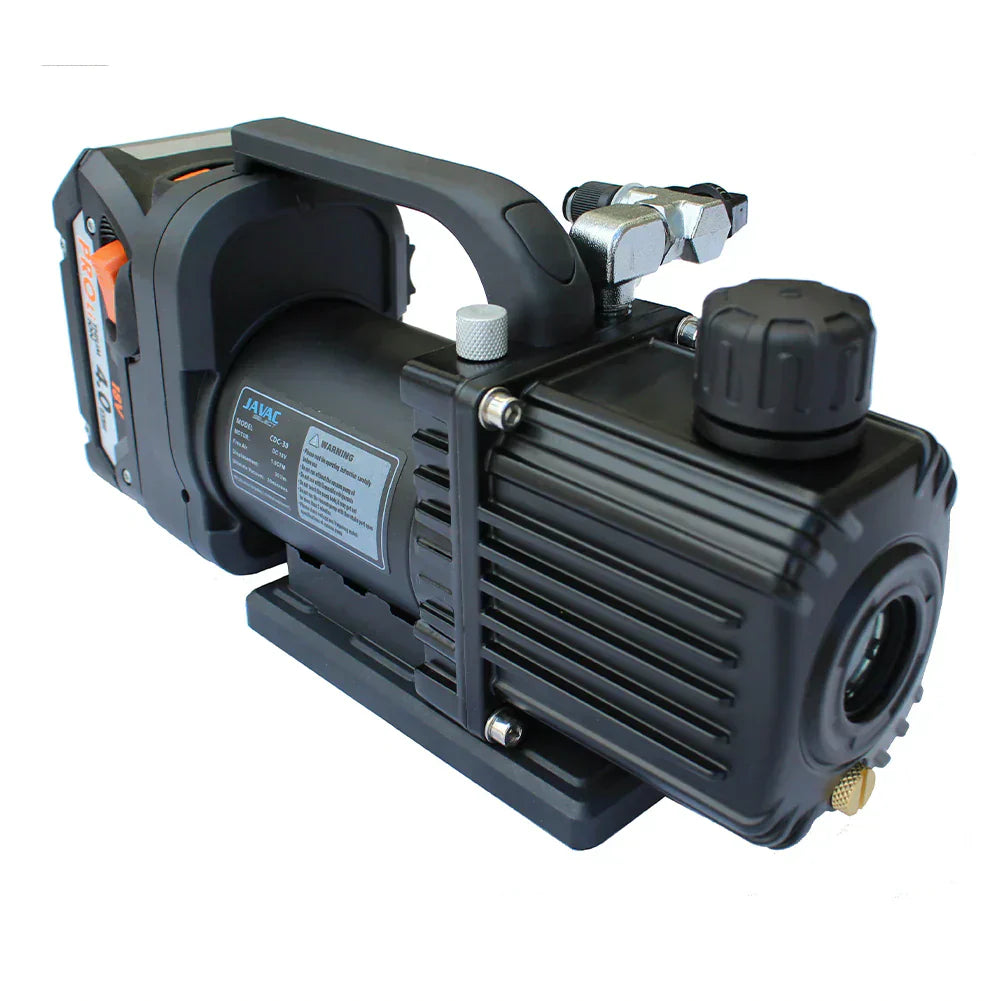
JAVAC CDC30 — cordless two-stage, 30 L/min, 15-micron ultimate vacuum
Battery-powered two-stage performance for jobs where a power point isn't available. Uses standard 18V batteries. Suits residential installs, rooftop work, and tight-access sites.
Single-Stage vs Two-Stage: Side-by-Side
| Feature | Single-Stage | Two-Stage |
|---|---|---|
| How it works | One compression cycle | Two compression stages in series |
| Ultimate vacuum depth | Moderate — suits rough vacuum work | Deep — reaches the levels needed for proper dehydration |
| Moisture removal | Limited below certain pressure thresholds | More effective — continues pulling in the dehydration range |
| Portability | Often lighter and more compact | Varies — cordless two-stage models are still field-portable |
| Best fit | Light service, small systems, quick jobs | Commissioning, new installs, moisture-critical repairs |
| Commissioning quality | Acceptable for basic work | Preferred for systems where reliability matters long-term |
When a Single-Stage Pump Makes Sense
Single-stage cordless pumps have a place in the right situations. For small residential systems, quick service calls, or jobs where you're doing a rough evacuation before a minor repair rather than a full commissioning, the simpler setup and lighter weight can be practical advantages.
They're also a reasonable backup tool. If a corded two-stage pump is the primary rig, a compact single-stage cordless pump can cover jobs with limited access or power issues without carrying the full kit.
The limitation is real though — single-stage pumps aren't the right choice when the job requires deep vacuum and confident moisture removal. If that's what the work demands, the pump will become the limiting factor in the setup rather than the system itself.
When a Two-Stage Pump Is the Better Choice
Two-stage pumps are the standard for commissioning, new installs, and any repair where system dryness directly affects long-term performance. They keep pulling where single-stage pumps plateau — which is exactly when the work matters most.
They're also more forgiving in real field conditions. Longer hose runs, warm engine bays, higher ambient temperatures, and more complex multi-circuit systems all make evacuation harder. A two-stage pump handles that kind of demand more consistently than a single-stage one.
For most professional HVAC technicians across Australia, a two-stage pump — cordless or corded — becomes the default because it produces consistent results across the full range of jobs. On a Brisbane install in January or a commercial fit-out in a WA warehouse in summer, the extra stage earns its weight.
Real-World Buying Considerations
The stage count is important, but it's not the only decision. Battery compatibility matters for cordless options — a pump that runs on the same 18V platform as the rest of the tool kit means one less battery ecosystem to manage. Runtime on a single charge should cover a typical residential commissioning; most quality cordless pumps deliver around 45–60 minutes, which is enough for a standard split-system evacuation with oil in good condition.
Oil condition is underrated as a performance factor. Contaminated or moisture-saturated oil dramatically limits how deep a pump can pull, regardless of whether it's single or two-stage. Fresh oil before each job, or at minimum when the sight glass shows cloudiness or discolouration, is one of the simplest ways to get better evacuation results from any pump.
Port sizing also affects real-world performance. A pump with 3/8″ or 1/2″ ports allows wide-bore evacuation hose setups, which reduce restriction and speed up pull-down times — often more noticeably than a pump upgrade on its own.

Mastercool, Fieldpiece, JAVAC, Robinair — corded and cordless, 30–283 L/min
Compare the full range of two-stage vacuum pumps at HVAC Shop. Sized from residential splits to large commercial VRF systems, with fast Australia-wide shipping.
Frequently Asked Questions
Is a single-stage pump suitable for commissioning a new split system?
For a basic residential install where evacuation targets are modest, a single-stage pump can technically complete the job. For systems where long-term reliability matters — newer R32 units, commercial installs, or any system where moisture is a concern — a two-stage pump is the more reliable choice because it reaches and holds lower micron levels more consistently.
How long does a cordless vacuum pump battery last?
Most quality cordless HVAC vacuum pumps deliver around 45–60 minutes of runtime on a single charge. That's generally enough to complete a standard residential split-system evacuation. For longer jobs or multi-circuit systems, a spare battery or a corded pump is the practical backup.
What micron level should I be targeting?
500 microns is the widely accepted baseline for HVAC evacuation in Australia. Many technicians target 250–350 microns as a preferred range. The reading alone isn't enough — a stable decay test (holding below the target for several minutes after the pump is isolated) confirms the system is both dry and leak-free.
Can I use a cordless vacuum pump on R32 systems?
Only if the pump is specifically rated for A2L refrigerant duty. R32 is classified A2L — lower flammability — and not all vacuum pumps are designed for use on A2L systems. Always check the product specification before connecting to an R32 system. The Fieldpiece VP series and JAVAC CDC30 are among the models with confirmed A2L ratings — verify on the product page before purchase.