
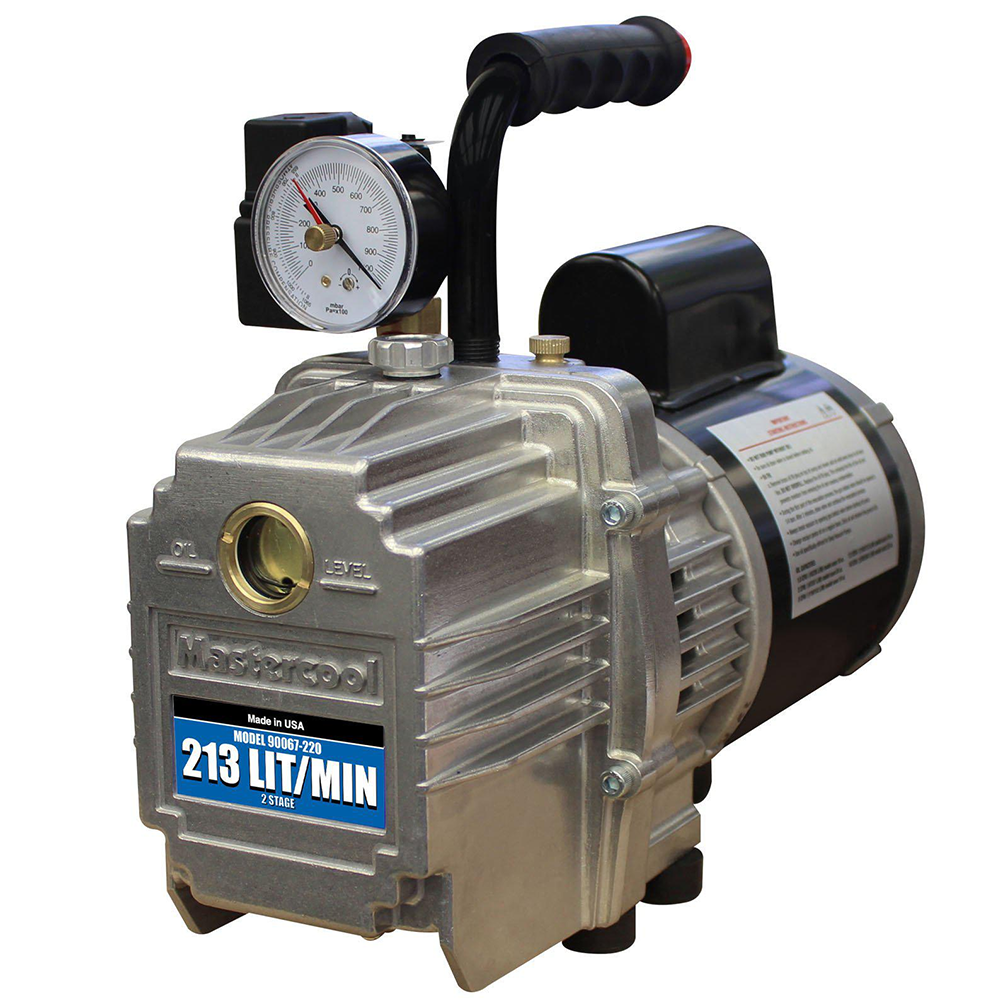
Every A/C Technician Needs a Good Cheap Vacuum Pump for Air Conditioning!
An air conditioner vacuum pump is a small piece of equipment with various outlets, controls, and hose connections. They are, nevertheless, simple to operate after you get over the initial impression.
So, when you go out and buy a new AC vacuum pump, consider the following factors. Finding out the following facts is crucial to getting the right pump at a fair price.

Why HVAC Evacuation is a Necessity?
Only the refrigerant and oil must circulate in a refrigerant system. Air may be accessed during maintenance or after several years of operation. The oxygen, nitrogen, and moisture in the air that enters the system come from the atmosphere. These undesirable components will result in:
- Greater compression ratios and discharge temperaturesare caused by a rise in head pressure. The system's efficiency is diminished.
- Acids are formed in the refrigerant, which causes a chemical reaction that results in electroplating and motor insulation degradation. When the compressor motor's insulation fails, a short circuit occurs, causing the compressor to be damaged. The compressor is one of the most expensive pieces of equipment in the system. Acids also cause metal items to corrode over time.
- Oil, acid, and moisture in the system combine to create sludge. Over time, it causes the strainers, filter drier, and expansion device to operate improperly.
Choosing an Amazing Air Conditioner Vacuum Pump
Capacity
One of the prime factors to think about is pumping capacity when it comes to pumps. The pump's power to make a vacuum is measured in cubic feet per minute, or CFM. After a thorough calculation, you can make an educated guess.
Other measurements, such as continuous flow rate, pressure, and so on, must be taken together with the ambient temperature.
The truth is that no one likes doing complicated arithmetic before buying a pump, and you wouldn't have to do it. It involves some Mathematics, but it's straightforward. Simple words, the pump must have a larger CFM rating than the unit.
Fortunately, all vacuum pumps will ultimately achieve the required vacuum level. But if you need to get there faster, look up the Ac tonnage and multiply by 2. If you're operating on a 2 ton AC unit, you'll need a 4 CFM pump.
Vacuum Level
Another key element to watch out is the Micron rating. The vacuum level is indicated by this rating created by the AC pump. At sea level, no vacuum will get a micron reading of 760,000. There's no ideal vacuum level. Your pump, on the other hand, does not require a perfect vacuum.
Search for a pump with a minimum micron rating of 500. Higher is preferable. However, you may discover that getting to a higher vacuum level is challenging. In such a case, remember that if you're buying one for household use, 500 to 700 microns should suffice. You might want to seek professional assistance at a higher level.

Weight
Even though weight is essential, it is not the most crucial component. It doesn't matter because you don't have obligation to hold these machines. However, if you're bringing them to work, a light model could be preferable.
Motor Power
Pumps come in various shapes and sizes. However, one critical factor for all sorts of pumps is the motor's power. Although it also uses 2-stage motors in pumps, single-stage engines are usually sufficient. These motors seem to be more powerful, faster, and long-lasting than previous models.
Single-stage motors will be enough if you're buying a pump for personal use. However, for professional service, you'll need a pump with a 2-stage motor.
Sight Glass
If you're familiar with rotary vane pumps, you're aware that they operate on oil. These pumps feature a sight glass that helps you keep a sharp eye on the level of the oil. So, if you're looking for a rotary vane pump but find one that doesn't include with a sight glass, keep looking.
You won't notice that you're out of oil if you don't have a sight glass. If you don't change the oil promptly, the pump may suffer substantial harm. So, acquire a model with a sight glass for a few extra dollars.
Noise
Pumps can make a lot of noise. The truth is, they're not a quiet piece of equipment. Noise shouldn't be an issue if you use it outside, but it can be a nuisance if you're using it indoors. So, if you're planning to buy a pump for indoor use, look for a quiet one or invest in earplugs.
Oil System
Oil changes are required for rotary vane pumps regularly. Although the sight glass will assist you in determining the oil level, you will also want a readily available oil plug to drain the machine.
Extra Features
Because there is so much rivalry, the biggest difference will be found while examining the additional characteristics of these pumps.
A few features, like 'Anti-Suck Back,' should be regarded as mandatory. This function prohibits the system from absorbing any extra air or liquid.
There are a few more things to check for, such as intake fittings of various sizes. The vacuum level can be adjusted using the isolation valves. It will assist you in using other equipment.
Pressure gauges are also essential. The most frequent gauges are analog gauges, which are inconvenient and inaccurate. As a result, you should look for digital gauges.
Buy a Good Air Conditioner Vacuum Pump from HVAC Shop
An AC Vacuum pump is a highly developed, specialized equipment used in HVAC businesses to remove all oxygen from a sealed system.
To get exactly what you're searching for, browse our greatest brands like Yellow Jacket, Mastercool, Imperial, Fieldpiece, Javac, Robinair, Hydrocell, Neutronics, Inficon, and many more.